Banarasi Saree Guide: Every Fabric, Weave and Pattern Explained
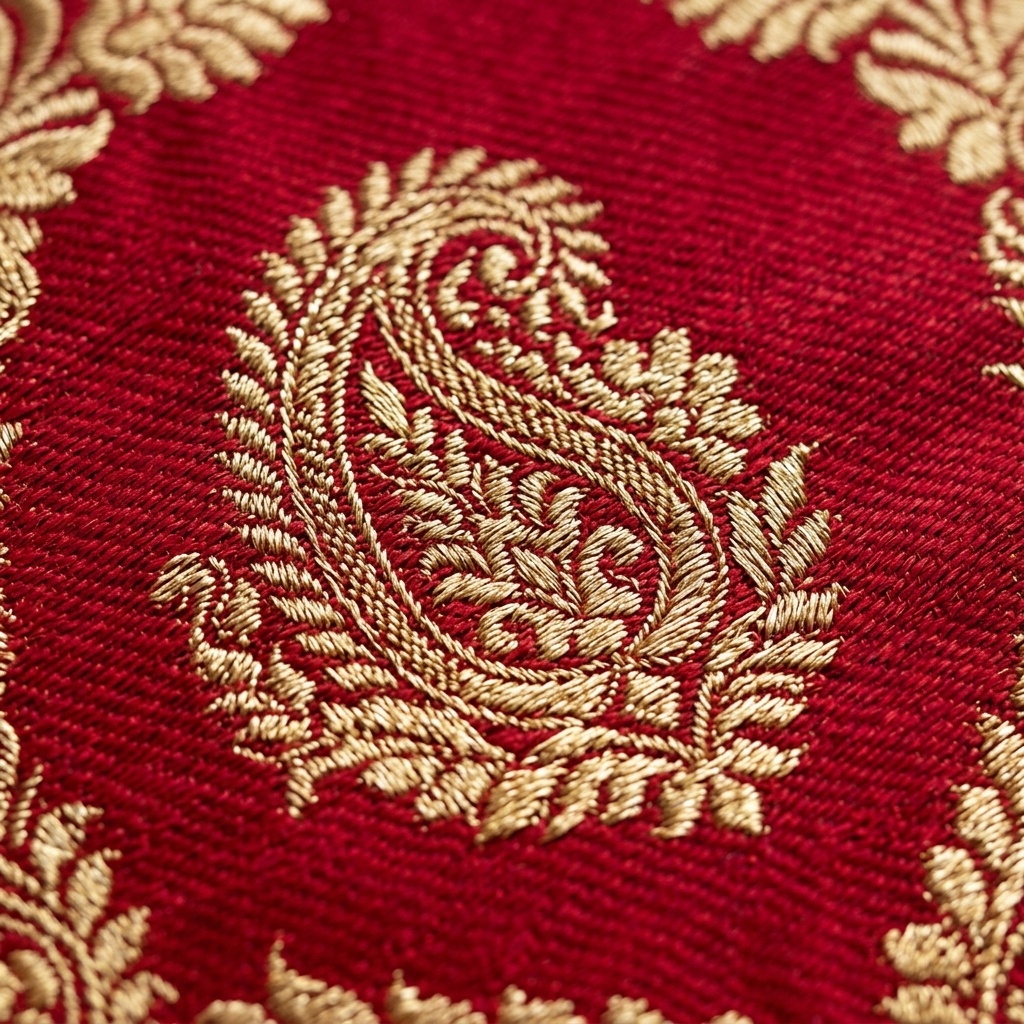
Ask a Banarasi weaver what saree he has made, and he will not just say "silk." He will tell you the yarn, the technique, and the pattern — three separate answers to what sounds like one question.
That distinction matters more than most buyers realise. Two sarees can look nearly identical on a store shelf, yet one took three weeks to weave and the other took four months. The difference is not in how they look — it is in how they were built: layer by layer, decision by decision.
This guide breaks a Banarasi saree into the three layers that every weaver in Varanasi thinks in: fabric (what the saree is made of), weave (how the pattern gets into the cloth), and pattern (what design sits on the weave). Once you can read these three, you stop guessing and start understanding what you are actually paying for.
A Short History, Because It Explains Everything Else
Banaras — Varanasi — has been a silk-weaving centre for centuries. But the brocade tradition most people recognise today did not originate in the city itself. It took shape after Gujarati silk weavers migrated to Varanasi following the devastating famine of 1603, carrying their craft and their looms with them.
The weaving matured under Mughal patronage across the 17th to 19th centuries. Persian motifs — paisleys, hunting scenes, floral trellises — merged with Indian temple and nature imagery, and that fusion created the visual language Banarasi sarees still use today.
In 2009, the Government of India granted the craft a Geographical Indication (GI) tag under the name "Banaras Brocades and Sarees," making Varanasi the only region in the world where a saree can legally be called Banarasi.
Today, an estimated 1.2 million people are directly or indirectly employed by the Banaras handloom cluster, spread across Varanasi and satellite weaving towns like Azamgarh, Mirzapur, Bhadohi, and Chunar. A complex bridal piece can still take anywhere from a few weeks to six months — occasionally longer — to complete on a traditional handloom.
Layer 1: The Fabric — What the Saree Is Made Of
Before a single motif is woven, the yarn has already been chosen. This is the foundation that decides the weight, drape, sheen, and durability of the finished saree. Most buyers walk into a shop asking about pattern or colour. Weavers, though, start with fabric — because everything else depends on it.
Katan Silk — The Gold Standard
Katan is not a finish, a print, or a brand name — it is the base silk yarn itself. Pure, degummed, lightly twisted mulberry silk with no filler or synthetic blending. A "Katan Banarasi" is widely accepted as the gold standard of pure-silk weaving in Varanasi, and most premium Kadhua and Jamawar work is done on a Katan base.
What makes Katan distinctive is its body — crisp enough to hold structure, soft enough to drape elegantly. If someone says a saree is a "pure silk Banarasi," they are usually describing Katan, whether they know the word or not.
Browse our Pure Silk Katan collection →
Kora / Organza — The Summer Favourite
Kora or Organza is a sheer, crisp, lightweight silk woven from raw, non-degummed silk yarn in both warp and weft. It holds embroidery and zari beautifully while staying breathable — a combination that has made it the go-to fabric for daytime and summer weddings.
The stiffness is inherent: the sericin gum in raw silk gives Organza its crispness without any chemical finishing. That natural quality is also why genuine Organza feels different from synthetic imitations — the texture is structural, not sprayed on.
Browse our Organza collection →
Khaddi Georgette — Fluid and Contemporary
Khaddi Georgette is woven on a traditional pit loom (khaddi) rather than a powerloom, and that single distinction defines everything about the fabric. The crinkle is softer, the drape more fluid, and the hand more luxurious than machine-made georgette.
It carries heavy zari or meenakari work without feeling stiff, which has made it one of the most in-demand modern Banarasi fabrics — especially among younger buyers who want heritage without the weight.
If you are deciding between Organza and Khaddi Georgette, our detailed comparison guide explains which drape suits which occasion.
Browse our Khaddi Chiffon collection →
Georgette — Light and Matte
A lightweight, slightly textured silk with a matte finish, made from highly twisted yarns. Georgette drapes close to the body and suits warmer climates. It is often confused with Khaddi Georgette, but the key difference lies in how it is woven: standard Georgette can come off a powerloom, while Khaddi Georgette is defined by its handloom origin.
Jacquard — A Loom, Not a Fabric
Jacquard is not a silk type — it is a loom mechanism. Metal punch-cards mechanically lift warp threads to weave patterns without hand manipulation, speeding up production and making brocade weaving more affordable.
Purists reserve their highest respect for the hand-worked naksha (draw-loom) method that Jacquard eventually replaced. But Jacquard does not automatically mean low quality — some genuinely fine sarees come off Jacquard looms. The distinction matters most when comparing price to labour. For a deeper understanding, read our guide on how handloom differs from powerloom production.
Cotton and Cotton-Silk — Everyday Elegance
A cotton-silk Banarasi keeps traditional zari motifs while staying light and breathable — ideal for daily wear, office wear, or puja rather than bridal occasions. These are among the most affordable Banarasi sarees and an excellent starting point for someone building their first collection.
Tissue — Liquid Metal
Tissue sarees are woven with a fine zari (metallic) thread running through the weft, giving a shimmering, almost translucent, metallic glow. It is less a separate silk type and more a metallic finish that can be applied over Organza or silk bases.
The result is a saree that catches light from every angle, which is precisely why Tissue has become a bridal favourite. To understand how it compares to Katan for wedding wear, read our Katan Silk vs Tissue comparison.
Browse our Pure Tissue collection →
Shattir (Sattir) — The Modern Entrant
A comparatively newer, lighter-weight Banarasi fabric designed for contemporary motifs and easy, everyday drape. Think of it as a more casual, affordable cousin to heavier Katan silk — positioned for women who want the Banarasi vocabulary without occasion-specific formality.
Muga Silk — The Golden Wild Silk
A golden-hued wild silk from Assam, occasionally used in Banarasi brocading. It lowers cost while adding a distinctive natural sheen that no dyeing process can replicate. Muga is one of the rarest commercial silks in the world and carries its own GI tag.
Sonapeet — Woven with Real Gold
A rare and increasingly hard-to-find category of Banarasi textile woven with genuine gold zari — as opposed to the silver-gilt or metal-coated "tested" zari used in most sarees today. Because real gold thread is prohibitively expensive and very few weavers still work with it, authentic Sonapeet pieces are now prized as heirloom or museum-grade textiles rather than everyday wear.
A Note on Art Silk
While not a traditional Banarasi fabric, art silk (artificial silk, typically polyester or viscose) is widely used in machine-made sarees marketed as "Banarasi." Understanding the difference between art silk and real silk is essential before making any purchase — our detailed guide on what art silk actually is explains the distinction honestly.
Layer 2: The Weave — How the Pattern Gets Into the Cloth
This is where Banarasi craftsmanship is truly judged. Two sarees can use identical silk and identical motifs, but if one is woven in Kadhua and the other in Fekwa, they are fundamentally different products — in durability, in labour, and in price. The weave decides how many hours, or months, a saree takes to finish.
Brocade (Kimkhwab) — The Royal Umbrella
The umbrella technique behind most traditional Banarasi sarees: an extra weft of silk or zari is woven on top of the base cloth to raise a motif, producing a rich, tapestry-like surface. Kimkhwab refers to the most opulent, densely gold-worked brocades in this family, historically reserved for royal courts. The name itself is Persian for "woven gold."
Kadhua (Kadwa) — The Slowest and Most Prized
The most painstaking Banarasi technique. Each motif is woven and interlocked into the base cloth individually and by hand, so there are no loose threads on the reverse — the back looks almost as finished as the front.
This matters practically, not just aesthetically. Because each motif is structurally integrated rather than floating over the surface, Kadhua sarees are significantly more durable and can last generations. They take weeks to months longer than cutwork to produce, and are the technique most associated with true bridal-grade Banarasi sarees.
Fekwa (Cutwork) — The Practical Alternative
The faster, more affordable counterpart to Kadhua. The extra-weft thread is carried continuously across the width of the fabric, and the floating threads left between motifs are cut away by hand once weaving is complete. Fekwa sarees are lighter and quicker to produce, although structurally less durable and less prized than Kadhua.
Here is the honest truth: most retail Banarasi sarees in the market today are Fekwa, not Kadhua. That does not make them inferior — it makes them different. Understanding that difference prevents you from overpaying for one when you are getting the other.
Tanchoi — Satin Woven in Light
Believed to have arrived in India via Chinese weavers — the name is said to derive from "tan" (three) and "choi" (the family name of the brothers who brought the technique) — Tanchoi uses one or two warp threads with two to five closely shaded coloured wefts.
The result is a dense, satin-like self-pattern across the whole fabric with no back-floats, so no cutting is needed. Tanchoi sarees have a distinctly different aesthetic from standard brocade work — subtler, more tonal, almost appearing as though the pattern were woven in light rather than thread.
Jamdani — Hand-Embroidery on the Loom
Originating in Dhaka and later adopted into the Banarasi tradition, Jamdani weaves each small motif (buti) individually using tiny shuttles — essentially hand-embroidering directly with the loom. The result is floatless, extremely fine, and among the most skill-intensive weaves practised anywhere in the world.
The broader Jamdani craft is itself recognised by UNESCO as an Intangible Cultural Heritage. In Varanasi, the technique has been adapted to silk and zari, creating something that belongs fully to neither Bengal nor Banaras but carries the finest of both traditions.
Rangkat (Rang Kaat) — A Rainbow in Silk
A Jamdani variant that joins sections of differently coloured base cloth — sometimes up to ten shades in a single saree — with motifs added afterward in zari. The striking multi-tonal ground is immediately recognisable and has become one of the most photographed Banarasi styles on social media.
The name literally means "colour cut" — each colour section is woven and joined with a precision that hides the seam within the motif work itself.
Jamawar — Kashmir Meets Varanasi
Recognisable by its large, ornate paisley (kairi) motifs woven completely into the fabric with no back-floats. Jamawar traces its lineage to Kashmiri shawl weaving, later adapted into Banarasi silk — bringing the grandeur of Kashmir's paisley tradition onto a six-yard drape.
Kadiyal — The Border Signature
A border-specific technique rather than a full-body weave. Contrastingly coloured threads are interlocked exactly where the border meets the body, producing a sharply defined, two-tone edge. Kadiyal borders are widely regarded as a mark of quality — the join is so precise that no stitching, glueing, or separate attachment is involved.
Vaskat — Rare and Dense
A specialist Banarasi weave that combines two or more coloured wefts to build geometric or floral all-over patterns without a separate ground thread, giving the surface a dense, gap-free richness. Vaskat is one of the rarer weaves — fewer retailers stock it today, and fewer weavers practise it.
Butidar — Spaced Elegance
Rather than an all-over jaal, Butidar sarees scatter small, individual motifs (butis) across the body at regular intervals, leaving visible plain ground between them. It is a lighter, more spaced-out alternative to Jangla — and often the better choice for someone who wants the Banarasi craft visible but not overwhelming.
Ektara — Simple and Honest
A weaving style using a single thread system to place buttas or motifs, typically for relatively simpler, evenly spaced zari work across the body. Ektara pieces are among the more accessible Banarasi weaves — straightforward, elegant, and often excellent value for the money.
Layer 3: The Pattern — What Design Sits on the Weave
Once fabric and weave are chosen, the actual artwork is layered in. These are the motif families that define the visual identity of a Banarasi saree.
Jangla — The Jungle Carpet
An all-over jaal (net-like) pattern of scrolling flowers, vines, and jungle-inspired vegetation covering the entire saree, traditionally woven fully in the Kadhua technique. Jangla is one of the oldest documented Banarasi patterns, and at its most extreme, it can be woven without any zari at all — relying entirely on silk-on-silk texture for a purely sculptural effect.
The density is the point: a true Jangla leaves almost no bare ground visible.
Shikargah — The Royal Hunt
Not a weave but a narrative design tradition. The word comes from the Persian shikar ("to hunt") and gah ("ground"). Shikargah sarees depict royal hunting scenes — horses, elephants, tigers, deer, hunters, and dense foliage, often blended with the Persian "tree of life" motif — all inspired by Mughal miniature paintings.
Because every figure must be woven individually using a supplementary-weft technique, Shikargah pieces can take up to four months to complete and are widely considered among the most technically demanding and collectible of all Banarasi designs.
Alfi — Meenakari with Restraint
A meenakari style using a single extra colour within each motif alongside the zari, producing a restrained two-tone effect. Think of Alfi as meenakari with discipline — one accent colour, deployed with precision.
Tilfi — The Colour Builder
A step up from Alfi: three distinct coloured threads are carried within each individual motif, with the weaver managing three separate bobbins simultaneously. The result is a richly shaded, almost embossed-looking motif. From Tilfi, weavers can build further — four, five, or even ten-plus colours for exceptional showpieces that cross into the territory of wearable art.
Meena (Meenakari) — Enamel in Thread
The broader technique of weaving coloured silk threads into motifs alongside zari, named for its resemblance to meenakari (enamelling) in traditional jewellery. Meenakari work can be layered onto Kadhua or Fekwa sarees, and the colours can fill either the motif (meenakari proper) or sections of the base cloth (as seen in Rangkat).
For bridal sarees, a pure Katan silk with full Meenakari is often considered the pinnacle of the craft — the most labour-intensive and visually rich combination a weaver can produce.
Asharfi — Coins of Prosperity
A pattern of small, round, coin-like motifs named after the gold asharfi coin. Historically linked to ceremonial gold coins given as royal gifts, the Asharfi pattern is favoured for weddings, Diwali, and newborn ceremonies as a woven symbol of prosperity and good fortune.
Konia — The Corner Anchor
A corner motif — typically a floral mango buta (kairi) — placed at the four corner points of the pallu or border rather than repeated across the entire body. Konia motifs serve as the punctuation marks of Banarasi design: they anchor the eye and frame the composition.
Jaal — The Underlying Net
Literally "net" or "web" — any all-over interlinked pattern of flowers, vines, or geometric repeats that covers the saree without gaps, as distinct from scattered Butidar motifs. Jaal is the structural principle behind many Banarasi patterns; Jangla is one specific, dense expression of it.
Individual Buti Motifs Worth Knowing
- Kairi / Badam buti — The paisley or almond shape, one of the oldest motifs in Indian textile history. Also known regionally as Ambi, Kalka, Mangaai, or the original Persian Boteh.
- Chaand buti — A crescent moon motif, often seen on evening and festive sarees.
- Paan buti — The betel-leaf motif, traditionally associated with auspicious occasions and married life.
- Pankha — A fan-shaped motif, used to add movement and rhythm to a pattern.
- Animal motifs — Elephants (hathi, symbolising power and wisdom), deer (mriga, grace), parrots (tota, love and companionship), and paired birds symbolising playful romance. These appear most often on haldi and mehendi sarees.
- Geometric borders — Khanjari (chevron), Ari Doria (diagonal lines), Charkhana (checks), and Heera (diamonds) are used for structure and a contemporary aesthetic.
How the Three Layers Combine
A finished Banarasi saree is really a sentence built from three vocabularies — fabric + weave + pattern. Understanding this formula is the fastest way to judge what you are actually paying for.
The Full Bridal Heirloom Katan silk + Kadhua weave + Jangla pattern with Tilfi shading. This means a slow, fully hand-interlocked, richly coloured piece that can take months of continuous weaving. This is what families pass down through generations. Read our complete bridal trousseau guide to understand where such a piece fits in a wedding wardrobe, or explore our guide to bridal Banarasi silk sarees for a deeper look.
The Everyday Elegant Georgette + Fekwa (cutwork) weave + A simple Asharfi buti. Light, relatively quick to produce, and far more affordable. Perfect for festivals and office wear.
The Collector's Statement Katan silk + supplementary-weft technique + Shikargah pattern. A narrative, museum-grade piece that ranks among the most labour-intensive sarees made anywhere in India. Pieces like these are not purchased for a single occasion — they are bought as family heirlooms.
How to Check Authenticity
This is the question we hear most often: "How do I know it is real?"
The GI Tag Genuine handloom Banarasi sarees are covered under the "Banaras Brocades and Sarees" Geographical Indication, registered in 2009. A GI tag does not guarantee quality — it guarantees geographic origin and traditional method.
Silk Mark Certification Pure-silk pieces may carry Silk Mark certification from the Silk Mark Organisation of India, confirming the silk content is genuine. This matters because the difference between art silk and real silk is nearly impossible to detect by touch alone on a brand-new saree.
The Reverse-Side Test This is the test that actually works in practice. On a Kadhua or Jamdani weave, the back of the saree should look almost as clean and finished as the front, with no loose floating threads. On Fekwa (cutwork) or machine-Jacquard sarees, you will see cut floats or a flatter, more uniform finish — not a flaw, just a different and generally more affordable method of production.
Weight and Warmth of Colour Real zari — especially older or Sonapeet-style pieces with genuine gold or silver content — tends to feel heavier and shows a warmer, less uniformly "shiny" glint than modern tested (metal-coated polyester) zari.
For a comprehensive walkthrough with images, read our complete authenticity guide. If you are buying in Varanasi for the first time, our guide to avoiding silk scams covers what to watch for on the ground, and our tourist's guide to buying in Varanasi walks through the process step by step.
Care: Protecting Your Investment
A Banarasi saree is an investment — emotionally and financially. Proper care is non-negotiable.
- Never hand-wash a Banarasi silk saree. The zari is highly sensitive to water and household detergents. Read exactly why professional dry cleaning is the only safe option.
- Store in muslin or soft cotton cloth — never in plastic. Plastic traps moisture, which encourages mildew and degrades both silk and zari over time. Our complete saree storage guide walks through the correct method.
- Air out, do not over-clean. If the saree was only lightly worn, hanging it in a shaded, well-ventilated space for a few hours is sufficient. Avoid direct sunlight — UV rays fade silk permanently.
For the complete care protocol covering cleaning, seasonal rotation, and long-term preservation, read our Banarasi silk care guide.
Buying: Where to Start and What to Watch For
Whether you are buying your first Banarasi or your fifteenth, these principles hold.
-
Know your three layers before you enter a shop. When a seller says "pure Kadhua Katan with Jangla," you should understand exactly what that sentence means — and roughly what it should cost. The pricing and wholesale guide provides transparent benchmarks.
-
Buy from traceable sources. The closer you are to the weaver, the more authentic and fairly priced the saree will be. If you are in Varanasi, read our guide to the best Banarasi saree shops. Shopping online? Our trustworthy online shopping guide explains exactly what to verify before placing an order.
-
Avoid the seven classic bridal mistakes. We have documented the seven most common mistakes brides make when buying Banarasi sarees — every single one is preventable with the right knowledge.
-
Start with your occasion and season, not the saree. A season-appropriate fabric matters more than most buyers realise. Wearing a heavy Katan in July or a light Georgette in December works against the saree, not with it. Our winter versus summer styling guide makes this decision straightforward.
If you are a complete beginner, our saree buying guide for first-time buyers covers everything — what to ask, what to check, and what to skip entirely.
Styling: Making It Yours
A Banarasi saree changes personality entirely depending on how you drape and accessorise it.
- Classic and Traditional — The Nivi drape with a Kadhua saree, gold jewellery, and jhumkas. Our guide to 4 elegant draping styles covers the traditional approach in detail.
- Modern and Minimal — A belted drape, statement earrings, and dewy makeup. Our modern draping guide walks through five contemporary styles that reduce bulk and add silhouette.
- Jewellery Pairing — The zari colour, weave density, and occasion should guide your jewellery choices. Read our detailed jewellery pairing guide for specific recommendations.
- Wedding Styling — From haldi to reception, each wedding function calls for a different fabric and drape. Our wedding styling guide and bridal trousseau guide cover the complete sequence.
- Gifting a Banarasi — Choosing a saree for someone else requires a different approach. Our gifting guide explains how to choose the right piece for any occasion.
For a comprehensive overview of finishing touches, explore our 13 saree styling tips for an effortless look.
Quick Glossary
| Category | Terms Covered |
|---|---|
| Fabric | Katan, Kora/Organza, Khaddi Georgette, Georgette, Jacquard, Cotton-Silk, Tissue, Shattir, Muga, Sonapeet |
| Weave | Kimkhwab/Brocade, Kadhua, Fekwa/Cutwork, Tanchoi, Jamdani, Rangkat, Jamawar, Kadiyal, Vaskat, Butidar, Ektara |
| Pattern / Motif | Jangla, Shikargah, Alfi, Tilfi, Meena/Meenakari, Asharfi, Konia, Jaal, Kairi/Badam, Chaand, Paan, Pankha, animal motifs, geometric borders |
Frequently Asked Questions
What makes a saree officially "Banarasi"? A saree can legally be called Banarasi only if it is woven in the Varanasi region using the traditional brocade methods that weave zari directly into the silk, rather than printing or embroidering it on afterward. This is protected under the "Banaras Brocades and Sarees" GI tag granted in 2009.
How long does it take to weave a real Banarasi saree? It depends entirely on the technique and design. A simple, lightly worked saree can take 3 to 7 days. A moderately detailed piece requires 15 to 30 days. A dense Kadhua Jangla or Shikargah bridal saree can take anywhere from six weeks to several months of continuous hand-weaving.
What is the difference between Kadhua and cutwork (Fekwa)? In Kadhua, each motif is woven and locked into the fabric individually by hand, with no loose threads at the back. In cutwork (Fekwa), the extra-weft thread runs continuously and the floats between motifs are cut afterward. Kadhua is slower but more durable; Fekwa is quicker and more affordable.
How can I tell a real handloom Banarasi from a machine-made copy? Turn it over. A genuine handwoven Banarasi shows small floating threads, knots, or slight irregularities on the back. Powerloom or printed imitations look unnaturally smooth and uniform on both sides. Also check for a Silk Mark tag and ask about the weaving cluster — genuine sellers can usually tell you.
Is a very cheap "pure silk Banarasi" ever genuine? Almost never. Real zari and hundreds of hours of hand labour make it very difficult to sell a genuinely handwoven, pure-silk Banarasi at a low price. An unusually low price on a saree described as Katan silk with dense Kadhua and real zari is a strong signal it is powerloom-made or printed.
What is the difference between Jangla and Butidar patterns? Jangla is an all-over jaal — flowers, vines, and foliage cover the entire body of the saree with no gaps. Butidar scatters individual motifs at intervals, leaving visible plain fabric between them — a lighter, less dense look.
Is Sonapeet the same as regular zari work? No. Most modern Banarasi zari is "tested" zari — silver or copper coated in a thin layer of gold or synthetic finish. Sonapeet refers specifically to sarees woven with real, solid gold zari, a technique now rare due to cost and scarcity of trained weavers.
What is Shikargah and why is it so expensive? Shikargah is a narrative pattern depicting Mughal-era royal hunting scenes woven using a supplementary-weft technique where every figure is placed individually by hand. Because it requires figurative, non-repeating detail, it is one of the slowest Banarasi designs, sometimes taking up to four months.
Which Banarasi saree is best for a bride? For the wedding ceremony, a pure Katan silk with Kadhua weave and rich Meenakari or Tilfi work is the gold standard. For lighter functions like haldi or mehendi, Khaddi Georgette or Organza offer comfort without sacrificing heritage. Our bridal trousseau guide maps the right saree to each function.
Can you wear a Banarasi saree in summer? Absolutely — choose the right fabric. Heavy Katan silk suits winter. For summer, Khaddi Georgette, Organza, and Cotton-Silk are significantly more breathable. Our seasonal guide covers which fabric suits which month.
How should I store my Banarasi saree? Fold carefully and wrap in breathable muslin or soft cotton cloth. Never use plastic bags, which trap moisture and damage silk and zari. Refold every few months to prevent permanent crease marks. Full method in our storage guide.
Does a genuine Banarasi saree come with a blouse piece? Most do — typically around a metre of matching fabric — though this varies by design and seller, so confirm with the specific listing.
A Banarasi saree is, in the end, a record of hours — every extra colour, every hand-woven motif, every choice of yarn adds to the story woven into the cloth. Once you can read the fabric, the weave, and the pattern together, you are no longer just buying a saree. You are reading a small piece of Varanasi's living textile history.
Continue Reading
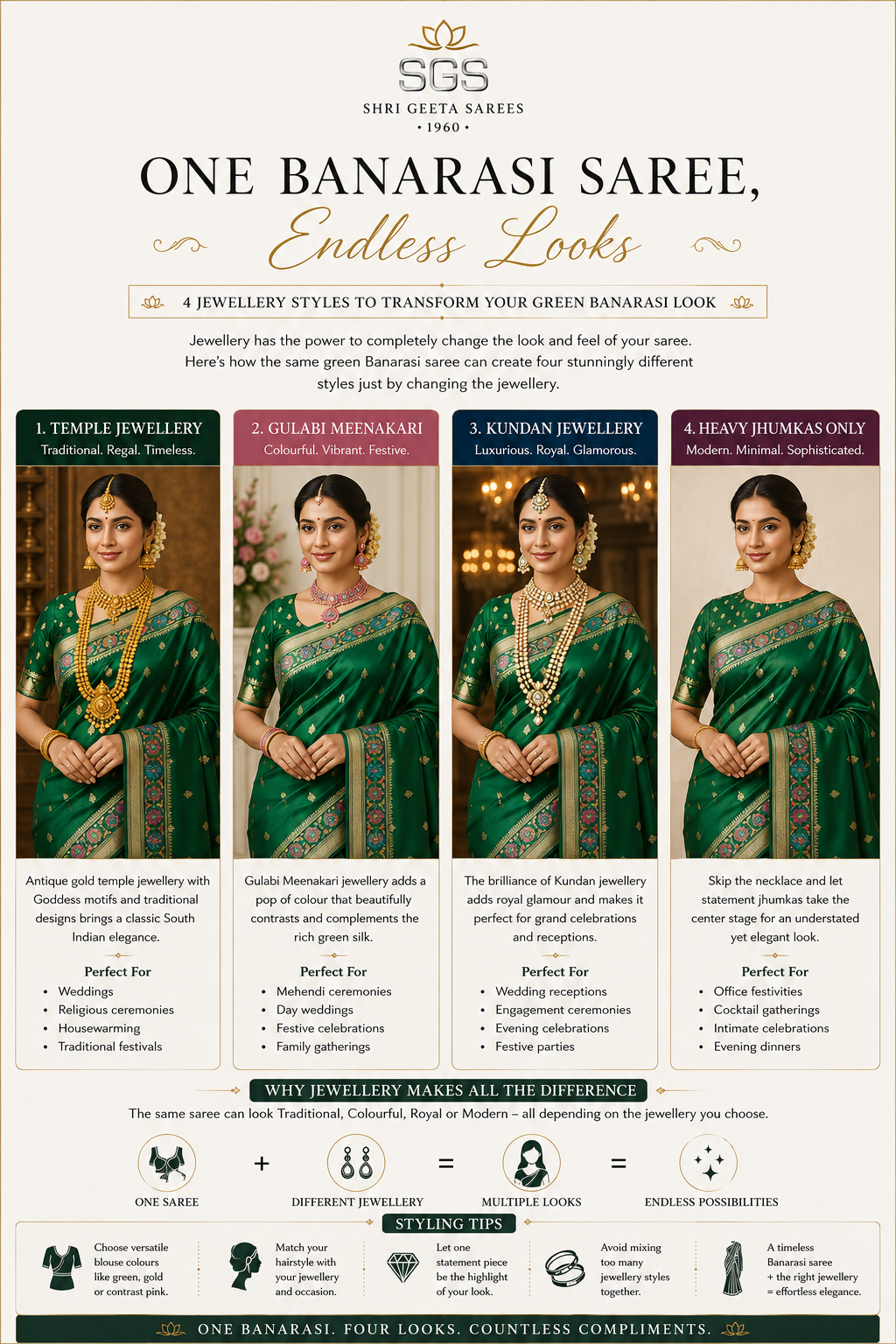
How One Banarasi Saree Can Create 4 Completely Different Looks
A beautiful Banarasi silk saree is one of the most versatile pieces in your wardrobe. Discover how to create four stunning looks just by changing your jewellery.
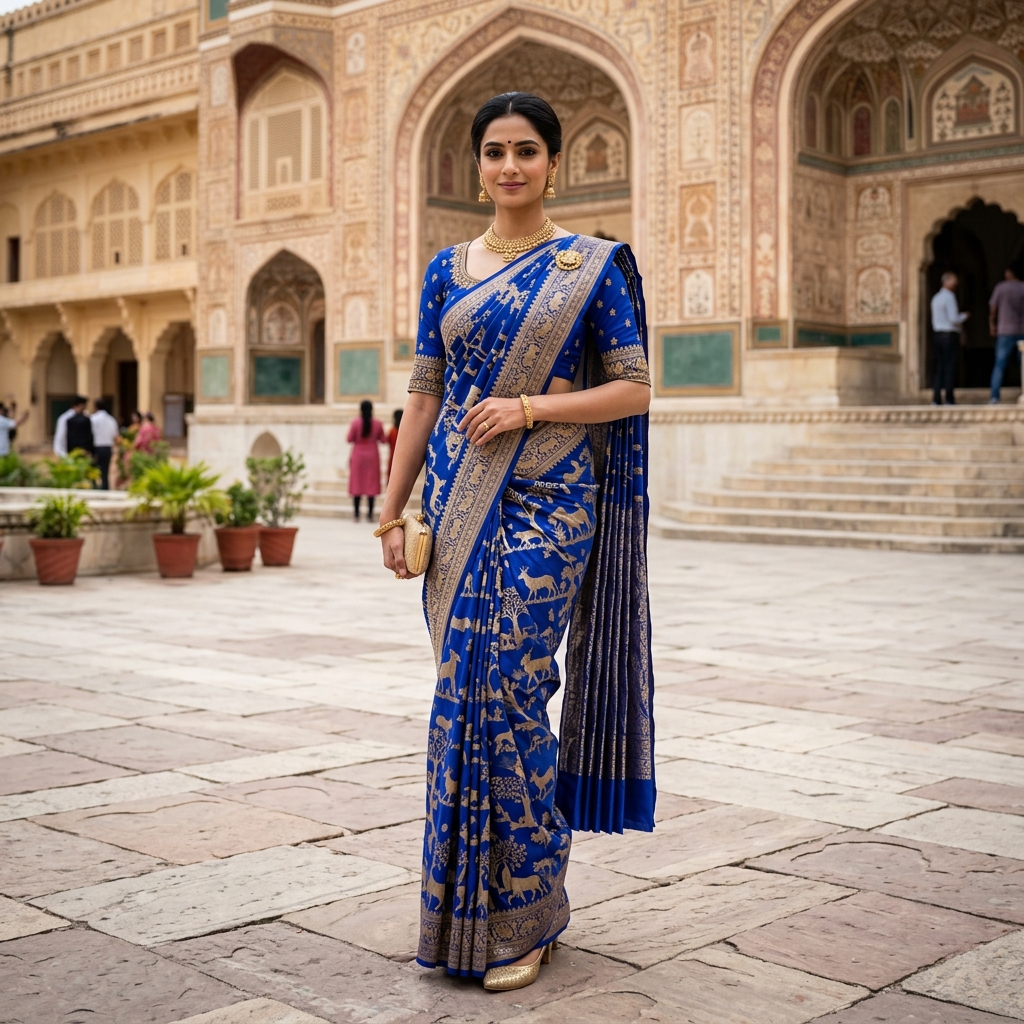
4 Elegant Ways to Drape a Banarasi Saree | Shri Geeta Sarees
Looking for new ways to wear your handwoven Banarasi saree? Discover 4 elegant and easy styling methods, from classic traditional to modern reception drapes.
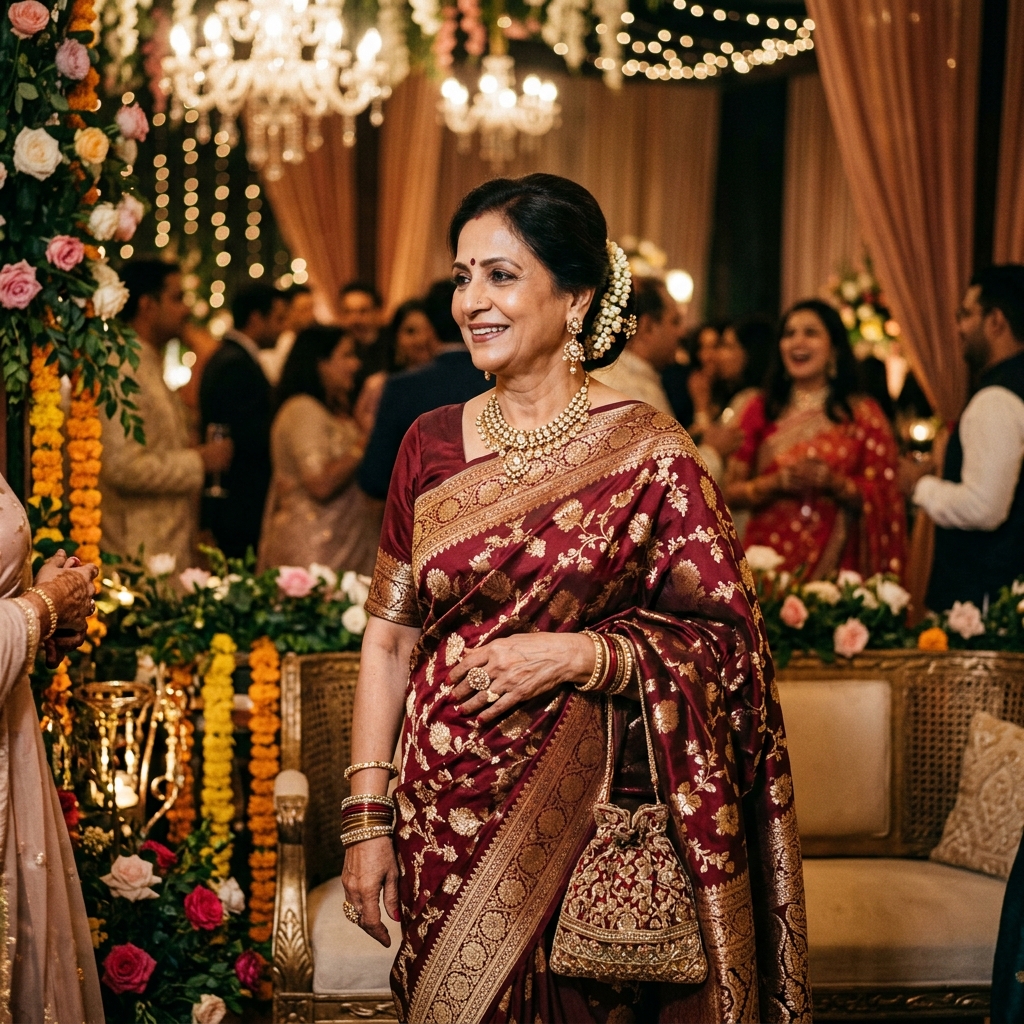
Banarasi Saree for Mother of the Bride: A Guide to Getting It Right
A comprehensive guide to choosing the perfect Banarasi saree for the mother of the bride, covering colors, weaves, and styling advice.
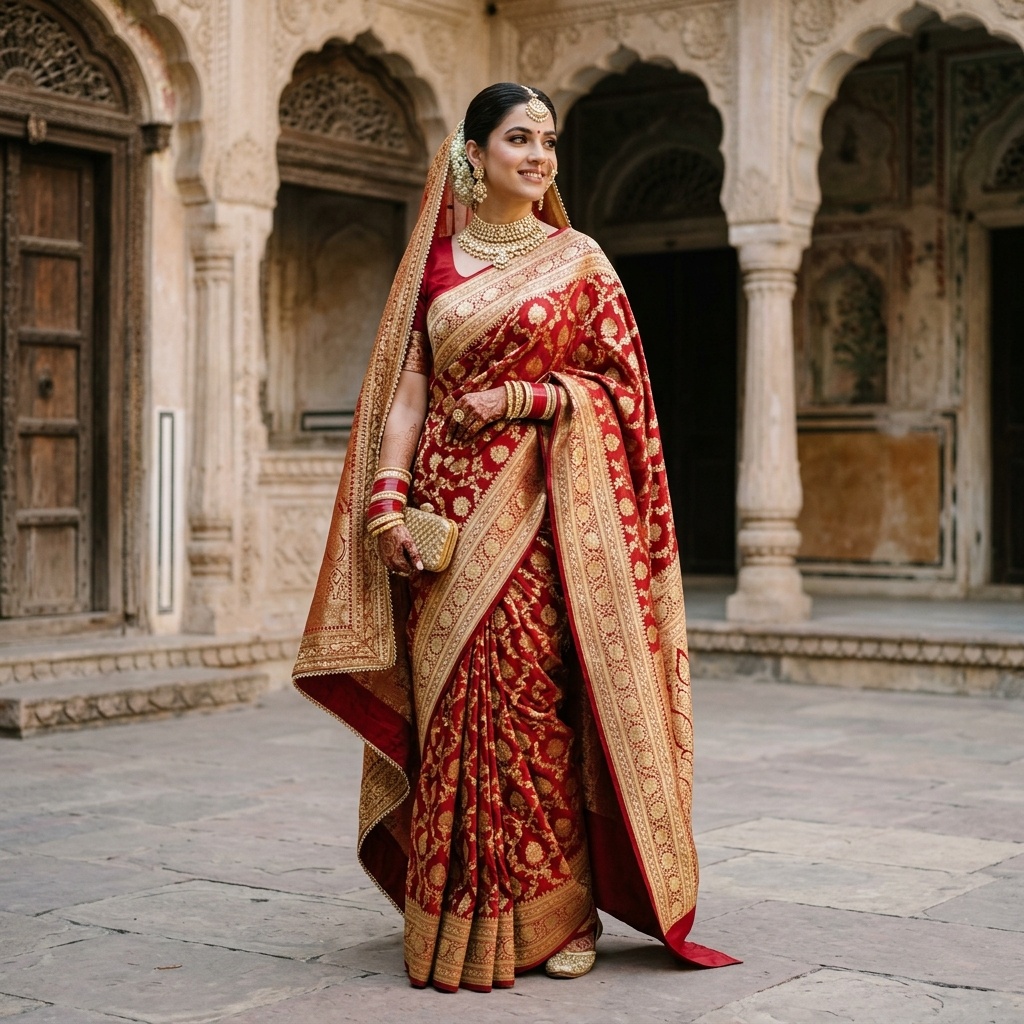
Types of Banarasi Silk: Katan, Georgette, Organza & Tissue Explained
Confused by Banarasi saree fabrics? A Varanasi weaver explains the exact difference in drape, weight, and styling for Katan, Georgette, Organza, and Tissue silk.