What is a Kadhua Banarasi Saree?
In the world of Banarasi weaving, the word Kadhua is spoken with quiet reverence — a whisper among weavers that says: this one took time, this one was made the right way.
Among the many glorious weaves that have emerged from the looms of Varanasi over centuries, the Kadhua Banarasi saree stands apart as the pinnacle of handloom artistry. It is not the fastest to make. It is not the simplest to weave. It is, however, the finest.
What Does "Kadhua" Mean?
The word Kadhua is rooted in a Hindi verb that carries the essence of the technique itself — to embroider, to carve, to bring out in relief. And that is precisely what the weaver does: he carves each motif into the fabric, thread by thread, with a patience that is almost meditative.
In a Kadhua Banarasi saree, every motif is woven individually. Unlike the Fekua (or Fakua) technique — where the coloured threads float continuously across the reverse of the saree, connecting one motif to the next — the Kadhua method cuts those threads free. Each buta, each floral, each paisley exists as its own complete element, woven in isolation and brought to life without shortcuts.
The result? The reverse of a Kadhua saree is as clean and composed as its face. No loose threads. No dangling ends. No evidence of compromise.
The Technique: Why the Reverse Tells the Truth
Experienced saree buyers and connoisseurs often judge a Banarasi by flipping it over. The reverse of a saree never lies. In the Fekua technique, you will find a web of floating threads crisscrossing the back — not a flaw, but a trade-off that makes faster production possible. In a Kadhua saree, that reverse side is immaculate.
This is because the weaver handles each motif as a self-contained unit, inserting the supplementary weft threads only where the motif demands them and nowhere else. The process requires deep skill, extraordinary patience, and an intimate understanding of the design — qualities that cannot be rushed or replicated by machine.
A master weaver in Varanasi often says: "The back of the saree is what I see all day. The front is my gift to you."
In a Kadhua saree, both sides are a gift.
The finished motifs have a distinctive embossed, three-dimensional quality — they appear to rise from the fabric like fine embroidery, each petal and leaf defined with quiet confidence. This is not a print. This is not machine jacquard. This is the human hand, working at a handloom, for months.
The Two Souls of Kadhua: Meenakari & Sonarupa
Within the Kadhua tradition, two distinct styles have emerged over generations — distinguished by the palette of threads woven into the motifs. Both are precious. Both carry the full weight of Banarasi heritage. Their character, however, is entirely different.
Meenakari
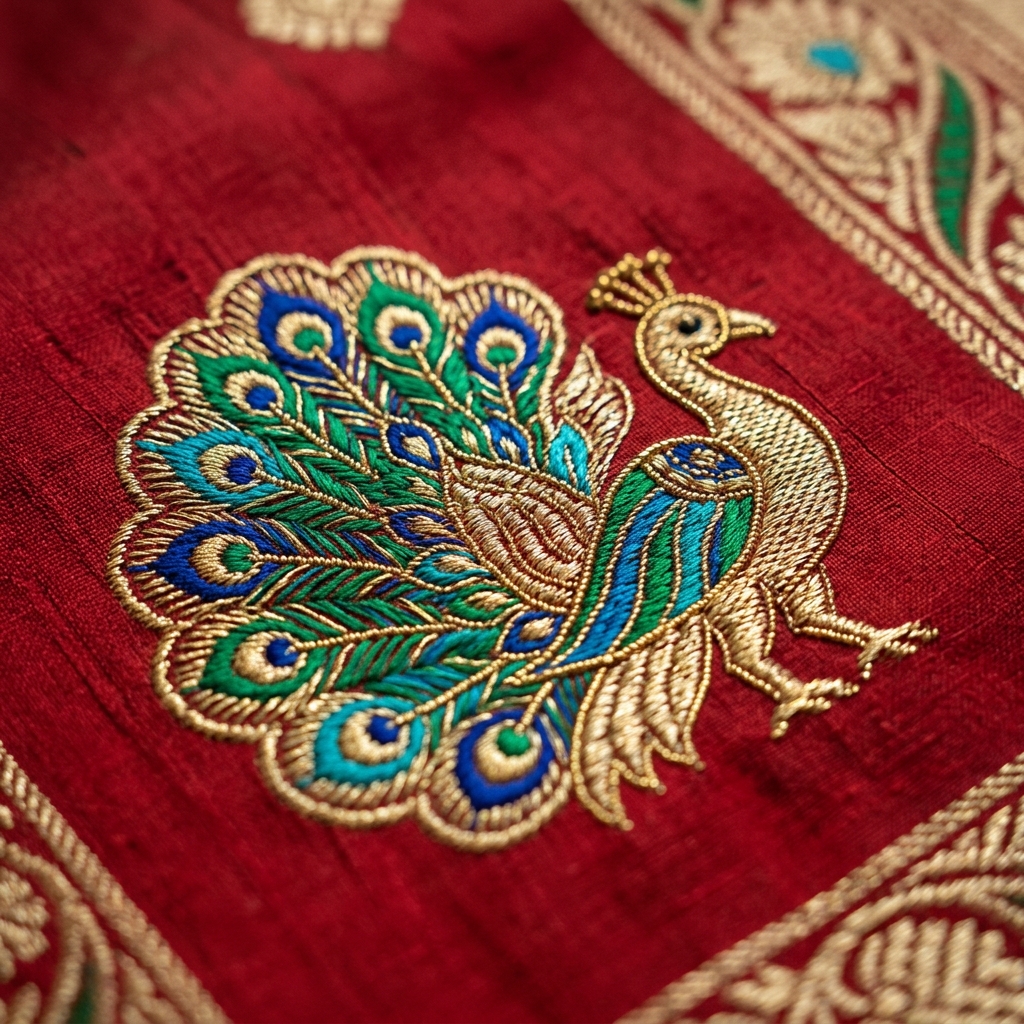
Inspired by the ancient art of enamel inlay, Meenakari Kadhua sarees feature motifs woven in multicoloured silk threads against the base colour of the saree. The result is a highly colourful textile — jewel-toned florals, peacocks in emerald and sapphire, paisleys in rose and saffron — each hue carefully interlocked within the weave. A Meenakari Kadhua saree is celebratory, bold, and deeply festive in spirit.
Sonarupa
Where Meenakari revels in colour, Sonarupa Kadhua sarees practise elegant restraint. Only pure gold (zari) and silver threads are used to craft the motifs on the base fabric. The effect is regal and timeless — luminous metallic motifs that seem to be cast in precious metal rather than thread. A Sonarupa is the saree a bride wears when she wants to speak in the language of quiet opulence.
Time, Labour & the Making of a Masterpiece
A Kadhua Banarasi saree is not woven on a schedule. Depending on the intricacy of the design — the density of the butis, the complexity of the border, the fineness of the pallu — a single saree can take anywhere from several weeks to many months to complete on the handloom.
This is not inefficiency. This is integrity.
The weaver sits at his pit loom, in a narrow lane of old Varanasi, moving the shuttle with rhythmic precision, counting threads, referencing the naqsha (the punch-card design pattern overhead), making decisions that no algorithm can replicate. The Kadhua technique demands that he be fully present for every motif — there is no automation in this work, only mastery.
Kadhua Across Fabrics: A Tradition Without Boundaries
The Kadhua technique is not bound to a single fabric. The same exquisite weaving discipline finds expression across the finest textiles that Varanasi's looms produce:
- Katan Silk
- Tissue Banarasi
- Kora (Organza)
- Georgette
- Shattir
- Tussar Silk
Each fabric brings a different personality to the Kadhua weave. A Katan silk Kadhua is dense, weighty, and luminous — the classic bridal choice. A Tissue Kadhua shimmers with an other-worldly quality, the zari threads catching every beam of light. A Kora Kadhua is sheer, delicate, and breathtaking — the choice of the connoisseur who knows that transparency and craftsmanship are not opposites.
What unites them all is the Kadhua weave: individual motifs, clean reverse, raised texture, and a richness that deepens with time rather than fading.
How to Identify an Authentic Kadhua Banarasi Saree
In a market where imitations are plentiful and labels are generous, knowing how to authenticate a Kadhua saree is an invaluable skill.
- Turn it over. Examine the reverse. In a genuine Kadhua saree, each motif ends cleanly — there are no long floating threads connecting motifs across the back. The threads are cut and secured at the edges of each buta.
- Feel the motif. Run your fingertip across a buta. A Kadhua motif has a perceptible embossed quality — a gentle but definite rise from the fabric surface. This is the three-dimensional signature of the weave.
- Ask about the timeline. An honest weaver or heritage house will tell you how long the saree took to make. A Kadhua is never a quick product. If the story is rushed, ask more questions.
At Shri Geeta Sarees, every Kadhua saree we carry comes with the full knowledge of its origin, its weaver, and its making. We have been working directly with Varanasi's master weavers since 1960, and we do not cut corners. Explore our collection of handloom Banarasi sarees and our bridal Banarasi saree collection to discover Kadhua weaves across fabrics and occasions.
An Heirloom, Not Just a Saree
There are sarees you wear once and store away. And then there are sarees you reach for again, year after year — that you hold up to the light and find richer than you remembered, that you fold carefully and set aside for your daughter with the quiet certainty that she will understand its worth.
A Kadhua Banarasi saree is the latter. The handloom silk does not weaken — it softens and deepens. The zari does not tarnish in the way of inferior threads — it holds its lustre across decades. The motifs do not unravel — they are locked into the weave, permanent as a memory.
Generations of Indian families have trusted the Kadhua weave for bridal trousseaux, for gifting at milestone moments, for occasions that deserve nothing less than the finest. This trust is not born of marketing. It is born of the saree itself.
A Kadhua Banarasi saree is not an expense. It is an inheritance — woven thread by thread, to outlast a lifetime.
Frequently Asked Questions
What is the difference between Kadhua and Fekua (Fakua) Banarasi sarees?
In a Kadhua Banarasi saree, each motif is woven individually — threads are cut after every buta, leaving no loose threads on the reverse. In the Fekua technique, the coloured threads float continuously across the back of the saree, connecting the motifs. Kadhua sarees have a cleaner reverse, an embossed three-dimensional look, and are considered more premium and labour-intensive.
Why are Kadhua Banarasi sarees more expensive?
Kadhua sarees require significantly more time, skill, and concentration to weave. A single saree can take weeks to several months on a handloom, depending on the intricacy of the design. Each motif demands individual attention from the weaver. This time and artisanal mastery is reflected honestly in the price — a Kadhua Banarasi is priced for what it is: a handcrafted heirloom.
What is a Meenakari Kadhua saree?
A Meenakari Kadhua saree uses multicoloured silk threads to weave the motifs using the Kadhua technique. The result is rich, jewel-toned florals and precise patterns that are individually woven — never floating. Meenakari is inspired by the traditional art of enamel inlay and is ideal for festive and bridal occasions.
What is a Sonarupa Kadhua Banarasi saree?
A Sonarupa Kadhua saree uses only gold and silver zari threads for the motifs — no additional colours. The look is regal, luminous, and timeless. Sonarupa is the choice for brides and occasions that call for understated grandeur. The gold and silver motifs are woven with the same Kadhua precision: individually, with a clean reverse and an embossed finish.
Which fabric is best for a Kadhua Banarasi saree?
The Kadhua technique is woven on multiple fabrics — each with its own character. Katan silk Kadhua sarees are the classic bridal choice: weighty, luminous, and structured. Tissue Kadhua sarees shimmer brilliantly under light. Kora (organza) Kadhua sarees are sheer and delicate, ideal for summer weddings. The best fabric depends on the occasion, the season, and the personal aesthetic of the wearer.
How do I identify an authentic Kadhua Banarasi saree?
Turn the saree over and examine the reverse side. In an authentic Kadhua Banarasi saree, there are no long floating threads connecting the motifs — the threads are cut cleanly at the edge of each buta. The motifs also have a subtle raised, embossed quality when felt with the fingertips. Always purchase from a trusted heritage house with direct weaver relationships, like Shri Geeta Sarees in Varanasi.
Continue Reading
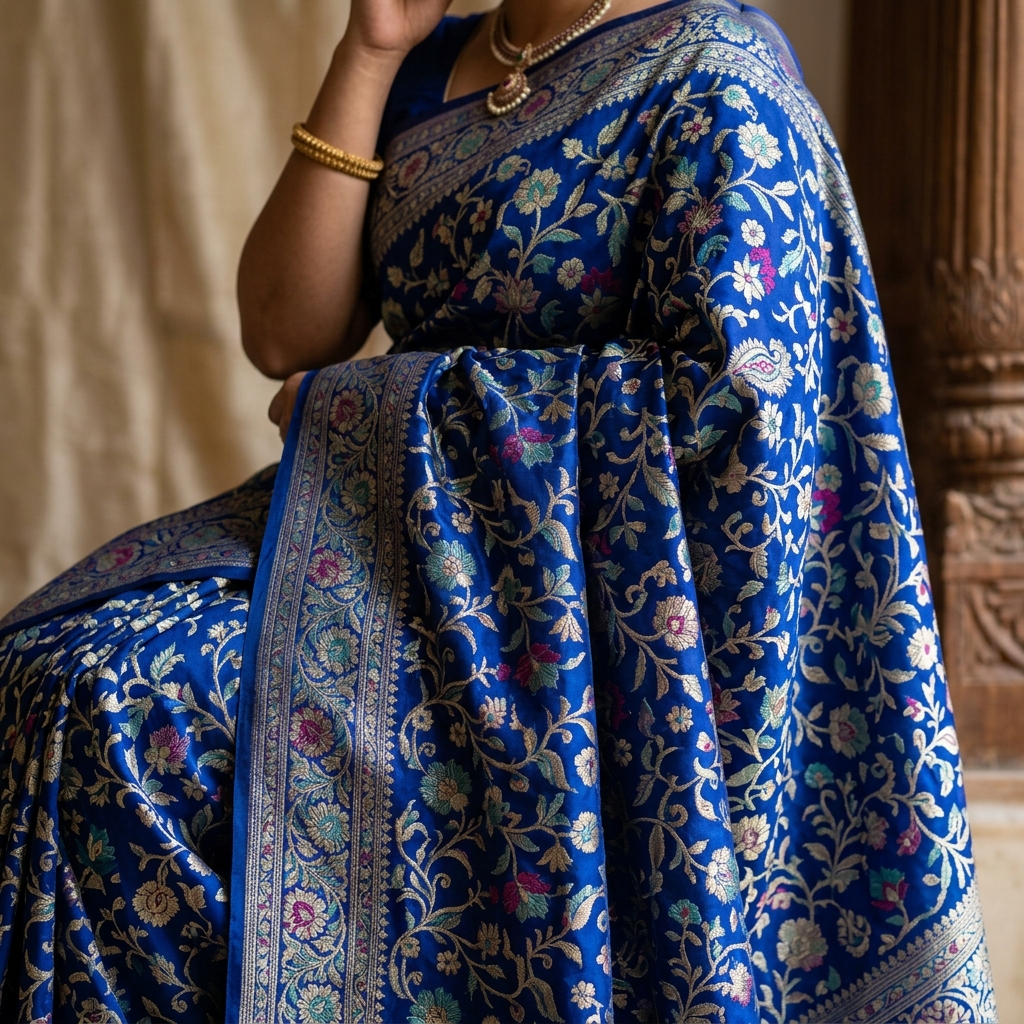
What is Fekwa (Fakua/Cutwork) in Banarasi Sarees?
Learn about Fekwa (or Fakua/Cutwork), an authentic Banarasi weaving technique that creates beautiful floral motifs and jaal patterns. Find out why it's more affordable without compromising quality.
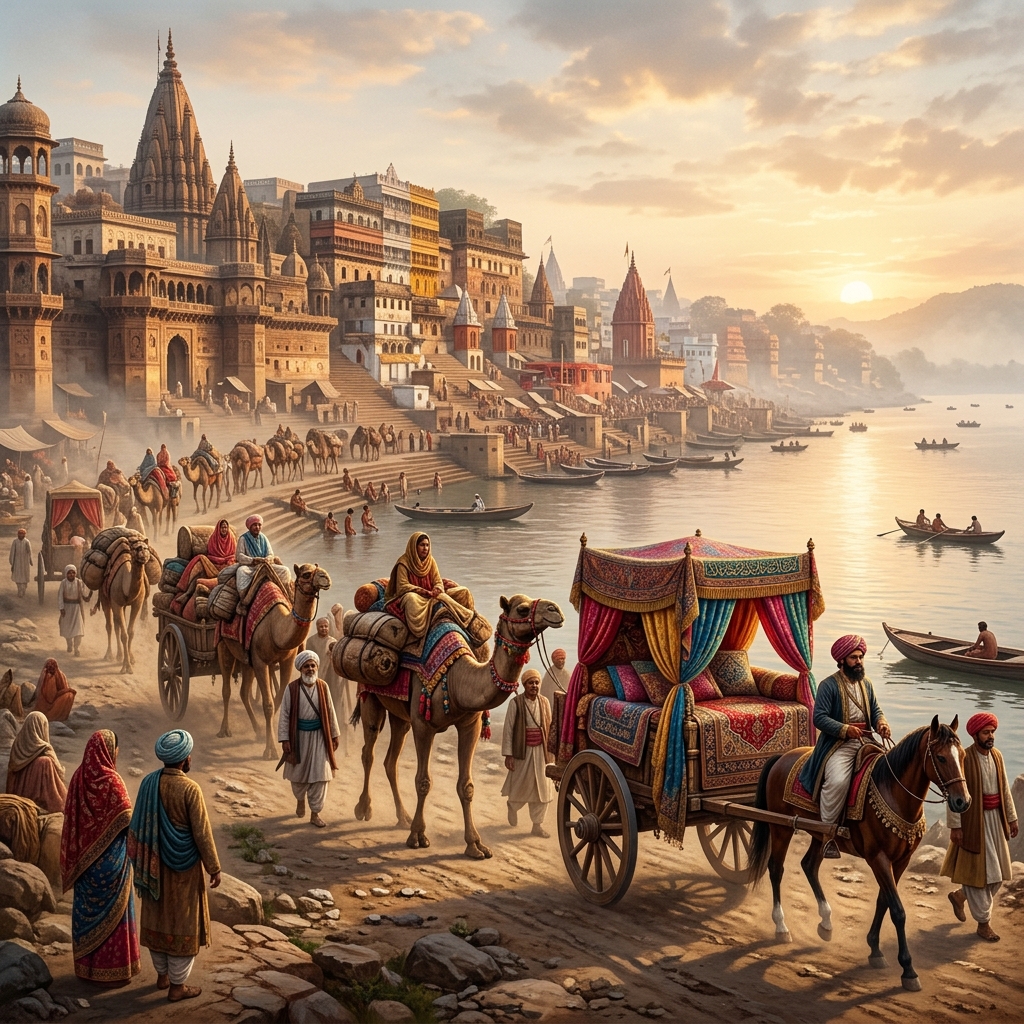
The Silk Route Through Varanasi: History of Banarasi Weaving
Trace the centuries-old journey of silk into Varanasi — from ancient trade routes to Mughal courts to the handloom houses of today.
The Banarasi Saree as a Family Legacy: An Heirloom Woven in Silk
Explore the tradition of passing down Banarasi sarees, the craftsmanship that makes them endure, and how to preserve a vintage Banarasi silk saree as a family legacy.
What is a Banarasi Saree Motif? A Guide to Buta, Jaal, and Paisley Patterns
Understand the language of Banarasi saree motifs — from the mango-shaped buta to the trellis-like jaal. A weaver's guide to reading pattern, symbolism, and craft.