What is a Banarasi Saree Motif? A Guide to Buta, Jaal, and Paisley Patterns
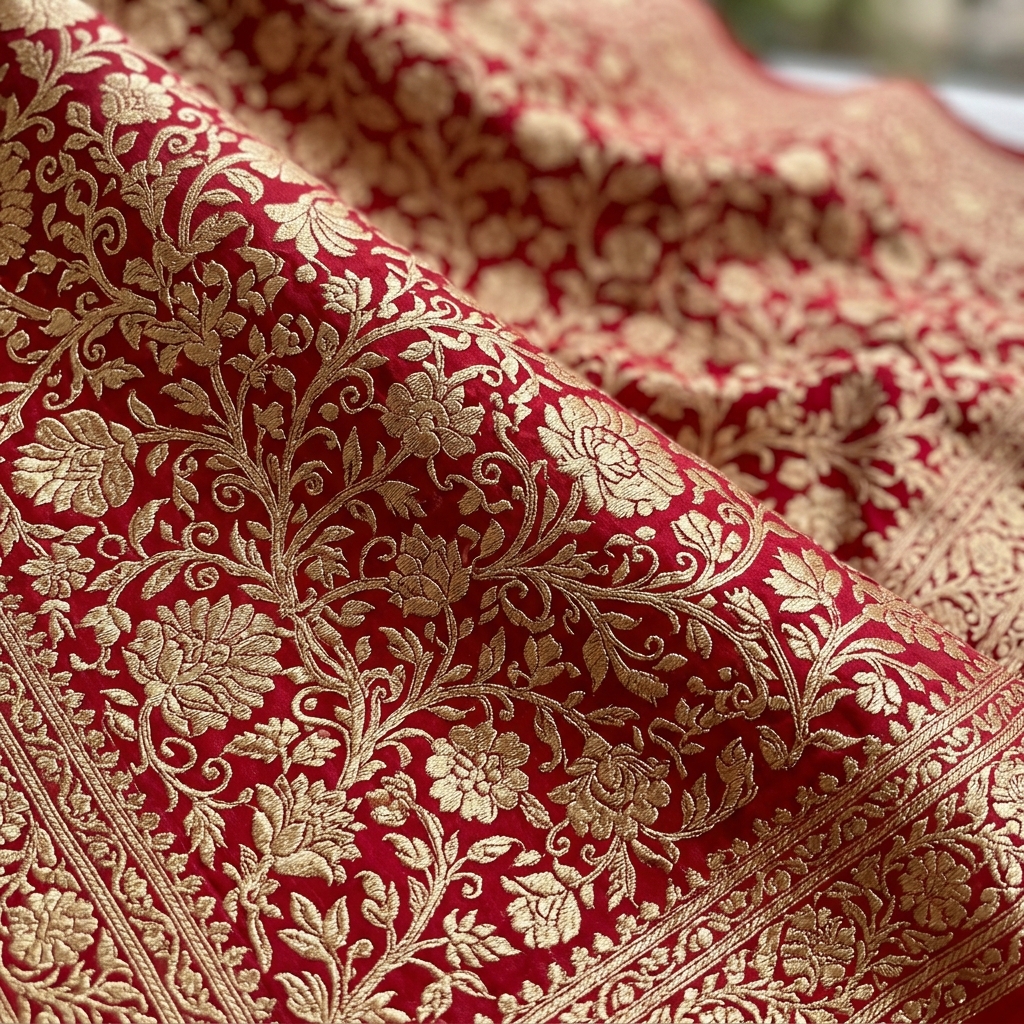
Look closely at a Banarasi saree before you look at its price, its silk, or even its color. Look at the pattern first. What you're reading isn't decoration — it's a vocabulary. Every curve of a buta, every diamond in a jaal, every trailing paisley carries centuries of grammar that a weaver in Varanasi learns not from a book, but from the loom itself, passed hand to hand across generations.
Most people shopping for a Banarasi saree today can tell you the price. Very few can tell you what they're actually looking at. This guide is for the second kind of buyer — the one who wants to know why the pattern on her saree looks the way it does, and what it's quietly telling her about the craft underneath it.
Understanding Motifs: Why Pattern Is the First Language of a Banarasi Saree
A motif, in Banarasi weaving, is a repeating design unit — a single visual idea, woven again and again into the body, border, or pallu of the saree. Before mechanized looms, before printed catalogs, motifs were how a weaver signed his work and how a buyer identified a weaving house or a region. They are structural, not applied — woven directly into the fabric using the zari (metallic thread) and silk yarns, not stamped or printed afterward.
Three motif families dominate Banarasi weaving: the buta, the jaal, and the paisley (often called kalka or ambi locally). Understanding them changes how you shop — and how you see the saree once it's in your hands.
The Buta: The Single Motif That Built a Tradition
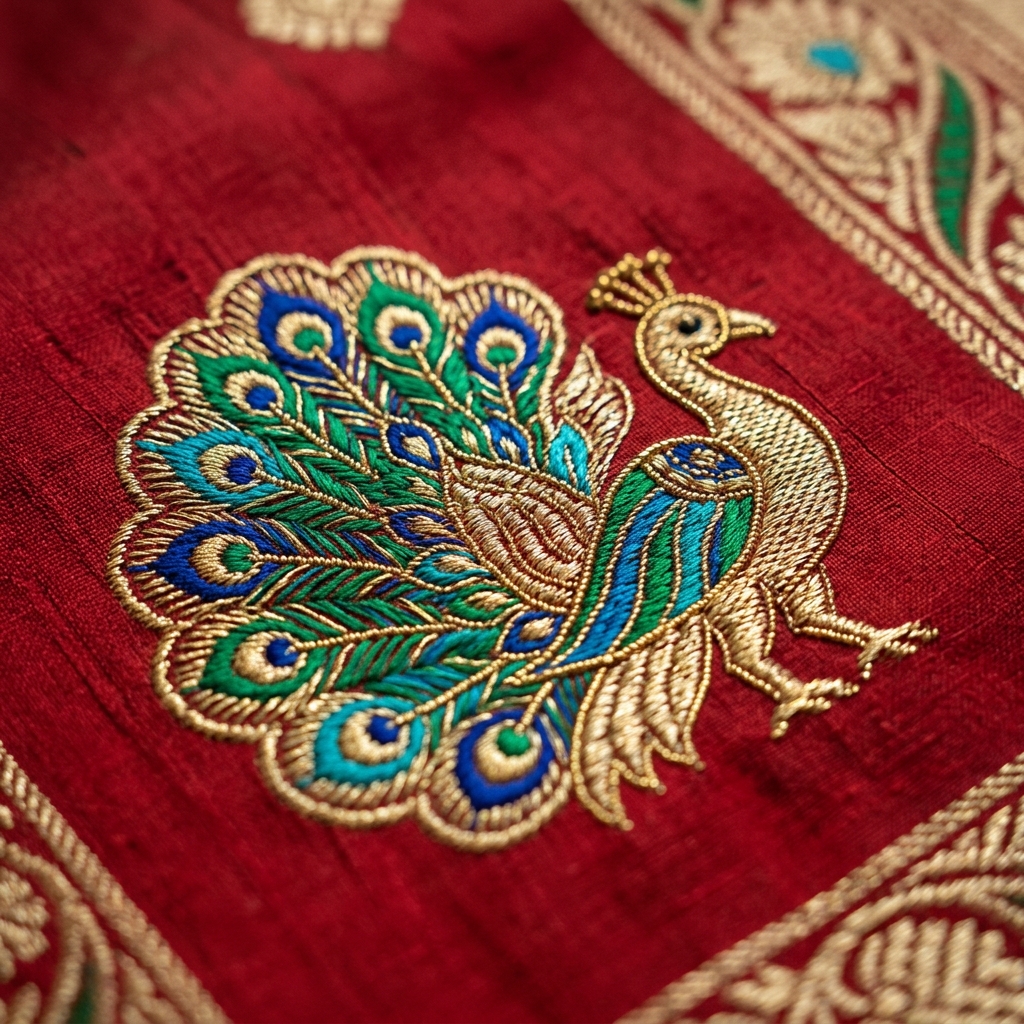
Buta (also spelled booti or buti) is a Persian-origin word meaning a small flower or plant motif. In Banarasi weaving, it refers to a single, self-contained decorative unit — often floral, sometimes geometric — repeated across the body of the saree in a grid or scattered arrangement.
A buta can be as small as a few millimeters, dotting the body in a fine, restrained scatter (common in everyday and semi-formal Banarasi sarees), or large and elaborate, dominating the pallu in bridal pieces. The size, spacing, and density of buta work is one of the clearest visual signals of how much weaving time went into a piece — denser buta placement generally means more hours on the loom.
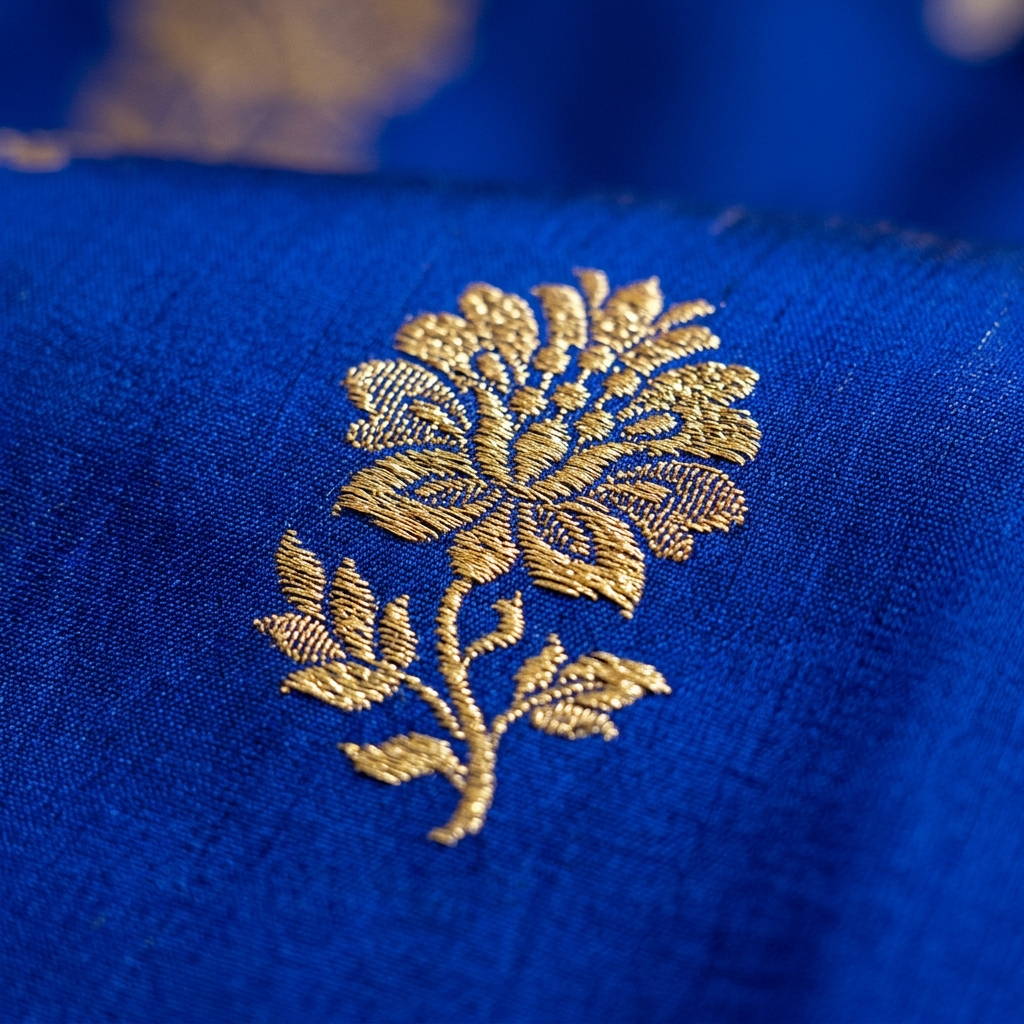
Buta motifs are woven using a supplementary (extra) weft — additional threads introduced into the fabric only where the motif appears, over and above the base weave. Within this, two methods are common in Banarasi weaving:
- Kadhwa technique — each motif is woven separately using individual bobbins, so the design has no loose threads carried across the back and could technically be cut apart without unraveling. This is slower and more labor-intensive, and is generally considered the more prized method.
- Phekwa (floating extra-weft) technique — the weft thread is carried loosely across the reverse of the fabric between motifs rather than cut at each one. It's faster to weave and more affordable, but leaves visible thread floats on the back.
Turning a saree over and checking the reverse side is one of the simplest ways to tell the two apart — clean, discrete motifs with minimal thread carry suggest kadhwa work; long floating threads between motifs suggest phekwa.
The Jaal: The Net That Holds the Saree Together
Jaal means "net" or "web" in Hindi, and that's exactly what it looks like — a continuous, interconnected lattice of small motifs (often buta or floral forms) that covers the entire body of the saree in an unbroken pattern, rather than scattered individually.
Where a buta is a single unit repeated with visible gaps, a jaal is designed so the motifs connect edge to edge, creating the illusion of a fine, continuous net thrown over the fabric. This is considerably more demanding to weave, because the weaver must maintain perfect alignment across the entire width and length of the saree — any inconsistency in spacing breaks the illusion of a seamless web.
Jaal work is closely associated with Jangla Banarasi sarees, one of the oldest documented weaving styles from Varanasi, where dense, all-over floral and foliage jaal patterns cover the saree almost entirely, leaving very little plain ground visible. A well-executed jaal saree tends to command a higher price than a scattered-buta saree of similar silk quality, precisely because of the extra loom hours the continuous pattern demands.
The Paisley: Banarasi Weaving's Most Recognized Motif
The paisley — called kalka or ambi in Hindi, and keri in some regional dialects — is the curved, teardrop-shaped motif with a bent tip that most people recognize instantly, even if they don't know its name. It's one of the most widely used motifs across Indian textiles generally, but in Banarasi weaving it takes on particular importance in borders and pallus.
The shape is widely believed to represent a mango or a sprouting seed — symbols of fertility and abundance in South Asian textile tradition — though its exact origins are debated among textile historians, with some tracing related forms to Persian and Mughal-era decorative art that reached Varanasi through centuries of trade and patronage.
In a Banarasi saree, paisley motifs appear most often:
- Running along the border, in a repeated chain, framing the saree's edge
- As the dominant motif in the pallu, often large-scale and highly detailed, sometimes filled internally with smaller buta or jaal work
- In combination with floral vines, where the paisley acts as an anchor point along a trailing creeper design
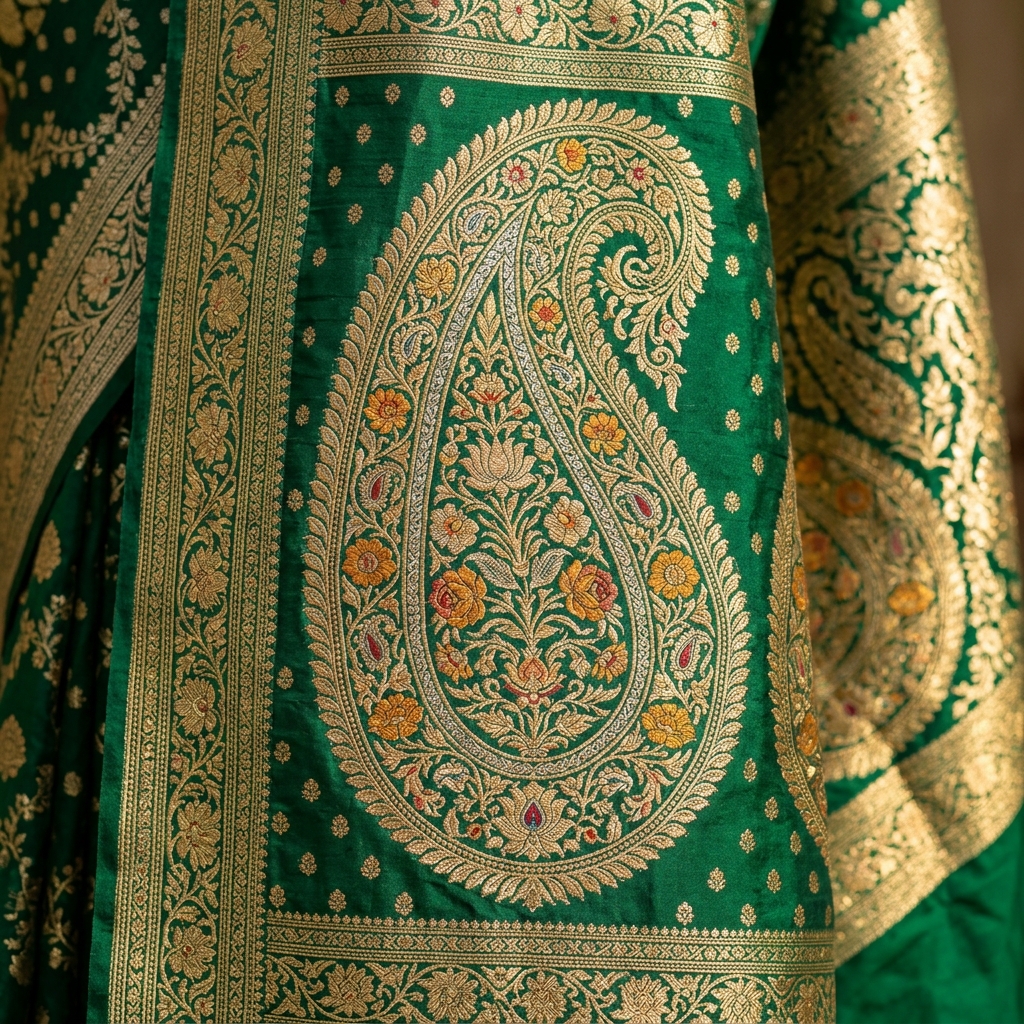
A large, intricately filled paisley in the pallu — with visible internal detailing rather than a flat, solid shape — is generally a marker of more skilled, time-intensive weaving.
How These Motifs Combine in a Finished Saree
Most Banarasi sarees don't use just one motif family in isolation — they layer them. A typical bridal Banarasi might have:
- A jaal covering the body in a fine, continuous net
- A paisley border running the length of both edges
- A large, detailed paisley or floral pallu as the visual centerpiece
Reading a saree this way — body, border, pallu, each carrying its own motif logic — is how a weaver and a trained buyer both evaluate a piece. It's also why two Banarasi sarees can look superficially similar in a photograph but differ enormously in actual weaving time and price once you understand what's been woven into each section.
Why Motif Literacy Matters When You're Buying
Understanding buta, jaal, and paisley isn't just academic — it protects you as a buyer in three concrete ways:
- It helps you judge value honestly. A saree with dense jaal work and a heavily detailed paisley pallu has demonstrably more loom hours in it than one with sparse, scattered buta — and the price difference should reflect that.
- It helps you spot printed imitations. A genuine handwoven motif has slight texture and structural integration with the fabric. A printed or embroidered imitation sits flat on the surface and often shows telltale signs — bleeding color edges, uniform machine-perfect repetition, or a design that looks identical on the front and back (a handwoven motif's reverse side often shows carried threads or subtle texture differences).
- It gives you language to ask better questions. When you know to ask "is this a jaal or scattered buta?" or "is the pallu paisley hand-filled or solid?", you're asking questions a mass-market seller often can't answer — which tells you something too.
Styling Note: Letting the Motif Lead
When a saree carries strong, detailed motif work — a dense jaal or an elaborate pallu paisley — the most flattering styling choice is usually restraint elsewhere. A solid-color or subtly textured blouse lets the woven pattern remain the visual centerpiece, and jewellery is best kept to one statement piece (a substantial necklace or jhumkas, not both) so it doesn't compete with the saree's own detailing.
Care Note
Motif-heavy areas — particularly dense zari work in jaal and paisley pallus — are the most delicate parts of a Banarasi saree and deserve the most care. Always store the saree folded along its length rather than across woven motifs, to avoid stress-cracking the metallic threads. Avoid direct friction on raised buta or zari-filled paisley sections when ironing; iron from the reverse side, on low heat, with a thin cotton cloth as a buffer.
For more in-depth advice on storing your heirlooms safely, read our dedicated Banarasi silk care guide.
Closing
A Banarasi saree's motifs are not surface decoration — they're the visible record of hours a weaver spent at the loom, decision by decision, thread by thread. Buta, jaal, and paisley are the vocabulary of that record. Learning to read them doesn't just make you a more informed buyer; it lets you see the saree the way the person who made it does — as a piece of language, not just cloth.
At Shri Geeta Sarees, every motif on every saree we weave carries this same intent — pattern as craft, not print as decoration, in the tradition Varanasi's looms have carried since 1960.
Continue Reading
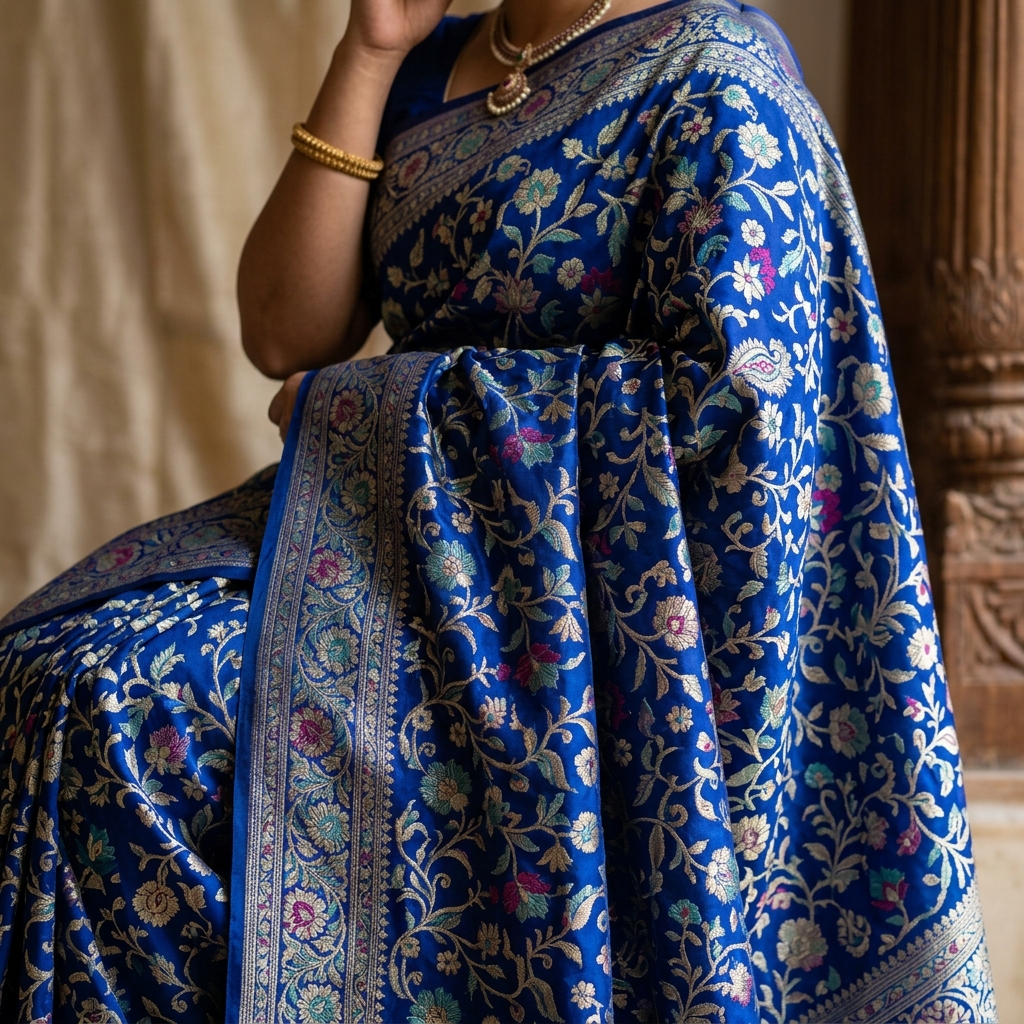
What is Fekwa (Fakua/Cutwork) in Banarasi Sarees?
Learn about Fekwa (or Fakua/Cutwork), an authentic Banarasi weaving technique that creates beautiful floral motifs and jaal patterns. Find out why it's more affordable without compromising quality.
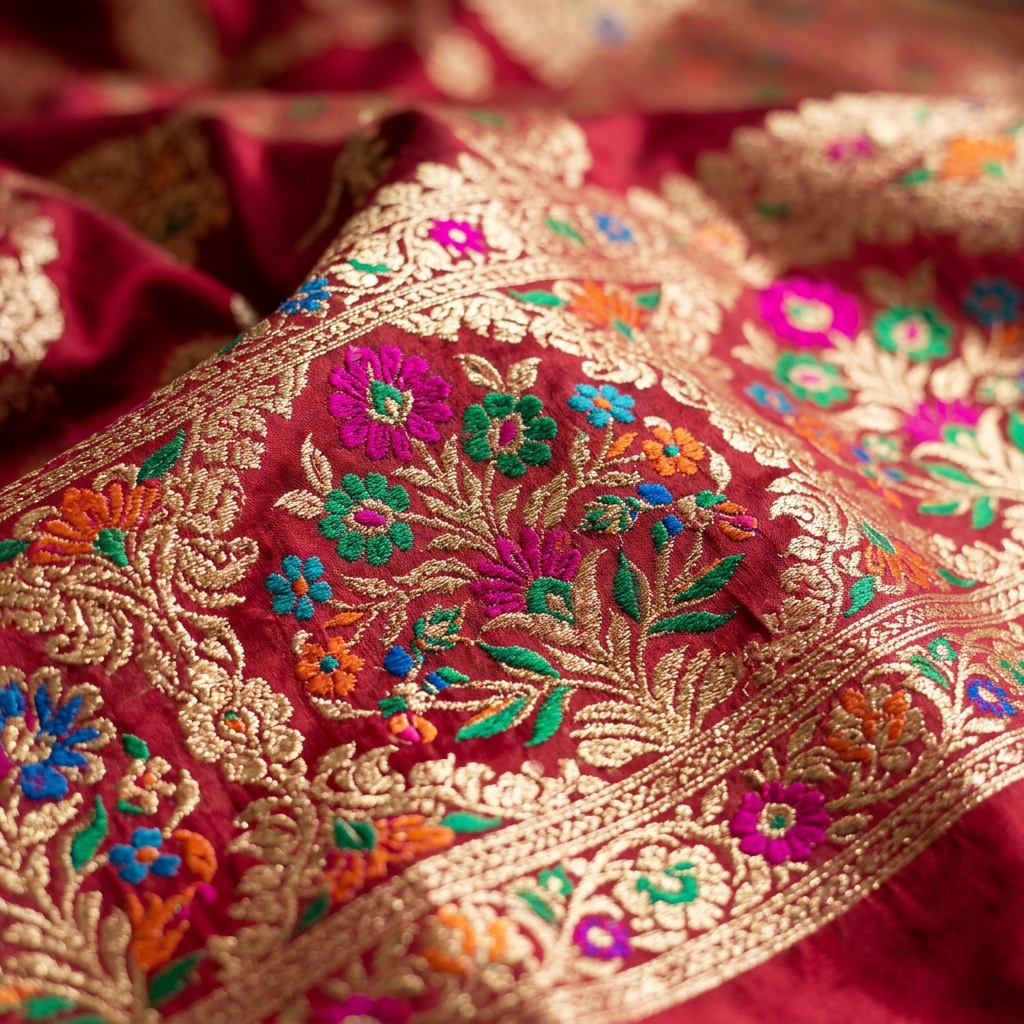
Meenabooti: A Heritage Woven in Every Buta
Discover the exquisite art of Meenabooti weaving. Learn about the intricate Banarasi techniques of Alfi and Tilfi that bring pure silk to life.
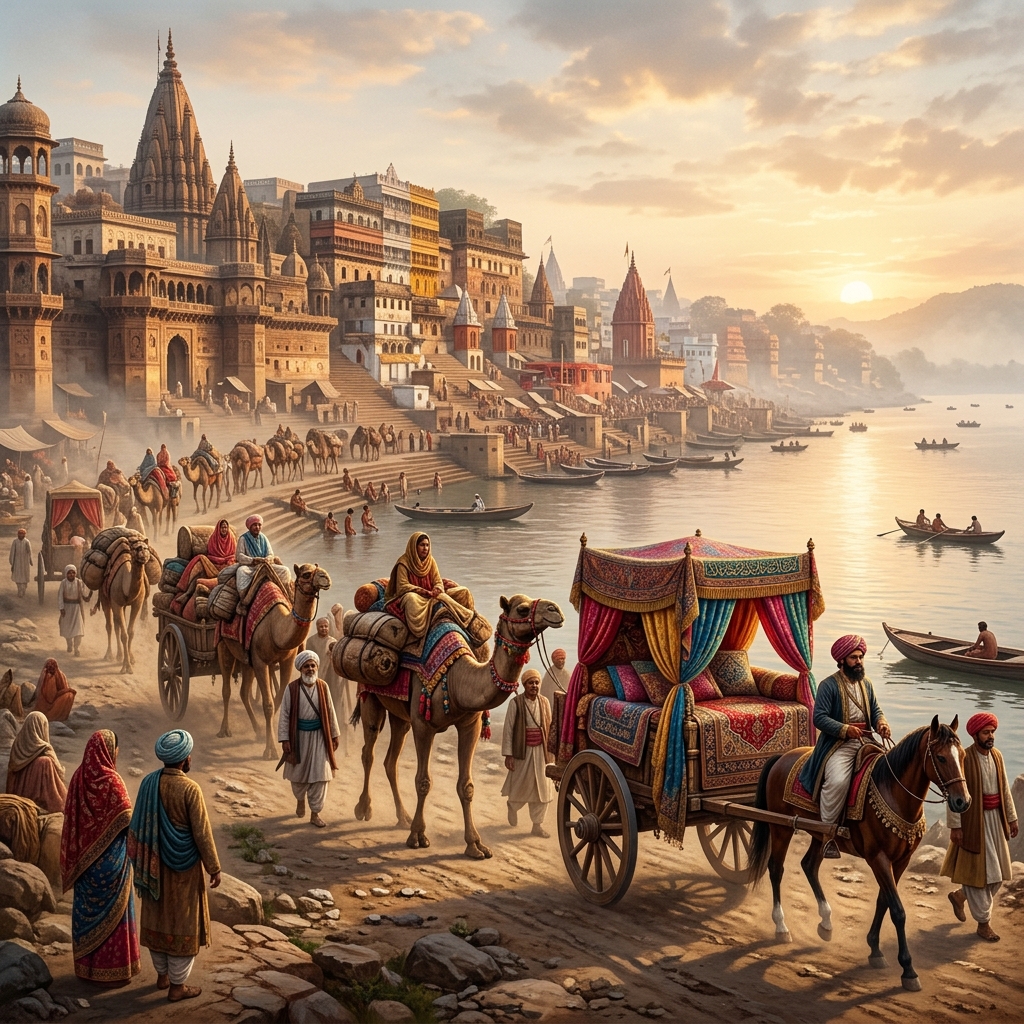
The Silk Route Through Varanasi: History of Banarasi Weaving
Trace the centuries-old journey of silk into Varanasi — from ancient trade routes to Mughal courts to the handloom houses of today.
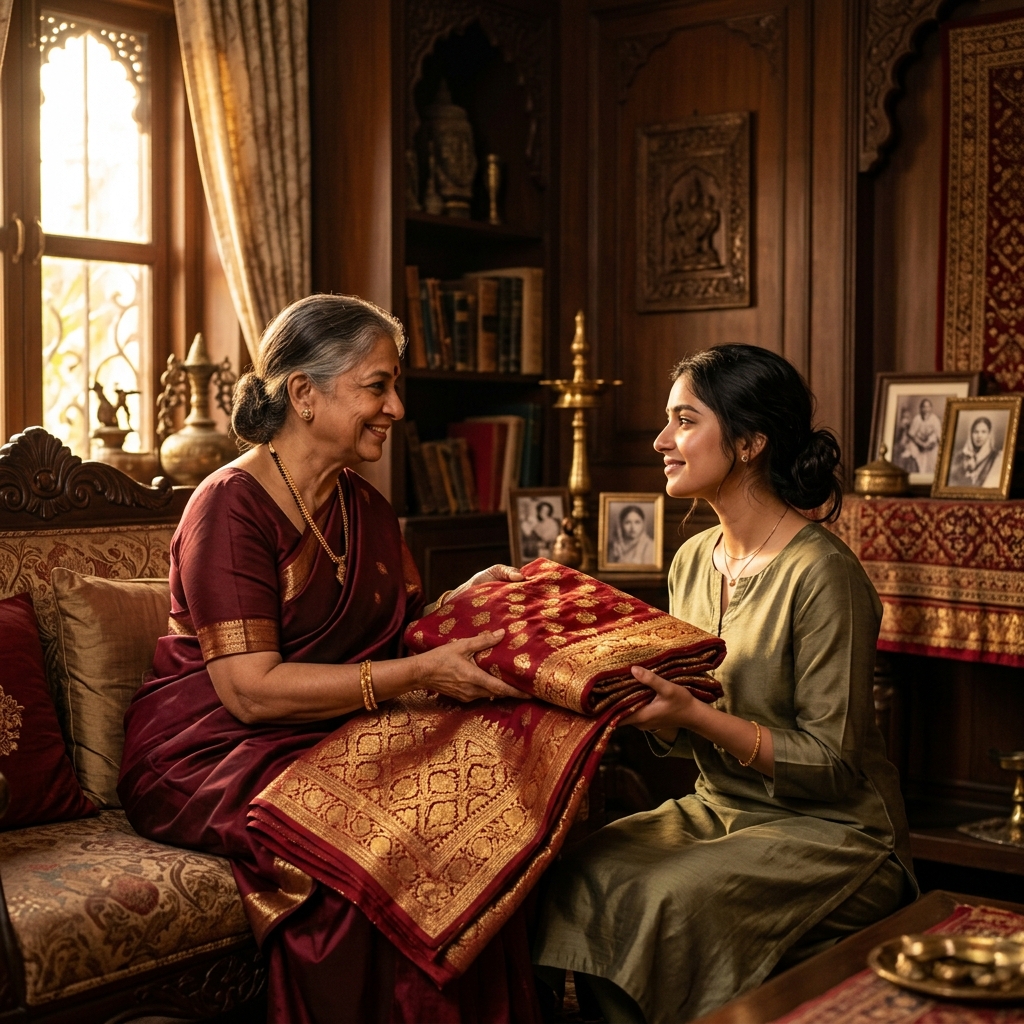
The Banarasi Saree as a Family Legacy: An Heirloom Woven in Silk
Explore the tradition of passing down Banarasi sarees, the craftsmanship that makes them endure, and how to preserve a vintage Banarasi silk saree as a family legacy.
What is a Kadhua Banarasi Saree?
Discover the art of Kadhua Banarasi sarees — individually woven motifs, no loose threads, and an embossed 3D finish. Learn about Meenakari vs Sonarupa and why Kadhua is the pinnacle of Banarasi craftsmanship.