
The Banarasi Saree Bridal Styling Guide: Ergonomics, Double-Dupatta Architecture, and Zari Physics
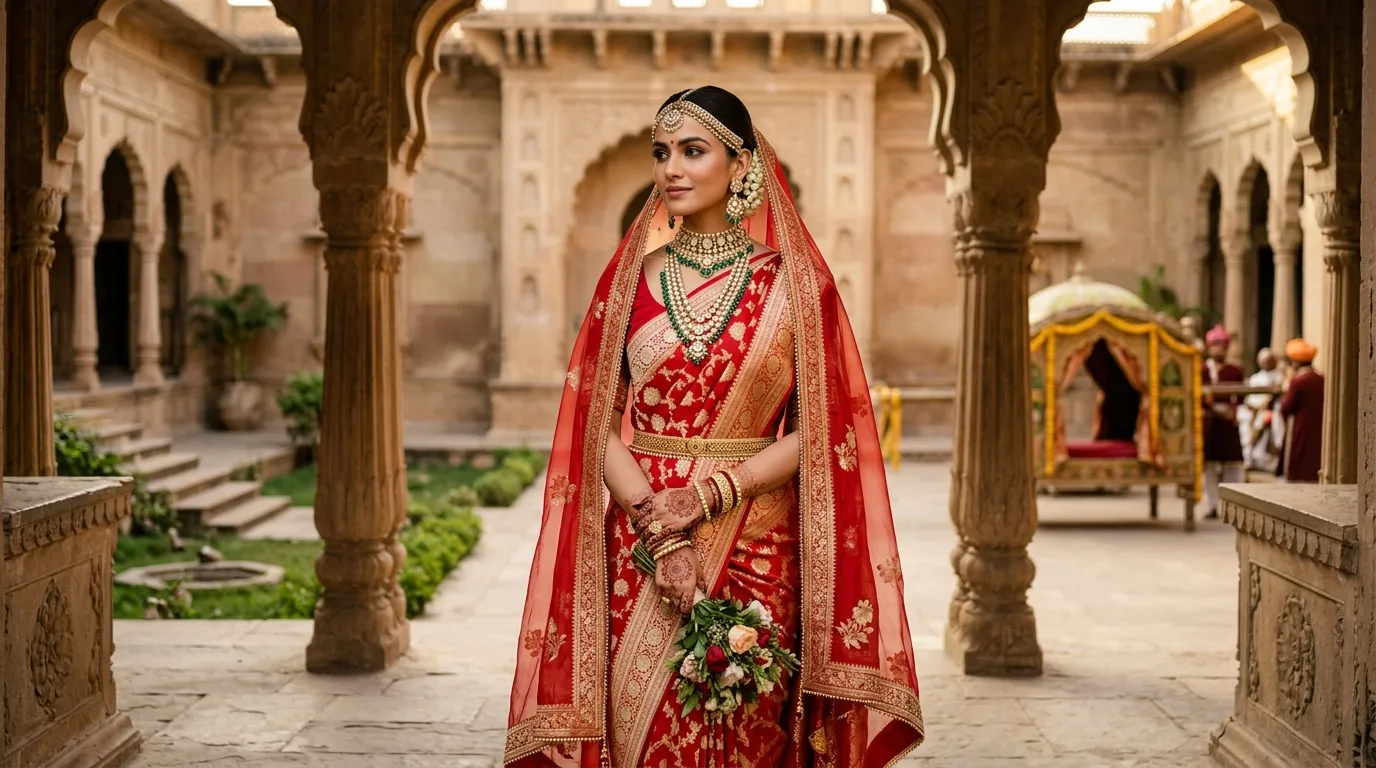
The Banarasi Saree Bridal Styling Guide: Ergonomics, Double-Dupatta Architecture, and Zari Physics
A handwoven bridal Pure Silk Katan Banarasi carries between 900 grams and 1.4 kilograms of high-density mulberry silk warp and pure metallic zari. It does not behave like a flowy chiffon or a light georgette. When a bride treats a heavy Kadhua handloom like an everyday partywear drape, the fabric fights back. Within thirty minutes of walking into the wedding venue, the shoulder pleats begin to drag, the front pleats balloon outward, and by the time the varmala starts, the neckline shifts off-center.
Styling a bridal Banarasi is an exercise in structural engineering. Every pin placement, inner lining fabric, and pleat width directly dictates whether you will move through a three-hour mandap ceremony with effortless poise or spend the entire night hitching up six yards of collapsing silk.
Here is the master bridal blueprint developed over decades on the looms of Varanasi, balancing centuries of artisanal weaving with the physical realities of modern Indian weddings.
The Bridal Banarasi Engineering Matrix
If you only remember seven rules on your wedding day, keep this quick reference table in mind:
| Styling Component | Architectural Rule | Critical Failure Point |
|---|---|---|
| Waist Foundation | 100% thick cotton cambric 8-panel petticoat; broad flat woven tape | Lycra shapewear rolling down; slippery polyester satin slipping under weight |
| Hemline Clearance | Exactly 1 inch (2.5 cm) off the floor while standing in your bridal footwear | Draping barefoot; tripping on heavy zari borders while walking down the aisle |
| Pleat Geometry | 5.5 to 6 inches wide; 5 to 6 deep structured folds; 0.5-inch micro-stagger | Narrow 3-inch pleats accordioning and bunching across the lower abdomen |
| Pallu Anchorage | Diagonal cross-chest lock pinned to the blouse rear shoulder seam | Pinning directly on top of the shoulder crest where gravity levers the fabric forward |
| Head Veil Rigging | Lightweight secondary veil (under 250g) pinned to high bun and blouse seam | Anchoring a heavy head dupatta directly to the saree shoulder drape |
| Blouse Cut | 0.5-inch forward armhole pitch with pre-shrunk cotton interlining | Tight armholes that pinch when sitting cross-legged; synthetic lining causing sweat stains |
| Fastener Physics | Coilless brass bulb pins with cardstock or felt backing disks | Standard coiled safety pins catching and severing 20/22 denier silk filaments |
1. The Sub-Structure: Petticoat Physics vs. Shapewear Pitfalls
The success of your drape is determined before the saree ever touches your skin. A common misconception pushed by modern bridal trends is that seamless lycra shapewear provides the sleekest silhouette for a bridal Banarasi.
Under real wedding conditions, this is a recipe for disaster.
A pure Katan silk saree woven with dense Sonarupa Kadhua or antique zardozi work exerts continuous downward shear stress. Lycra shapewear relies on elastic tension and spandex grip. As you walk, sit, and bow during the rituals, the weight of the silk slowly drags the elastic waistband downward. Because shapewear lacks a rigid mechanical lock, it rolls over on itself, creating an uncomfortable roll across the midriff that cannot be adjusted once your jewellery and dupatta are pinned.
The Gold Standard: 8-Panel Cotton Cambric
For bridal silks weighing over 800 grams, use a traditional tailored 8-panel or 6-panel petticoat made from 100% unmercerised cotton cambric or heavy poplin.
- Tensile Rigidity: Woven cotton does not stretch under load. It holds the tucked fabric firmly against your pelvic bones without budging an inch.
- The Waistband Cord: Throw away thin twisted cord drawstrings. They dig into the flesh like piano wire under the weight of the saree. Replace them with a flat, 1-inch-wide woven cotton twill tape (nada). Tie it firmly over the right or left hip bone—never directly over your navel, which creates unnecessary bulk under the central pleats.
- Friction Grip: The natural micro-texture of woven cotton acts like natural velcro against pure mulberry silk, preventing the tucked pleats from shifting sideways during the pheras.
For a detailed analysis of footwear timing and waist heights, refer to our master breakdown on heels-first or saree-first draping biomechanics.
2. Body Biomechanics & Motif Geometry
Banarasi sarees are defined by their surface density. The scale of the woven motif (buta, buti, or all-over jaal) interacts dynamically with your physical frame and posture.
| Physical Frame | Recommended Weave Architecture | Draping Strategy |
|---|---|---|
| Petite (< 5'3") | Fine Ashrafi butis, Minakari floral sprays, borders under 3.5 inches | 5-inch pleats; single-pleat pallu pinned at shoulder to elongate vertical line |
| Curvy / Heavy Bust | Diagonal Jangla jaal (Tirchi flow), matte antique zari, Katan base | Broad 6-inch pleats; structured shoulder pleats pinned diagonally across bust |
| Tall (> 5'7") | Grand Shikargah, wide 7-inch Kadwa borders, Kimkhwab brocade | Deep box pleats; cascading open pallu pinned lightly at forearm |
The Pleat Width Formula
When draping lighter textiles, narrow 2-to-3-inch pleats look delicate. On a heavyweight bridal Pure Silk Katan, narrow pleats are fatal: each fold stacks multiple layers of stiff zari-woven silk on top of each other. Ten narrow pleats produce a rigid, 20-layer block of stiff fabric that projects outward from your stomach like a shelf.
- Fold Width: Measure pleats between 5.5 and 6 inches wide (roughly the span from your thumb tip to your little finger tip).
- Pleat Count: Aim for 5 to 6 deep, well-defined pleats rather than 10 to 12 shallow ones.
- The 0.5-Inch Micro-Stagger: When collecting the pleats, do not keep the edges perfectly flush. Stagger each successive inner pleat approximately 0.5 inches higher than the outer front pleat. This prevents the pleat stack from drooping towards the floor in the center and guarantees a razor-straight, floor-parallel hemline.
3. The Mandap-Proof Double-Dupatta Architecture
Almost all royal Indian bridal aesthetics now incorporate the double-dupatta system: the rich, opaque Banarasi saree pallu draped across the torso, complemented by a sheer, translucent veil covering the head.
The biggest pitfall brides encounter is cross-anchoring: pinning the head veil directly onto the saree shoulder pleats. When you turn your head, you pull the saree; when you step on the saree, you pull your neck.
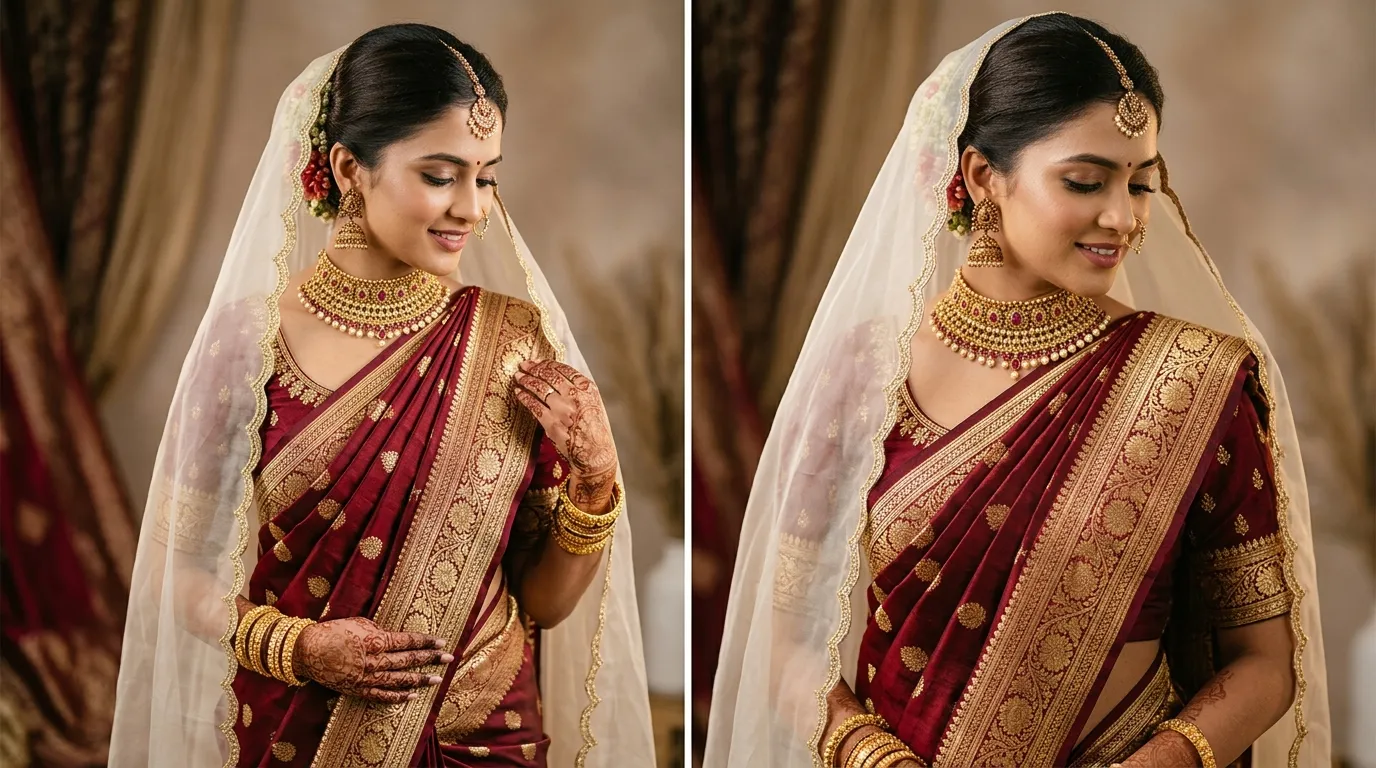
To execute a flawless double-dupatta drape that leaves your neck completely unburdened, follow this 4-point mechanical separation:
Step 1: The Saree Pallu (The Structural Shield)
Gather the Banarasi pallu into neat 4-to-5-inch pleats so that the primary border sits directly along the outer edge of your left shoulder. Pin this stack to your blouse 2 inches behind the shoulder seam. Positioning the anchor behind the peak of your shoulder uses your trapezius muscle to balance the weight, preventing the heavy pallu from tipping forward across your chest throughout the day.
Step 2: The Head Veil Selection (The Kinetic Element)
Never choose a heavy velvet or dense silk dupatta for your head veil when wearing a Banarasi saree. The saree already accounts for over a kilogram of weight. Your head veil should be crafted from pure silk organza, lightweight tissue, or monofilament nylon net, weighing no more than 200 to 250 grams. A delicate scalloped border (kiran or subtle zardozi) adds frame definition without adding structural drag.
Step 3: Independent Hair-Junction Anchoring
The head dupatta must anchor exclusively to your hair armature—never to the saree.
- Build a solid bridal hair base: a reinforced, low-to-mid hair bun supported by internal padding and criss-crossed bobby pins.
- Secure the center front of the veil to your hair bun using U-shaped bridal hairpins bent slightly outward for locking leverage.
- Let the veil drape naturally over your shoulders without pinning it to the saree's shoulder pleats. This gives your head a 180-degree free range of motion.
Step 4: The Front Cross-Chest Sweep (Optional Gujarati Variation)
If you prefer showcasing the intricate zari work across your chest rather than bundling it over the shoulder, use the royal Gujarati or Seedha Pallu drape. Bring the pallu from the back over the right shoulder, fan out the intricate jaal across the bust line, and anchor the upper left corner neatly into the petticoat waistband at the left hip. Pin a complementary sheer veil over the head to frame the face.
For an extensive review of veil fabrics, check our dedicated dupatta styling guide.
4. Blouse Engineering & Neckline-Jewellery Alignment
A bridal blouse paired with a Banarasi saree is not merely an aesthetic top; it is a load-bearing garment. Because the blouse carries the anchor pins for the pallu, the waistband, and the chest drape, its construction must be technically sound.
Blouse Tailoring Secrets for Heavy Silk
- Pre-Shrunk Pure Cotton Interlining: Banarasi silk has zero natural stretch. The lining inside must be 100% pure mulmul or cambric cotton, thoroughly soaked in cold water and air-dried before cutting. If the tailor cuts unwashed lining, dry-cleaning or mandap perspiration will shrink the inner lining, puckering the outer silk into permanent ripples.
- The 0.5-Inch Forward Shoulder Slope: Standard blouse patterns cut the shoulder seam straight across. For bridal wear, instruct your master tailor to slope the shoulder seam 0.5 inches forward toward the collarbone. This counters the constant backward drag exerted by the heavy pallu.
- Perspiration Shields (Padded Armhole Guards): Pure silver and copper electroplated zari reacts violently to human sweat. Acidic perspiration will turn pure gold zari black or tarnished green within hours. Have your tailor sew detachable double-layer cotton sweat shields inside the armhole sockets to absorb sweat before it reaches the saree.
The Color Theory Matrix: Monochromatic vs. Contrast
- Monochromatic Crimson/Vermilion: Pairing a red Banarasi with a matching red blouse is the quintessential heirloom look. To prevent it from looking flat, introduce texture: opt for a raw silk or velvet blouse embellished with delicate zardozi, Pitta work, or marodi embroidery that echoes the motif density of the saree's border.
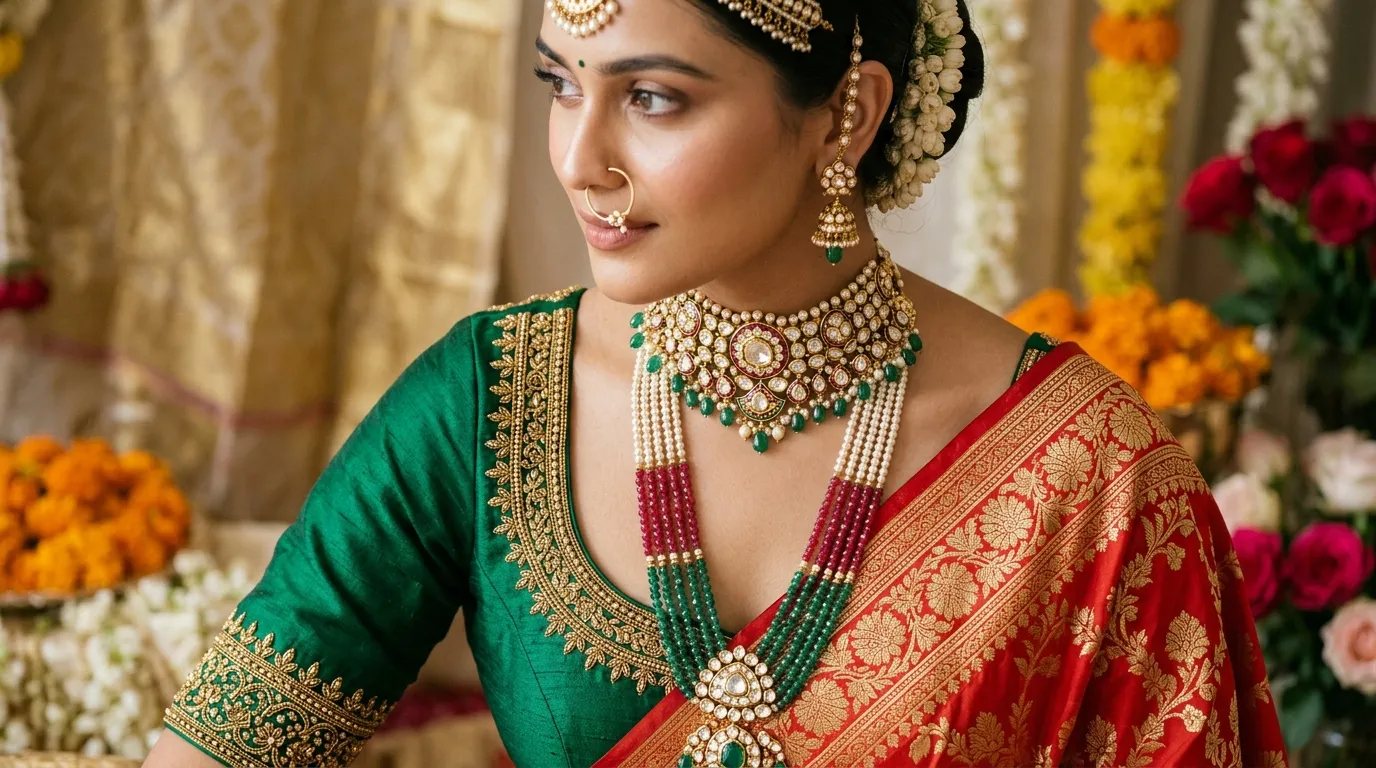
- Jewel-Tone Contrasts: If your saree is vermilion red or deep bridal maroon, contrast blouses in emerald green, royal midnight blue, or rich mustard yellow add regal dimensionality. The golden rule: the base undertone of the blouse must match the zari undertone (warm yellow gold with warm gold; antique champagne zari with antique dull gold).
| Blouse Neckline | Optimal Jewellery Layering | Common Conflict to Avoid |
|---|---|---|
| Deep Sweetheart or Broad U-Cut | Broad Polki choker resting flush against the skin, paired with a 24-inch Rani Haar sitting directly on the saree silk | Rani haar catching on the blouse neckline rim and flipping over |
| High Boat Neck or Closed Mandarin | Single dramatic collar necklace (Hasli or temple choker) worn over the fabric; statement Jhumkas | Layered beads tangling with high embroidered collar borders |
| Regal V-Neck (Sabyasachi Cut) | Triangular drop necklace framing the collarbones, paired with a layered Gutapusalu cascade | Choker overlapping with V-angle apex, creating visual congestion |
To determine whether antique gold, kundan, or polki complements your skin tone, read our master breakdown on how to choose jewellery colors for your skin undertone.
5. Pinning Physics: How to Anchor 1.2kg Without Tearing Pure Silk
Standard nickel safety pins are the number one cause of ruined bridal heirloom sarees. When heavy silk tugs against a standard safety pin, the delicate warp threads slip inside the coiled wire spiral at the base of the pin. As you move, that coiled loop acts like a miniature wire-cutter, slicing through the fine mulberry silk filaments.
Once those threads are severed, the silk develops an irreparable puncture hole that spreads along the weave.
The Master Pinning Arsenal
- Coilless Bulb Pins (Pear Pins): These pins have a completely smooth teardrop profile with zero circular coil at the base. Threads cannot get trapped or severed.
- Cardstock or Felt Disk Backing: Before passing the pin through your saree pleats, slide a 1-centimeter circular disk cut from thick cardstock, plastic, or medical micropore tape onto the pin. When the pin clasps shut, the disk acts as a washer, distributing mechanical tension across several square centimeters rather than concentrating it on a single thread.
- Anchor into Internal Blouse Seams: Never pin the heavy pallu to just a single layer of delicate blouse silk. Push the pin through the dense interior seam allowances or structural bra-strap stay holders built into the blouse shoulder.
For step-by-step visual diagrams on needle insertion angles, read our comprehensive guide on the physics of saree pinning without tearing silk.
6. Mandap Ergonomics & Ritual Realities
A wedding day is an endurance test. An Indian Hindu wedding ceremony involves sitting cross-legged on floor cushions (gaddi) for two to four hours in front of a blazing sacred fire (havan kund), followed by standing for endless stage photographs.
Here is how to prepare your drape for the physical rituals:
- The Mandap Knee-Slack Adjustment: Before sitting down at the mandap, gently gather 2 to 3 inches of fabric around your knees and ease it upward slightly before taking your cross-legged seat. This prevents the pleat stack from pulling violently against the waistband hooks when your knees bend.
- The Chest Pin Release: If you have pinned your pallu tightly across your chest for formal stage photographs, discreetly unfasten the chest-to-waist anchor pin before sitting down for the havan. Sitting bent forward compresses your ribcage; releasing that single pin allows you to breathe comfortably during long rituals.
- The Sacred Fire Smoke Hazard: True handloom silk is woven with organic animal protein filaments. Synthetic perfume sprays contain alcohol and synthetic musks that bond with havan smoke particles, accelerating the tarnishing of metallic zari threads. Apply all perfumes to your pulse points thirty minutes before dressing, and never spray perfumes directly onto the gold or silver zari weave.
7. How to Identify Real Handloom Bridal Katan vs. Powerloom Counterfeits
With the market flooded with machine-made polyester imitations marketed as "pure bridal silk," every bride must know how to inspect their garment before purchasing:
- Examine the Reverse Side (The Kadhua Test): In an authentic handwoven Kadhua Banarasi, each motif is individually crafted on the handloom. When you flip the saree over, the reverse is exceptionally clean, showing sheared thread ends cleanly tucked at each motif boundary. If you see hundreds of long, loose threads floating continuously across the entire back of the saree, it is a machine-made Fekwa or powerloom replica that will snag on your anklets and bangles.
- The Tactile Drape Test: Pure Katan silk woven from 20/22 denier twisted mulberry yarn possesses a distinct, satisfying weight and a soft, warm hand-feel. Synthetic polyester brocades feel cool, slippery, and plastic-crisp, holding sharp creases like origami paper when folded.
- Direct Weaver Sourcing in Varanasi: To avoid multiple retail distributor markups that inflate bridal prices by 300%, source directly from authentic multi-generational weaving houses. At Shri Geeta Sarees (established in 1960 in the historic Chowk bazaar of Varanasi), every bridal saree is handloomed by master weavers using certified pure silk yarns and tested zari.
Frequently Asked Questions (FAQs)
Can I wear shapewear instead of a traditional petticoat with a heavy bridal Banarasi saree?
No, it is strongly advised against. Bridal Banarasi sarees weighing 900 grams to 1.5 kilograms exert substantial downward drag that elastic shapewear cannot support. The waistband of shapewear invariably rolls downward during prolonged sitting, causing the tucked pleats to sag and bunch. A structured 6-to-8-panel petticoat made of heavy 100% cotton cambric with a flat, woven cotton drawstring provides the rigid structural support required for a heavy silk drape.
How much should the secondary head veil weigh when styling a bridal Banarasi?
The secondary head veil should weigh no more than 200 to 250 grams. Because a handwoven bridal Banarasi saree already provides substantial visual and physical weight, a heavy head dupatta will pull backward on your bridal bun, causing neck strain and headache during long rituals. Opt for lightweight sheer silk organza or fine net with delicate scalloped border embroidery.
Should I get my bridal Banarasi saree pre-stitched?
While pre-stitched sarees work well for lightweight cocktail partywear, purists and professional bridal drapers recommend against pre-stitching an heirloom Katan silk Banarasi. Pre-stitching cuts and sews permanent seams into the continuous six-yard handloom, weakening the structural integrity of the pure silk warp and preventing future re-draping, sizing adjustments, or heirloom preservation across generations. Instead, use professional pre-pleating and coilless pin anchoring on the day of the wedding.
How do I avoid yellow/tarnished zari under wedding lights?
To prevent bridal zari from tarnishing or turning dull, ensure the saree never comes into direct contact with alcohol-based perfumes, hairsprays, or deodorants. Wear an inner blouse lined with pure absorbent cotton to create a barrier against acidic body perspiration. Store the saree wrapped in unbleached, breathable cotton muslin—never in plastic zip bags, which trap humidity and off-gas chemicals that darken metallic zari threads.
Which footwear should I wear while draping a bridal Banarasi saree?
Always put on your exact bridal heels or wedges before tucking the first round of the saree. Draping while wearing your bridal footwear ensures an exact 1-inch floor clearance, preventing the heavy border from dragging in dust or catching on your heels while walking down the aisle. If you plan to switch to flat juttis later in the evening, factor in that height differential during draping by positioning the waistband slightly higher.
Continue Reading
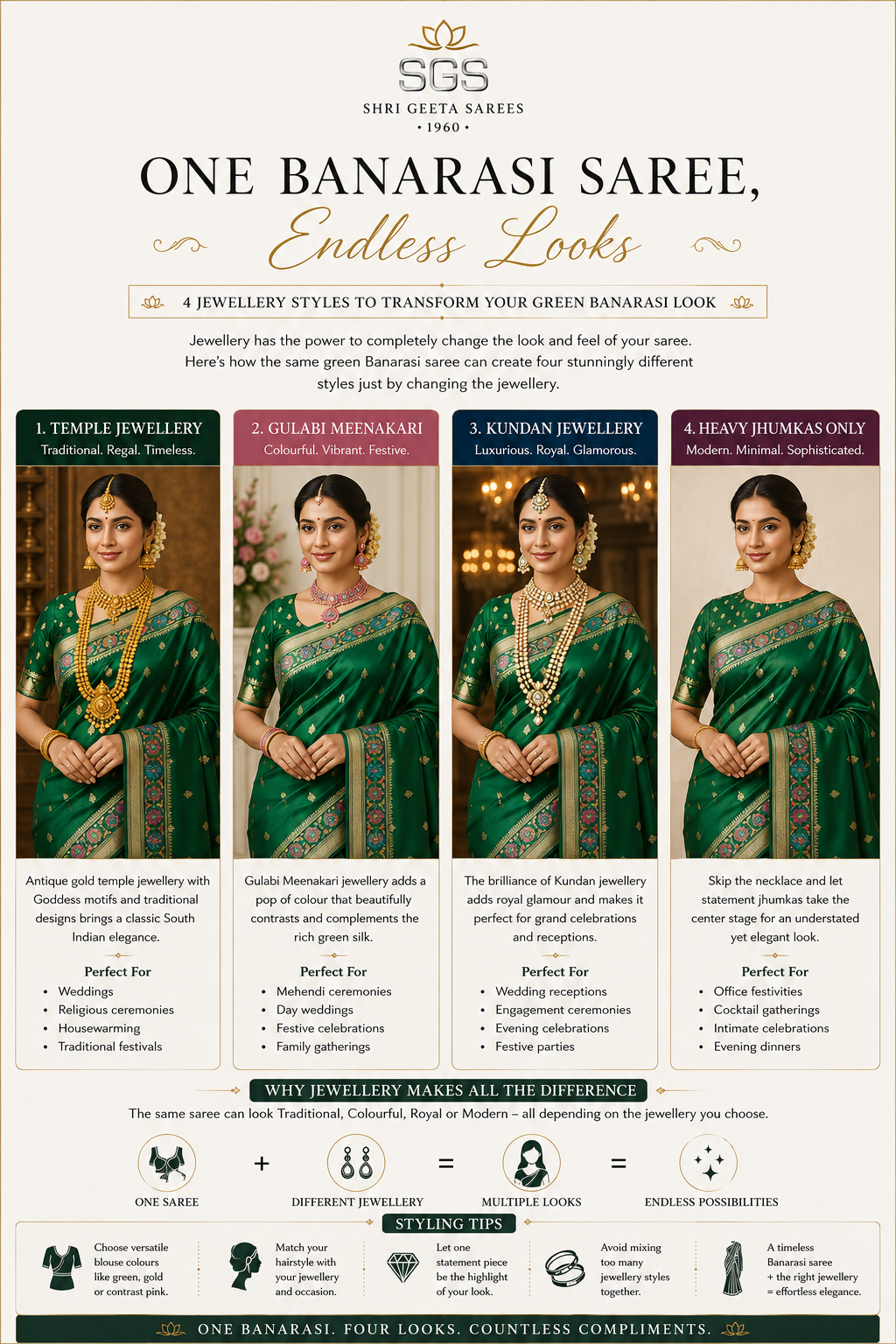
How One Banarasi Saree Can Create 4 Completely Different Looks
A beautiful Banarasi silk saree is one of the most versatile pieces in your wardrobe. Discover how to create four stunning looks just by changing your jewellery.
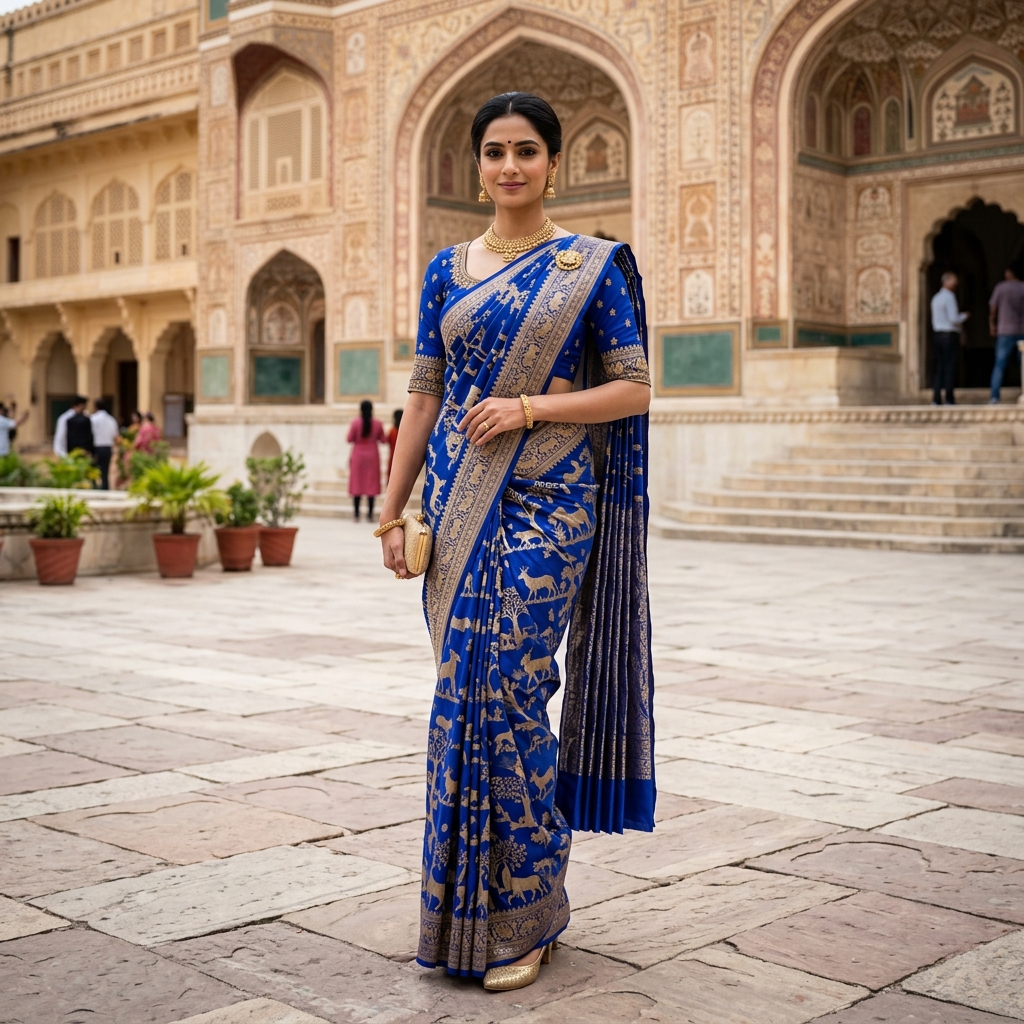
4 Elegant Ways to Drape a Banarasi Saree | Shri Geeta Sarees
Looking for new ways to wear your handwoven Banarasi saree? Discover 4 elegant and easy styling methods, from classic traditional to modern reception drapes.
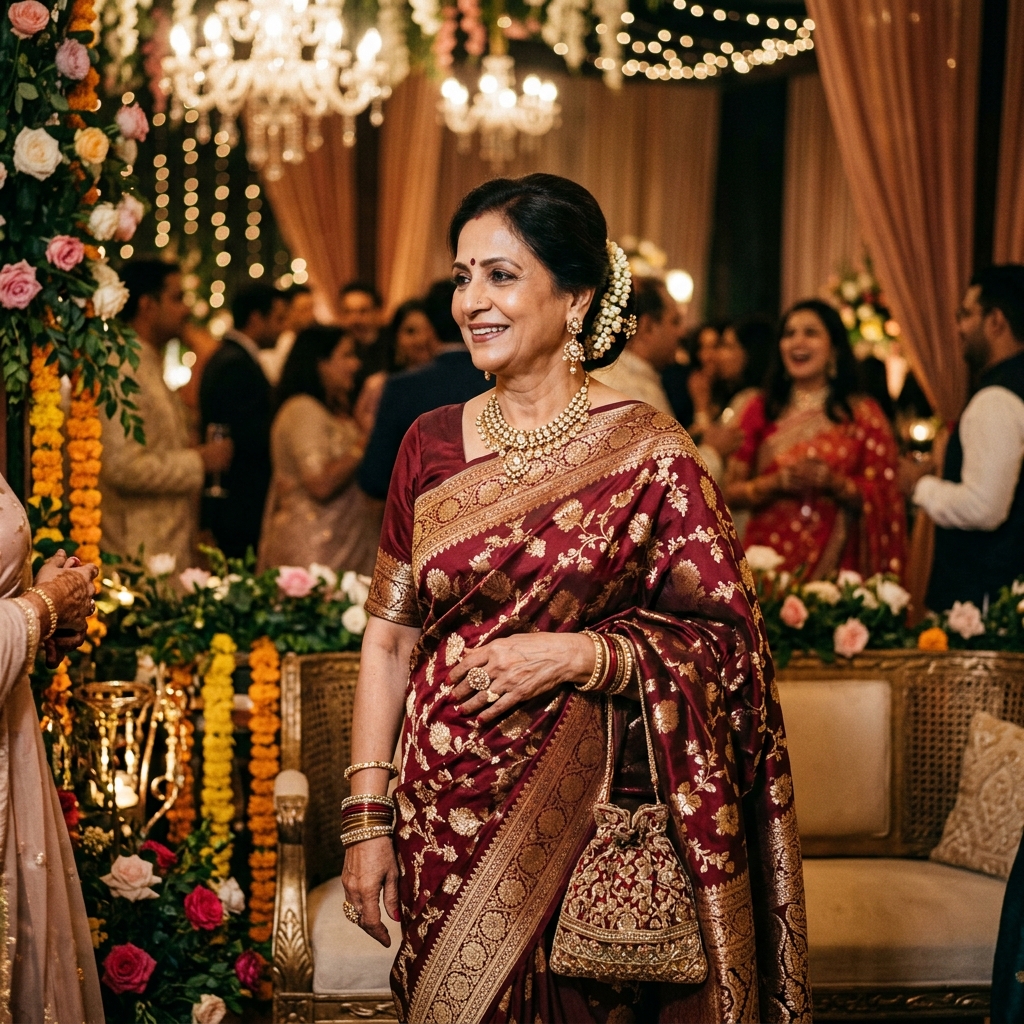
Banarasi Saree for Mother of the Bride: A Guide to Getting It Right
A comprehensive guide to choosing the perfect Banarasi saree for the mother of the bride, covering colors, weaves, and styling advice.
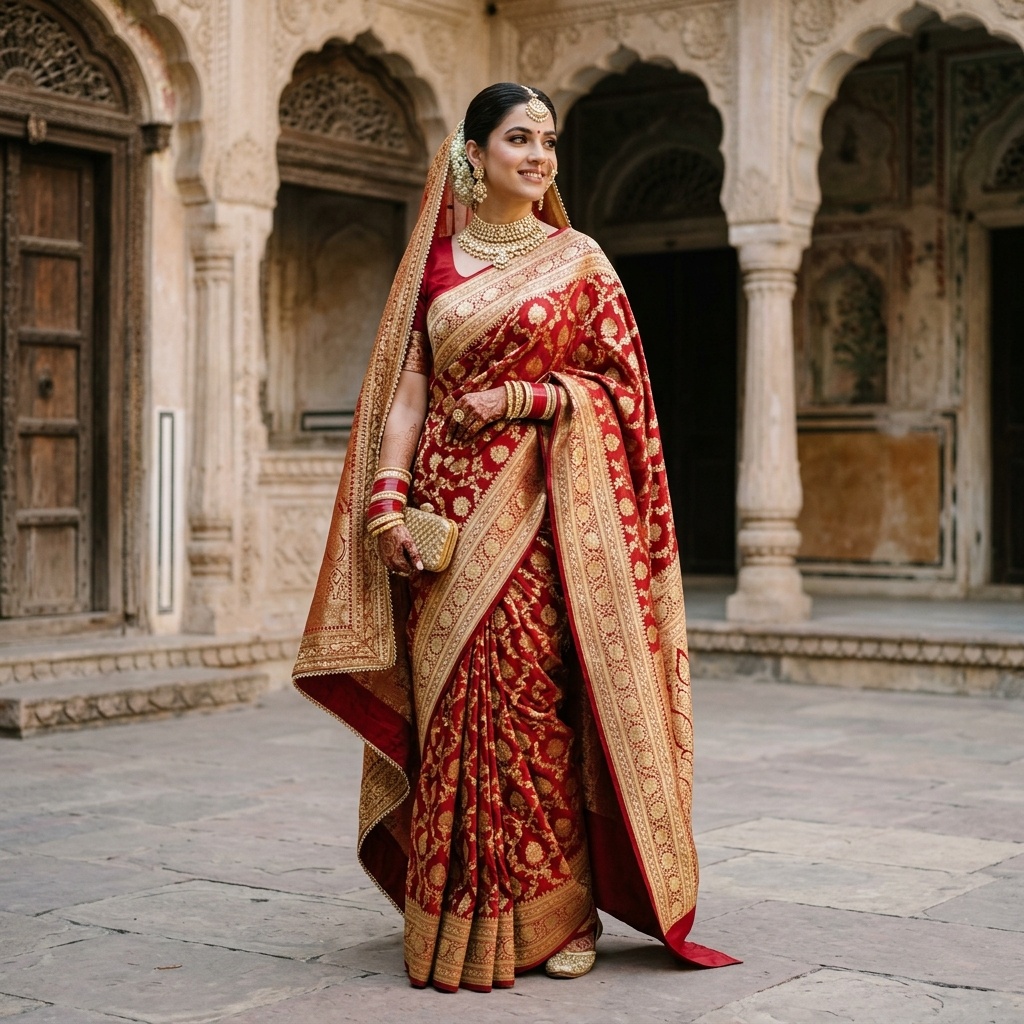
Types of Banarasi Silk: Katan, Georgette, Organza & Tissue Explained
Confused by Banarasi saree fabrics? A Varanasi weaver explains the exact difference in drape, weight, and styling for Katan, Georgette, Organza, and Tissue silk.