
Heels First or Saree First? The 1-Inch Floor Clearance Rule & Draping Biomechanics
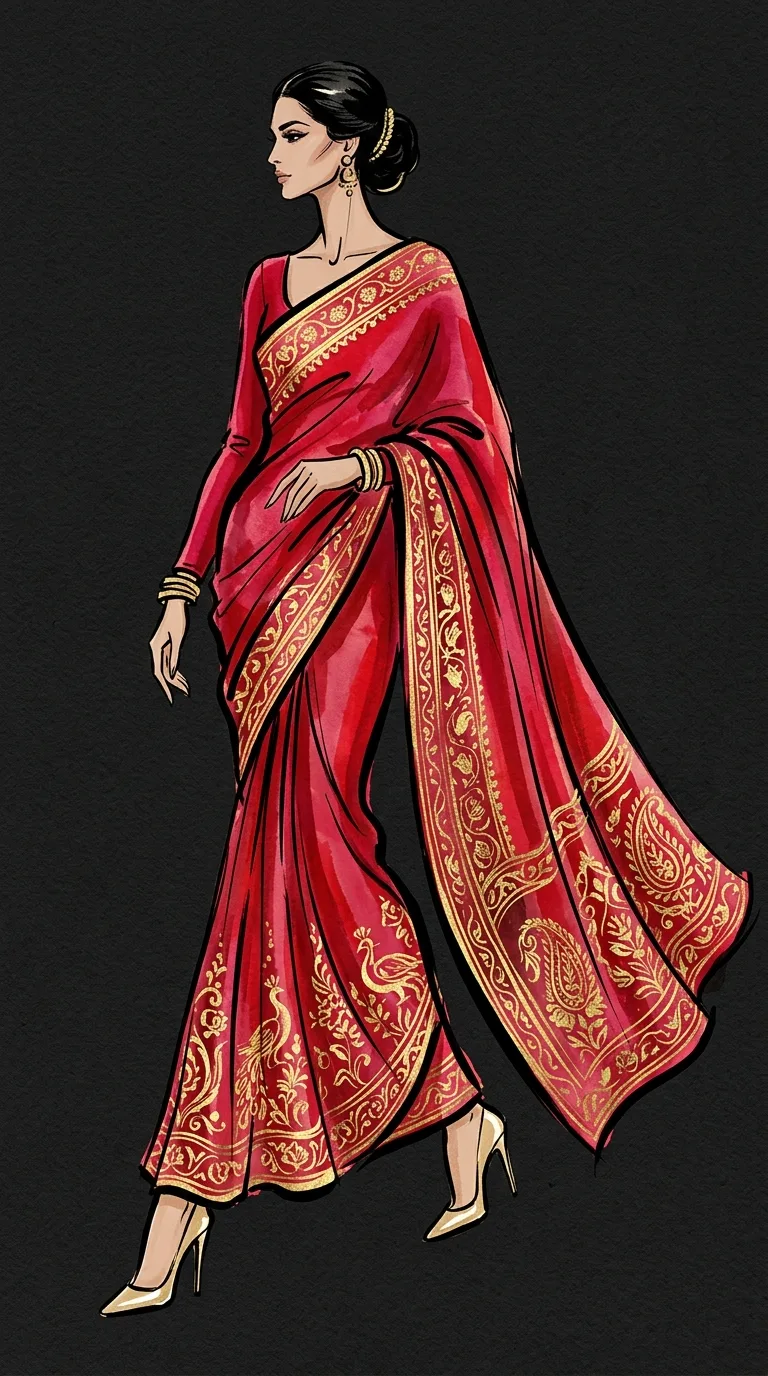
You have picked out a magnificent handloom Banarasi silk saree, spent weeks coordinating the jewelry, and had the blouse tailored to perfection. You spend forty-five minutes in front of the mirror crafting knife-edge pleats, making sure the lower zari border sits a hair above the marble floor.
Then, just before walking out the door, you slip into your 3-inch stilettos.
Suddenly, the entire drape collapses:
- Your front pleats lift awkwardly 3 inches above your ankles, exposing your petticoat and shoes.
- The waistband twists and sags, pulling the waistline out of alignment.
- The back hem drags on the floor, catching under your heels every time you take a step.
Most women assume they made a mistake with their pleating technique or that the saree fabric is too stiff.
In reality, you made a fundamental order-of-operations error: you draped barefoot before wearing your heels.
Draping a saree is not just styling; it is an exercise in applied biomechanics and structural tension. Here is the textile science of what happens when you step into heels, and the exact step-by-step protocol master drapers use to guarantee an effortless, unbroken 10-foot silhouette.
1. The Biomechanics of Saree Draping: What Actually Changes When You Wear Heels?
To understand why your drape shifts so dramatically, consider what happens to your skeletal posture the second you put on high heels.
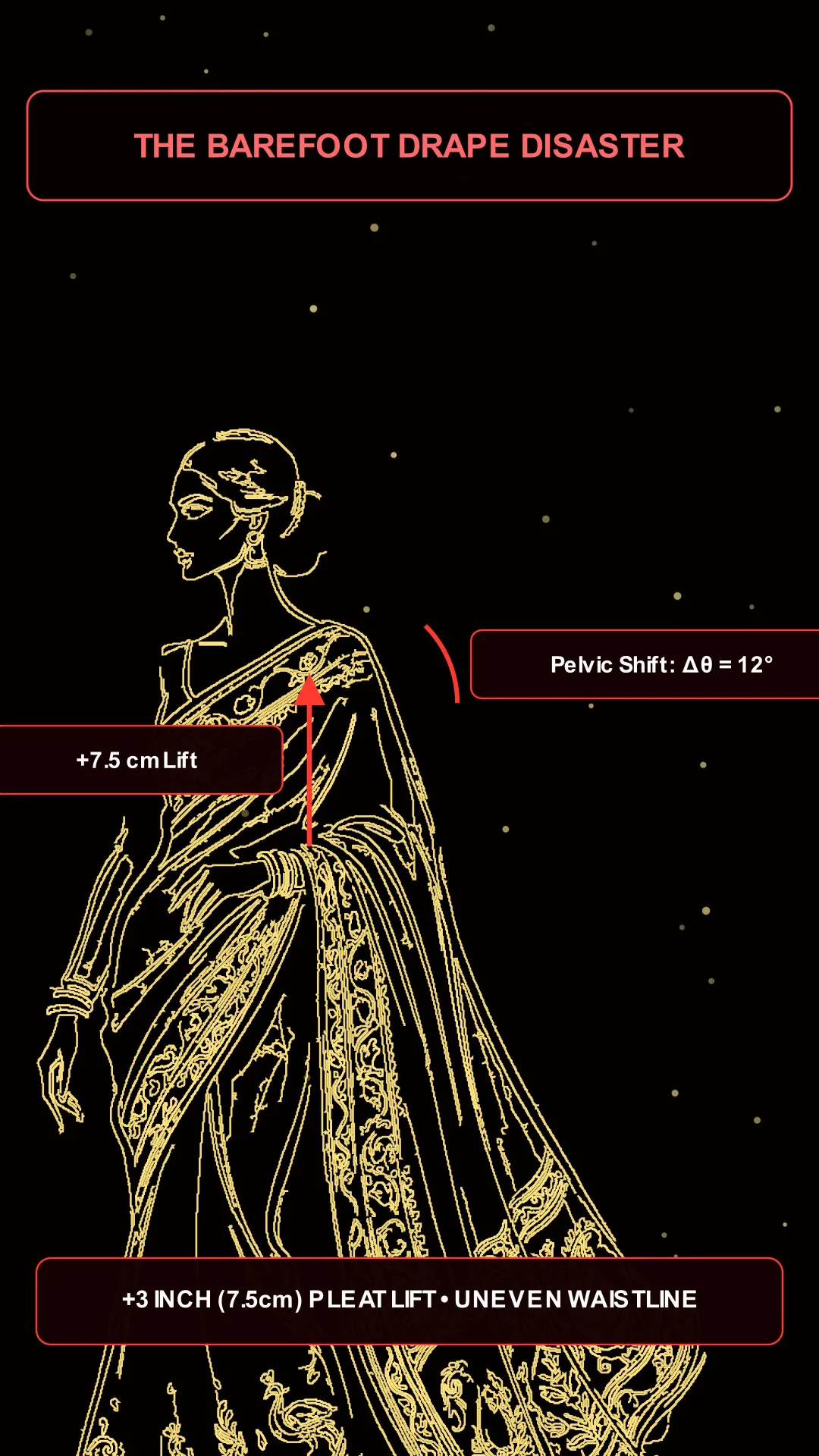
A. The Pelvic Angle Shift (\Delta \theta = 12^\circ)
When you stand barefoot, your pelvis rests in a neutral anatomical position. The moment you step into a 3-inch (7.5 cm) heel, your center of gravity is pitched forward over the balls of your feet.
To maintain balance, your body automatically compensates:
- Your lumbar spine arches (lordosis increases).
- Your pelvis tilts forward by 10 to 15 degrees (\Delta \theta \approx 12^\circ).
- Your abdominal wall flattens and elongates, while your glutes rise.
The Draper's Dilemma: If you tied your petticoat drawstring while standing barefoot, this pelvic rotation completely changes the tension of the waistband. The front waistband gets pulled downward and forward, while the back waistband rides up.
B. The Upward Pleat Lift (+7.5 cm / +3.0 Inches)
When you tuck your saree pleats into a barefoot waistband, you calibrate the lower hemline to ground level ($h = 0$).
When you put on heels afterward, your vertical height increases by the exact height of your heel lift. Because the saree fabric has zero elasticity along its warp threads, the gathered front pleat bundle is pulled upward by 7.5 cm.
Instead of sweeping gracefully near the floor, your pleats hang mid-shin like an ill-fitting curtain.
C. The Walking Stride & Heel-Stud Catch
When you walk in heels, your foot strikes the ground at a steeper downward angle compared to a barefoot roll.
If your saree was draped too long in an attempt to compensate for barefoot height, the excess fabric pools behind your ankles. As your heel lifts during each stride, the sharp metal tip of your stiletto catches the delicate zari threads on the underside of your pleats, causing permanent snagging and fabric tearing.
2. The 1-Inch (2.5 cm) Floor Clearance Rule: The Mathematical Sweet Spot
Every master draper and couture stylist adheres to one non-negotiable measurement: The 1-Inch Floor Clearance Rule.
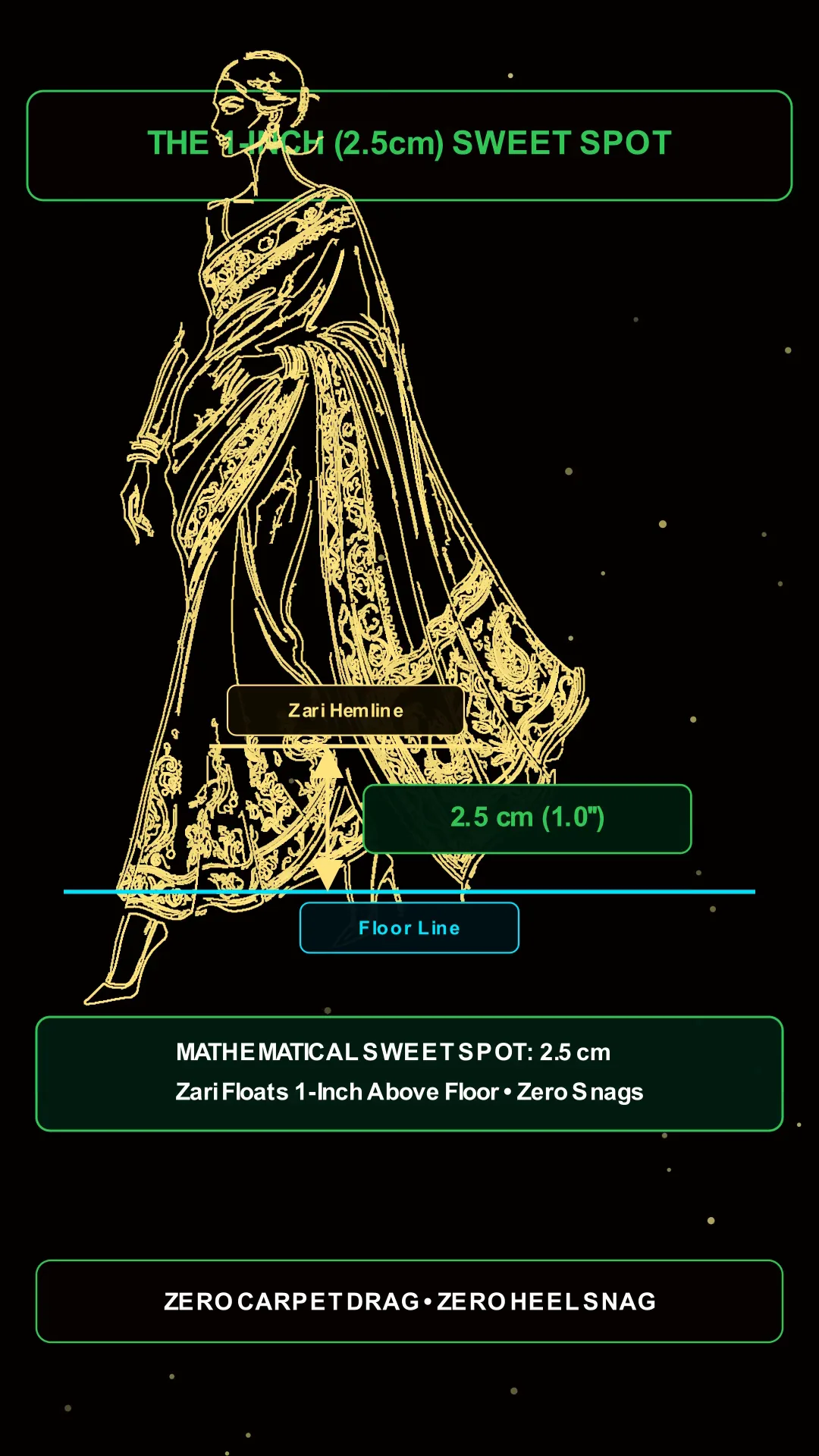
The Two Critical Hazards of Incorrect Hem Height:
| Drape Height | The Mechanical Hazard | The Visual Consequence |
|---|---|---|
| Too Low (0 to 0.5 cm) | Hemline sweeps dirty banquet carpets, picks up dust, and gets trapped under stiletto heel studs during forward strides. | Fabric bunching, frayed zari weft, constant tripping hazard. |
| Too High (> 4.0 cm) | Hemline floats too high above the ankles, exposing petticoat hems, ankles, and footwear hardware. | Disrupts vertical visual line; makes the wearer appear shorter. |
| The Sweet Spot (2.5 cm / 1.0 Inch) | Zari hem floats effortlessly 1 inch above the marble floor. Zero ground friction, zero heel catch, complete fluid motion. | Elongates the body into an unbroken, statuesque 10-foot column. |
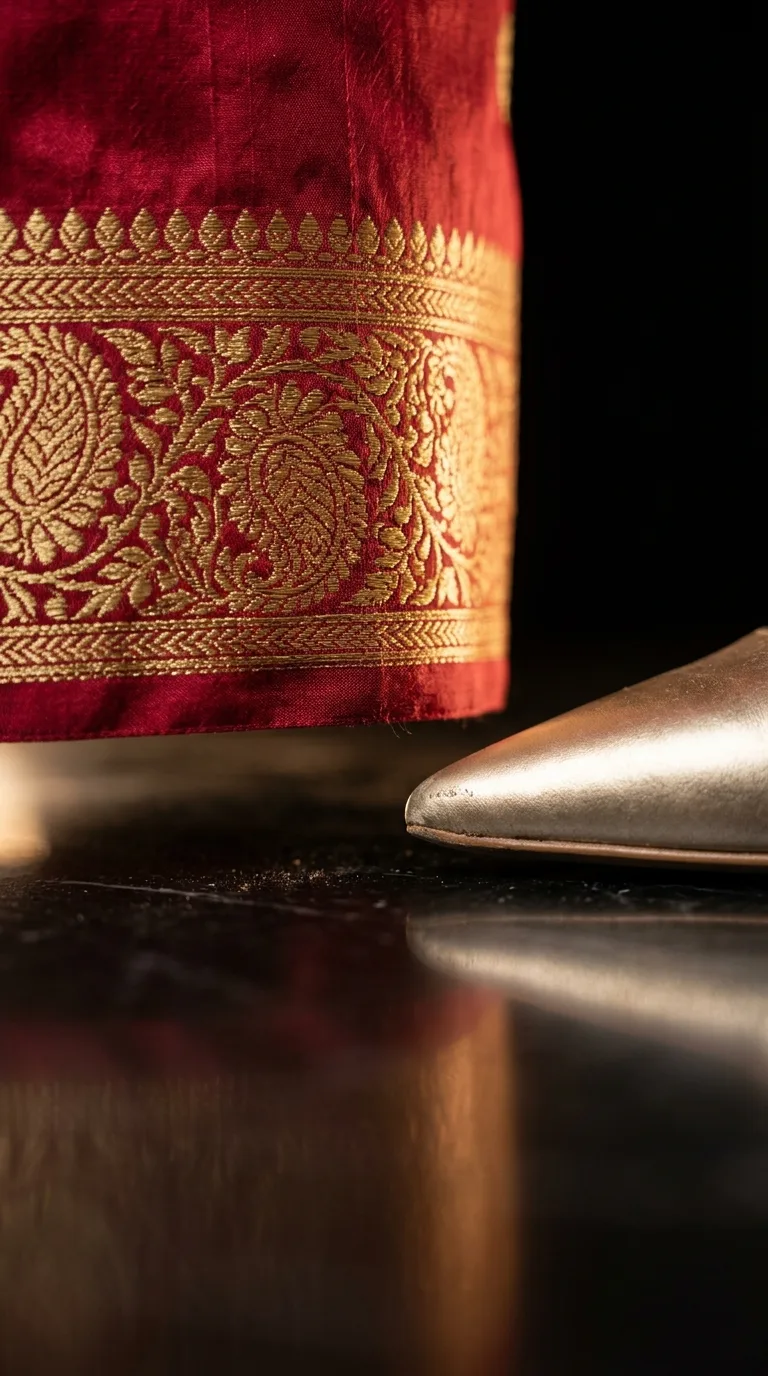
When a rich Pure Silk Katan Saree or heavy bridal weave floats exactly 1 inch above the floor, the bottom border maintains a crisp, uninterrupted horizontal baseline as you walk. The fabric sways freely without dragging, preserving the pure silver and gold zari leafing from abrasion.
3. The 5-Step Master Protocol: Draping With Heels
To achieve a flawless, magazine-cover silhouette that holds its tension from morning rituals to late-night receptions, follow this exact sequence:
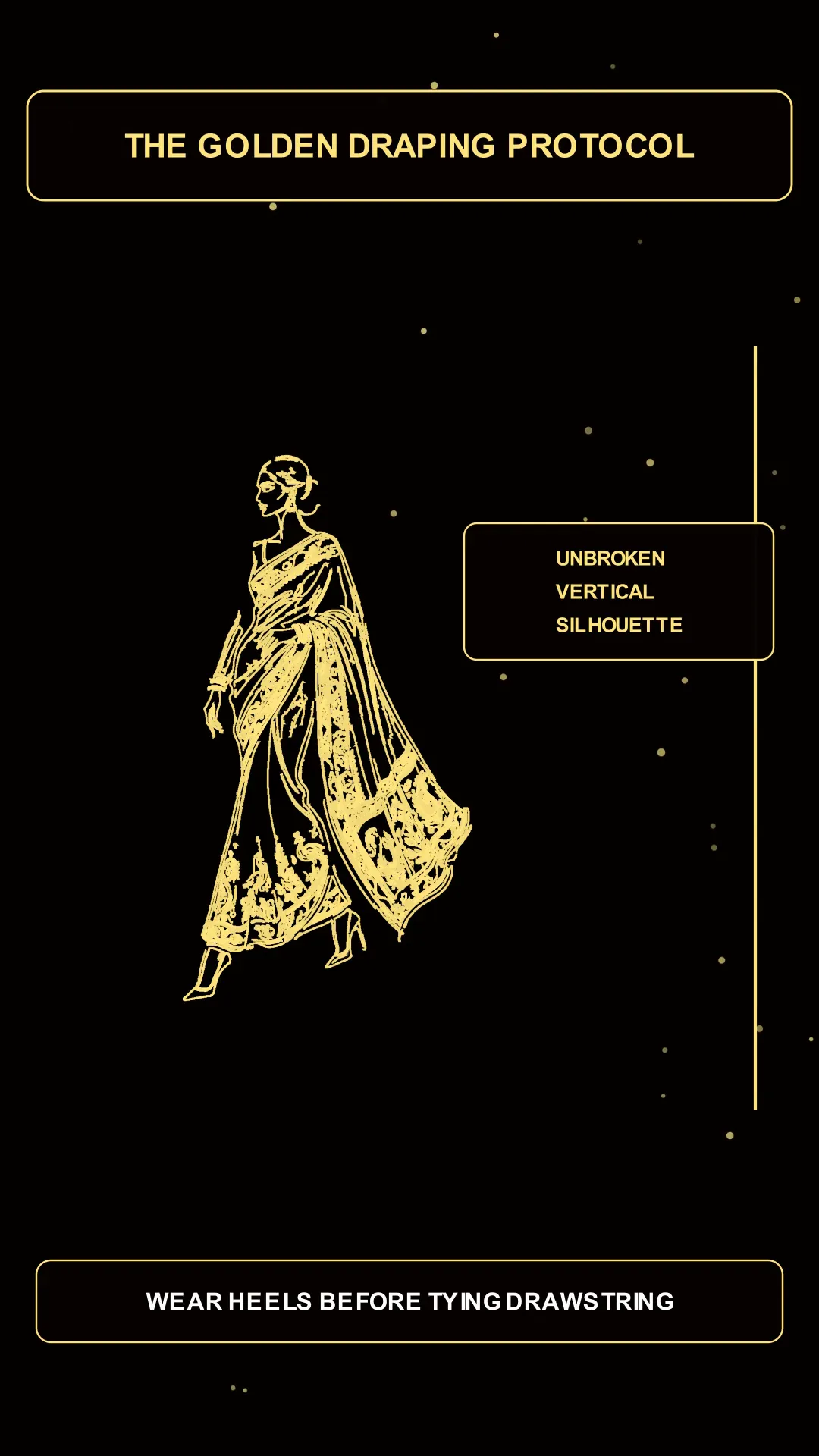
Step 1: Wear Your Exact Event Footwear First
Before unwrapping your saree or tying a single knot, put on the exact pair of shoes you intend to wear at the event.
- Do not practice in sneakers or flats if you plan to wear 3-inch heels.
- If your event shoes are delicate satin or embellished, stand on a clean towel or rug while draping.
Step 2: Anchor the Petticoat at the Adjusted Pelvic Height
With your heels on, stand with your natural posture. Tie the petticoat drawstring tightly around your waist.
- Position the knot slightly off-center (to the left of your navel) so it does not add bulk underneath your center pleats.
- Ensure the waistband is level across your front and back—it should sit securely above your hip bones.
Step 3: Calibrate the Basic Tuck with the 1-Inch Rule
Take the non-pallu end of your saree and begin the basic tuck from the right side, wrapping it around your waist.
- As you tuck, check that the bottom border floats consistently 1 inch above the floor at all four quadrants: right side, back, left side, and front.
- Walk two steps forward in your heels to verify that the hemline does not drag against your toes or heels.
Step 4: Form and Anchor the Center Pleats
Gather your front pleats (5 to 7 pleats, each 4 to 5 inches wide for structured silks like Banarasi Katan).
- Lift the pleat bundle and tuck it into the petticoat waistband.
- Because you are already standing at your full heel elevation, the pleats will settle into their natural gravitational cascade with zero upward tension.
- Secure the inner pleat bundle to the petticoat with a seamless bulb pin fitted with a pearl buffer to prevent fabric tearing. (Learn how in our Saree Pinning Protection Guide).
Step 5: Draft the Pallu for Proportional Balance
Drape the pallu over your left shoulder:
- For an open floating pallu, let the border reach mid-calf (approx. 7 inches below the knee).
- For a pleated pallu, ensure the pleats sit neatly behind the shoulder seam, allowing the rich jaal to cascade down your back.
4. Footwear Pairing Guide for Luxury Handlooms
Not all heels interact with sarees in the same way. Match your footwear architecture to your saree's weight and fabric drape:
| Footwear Type | Best Suited For | Draping Notes & Precautions |
|---|---|---|
| Block Heels (2.5 – 3.5 in) | Heavy Bridal Banarasi, Kadhua Silks (1+ kg) | Best Overall: Broad base provides exceptional stability under heavy silk weight. Zero risk of heel sinking into lawn grass. |
| Stilettos & Pencil Heels | Lightweight Georgette, Organza, Tanchoi | High Precision: Ensure the 1-inch clearance is strictly maintained to prevent sharp pointed heels from piercing sheer pleats. |
| Platform Wedges | Destination Weddings, Sangeet & Dancing | Comfort Choice: Provides continuous height without excessive arch fatigue. Drape hemline at 1.25 inches to accommodate the wider toe box. |
| Embellished Juttis / Mojaris (Flats) | Mehendi, Casual Handloom Cottons | Ground-Level Calibration: Must be draped barefoot or wearing the flats. Drape hemline at 0.75 inches above the floor. |
5. What To Do If You Must Switch From Heels to Flats Mid-Event
It is common for brides and wedding guests to wear high heels for the formal ceremony and switch to comfortable flats for dancing. If you anticipate changing footwear:
- The 1.25-Inch Compromise: When draping in your heels, set your hem clearance to 1.25 to 1.5 inches instead of 1.0 inch. When you step down into flats, the saree will lower by 2 inches, skimming the floor gracefully rather than dragging heavily.
- The Waistband Roll Technique: If you draped strictly for 3-inch heels and switch to flat juttis, your hem will drag on the ground. Simply make a single neat roll of the petticoat waistband upward at your waist to raise the entire saree by 1.5 to 2 inches in seconds.
- Carry Platform Wedges as Backup: Instead of dropping all the way down to flat shoes, carry a lightweight 2-inch platform slide or wedge. This keeps your height drop minimal ($le 1 ext{ inch}$), keeping your pleats immaculate.
Final Thoughts: Engineering Royal Grace
A handloom Banarasi silk saree is a timeless masterpiece of Indian textile heritage. Every zari motif is woven with centuries of artistry.
By mastering the simple sequence of wearing your heels first and anchoring your hem to the 1-inch clearance rule, you transform five yards of unstitched silk into a sculpted, statuesque silhouette that radiates effortless majesty.
Explore our curated collection of authentic, hand-woven Pure Katan Silk Sarees, Tanchoi Weaves, and bridal heirlooms directly from the master artisans of Varanasi at Shri Geeta Sarees.
Frequently Asked Questions (FAQs)
Why does my petticoat peek out from under my saree pleats when I wear heels?
This occurs when the saree was draped barefoot. When you put on heels, the outer saree pleats lift upward, but the heavier inner petticoat may stay lower or sag, exposing the underside. Wearing your heels first ensures both petticoat and saree are tucked at the exact same elevated baseline.
Can I wear a saree with kitten heels (1.5 inches)?
Yes. Kitten heels offer a subtle, elegant lift that improves posture without causing extreme pelvic tilt. Follow the same rule: put on the kitten heels before tucking the basic wrap and setting your 1-inch floor clearance.
How do I prevent my heel from tearing the saree while walking?
Maintain the 1-inch floor clearance, and ensure you kick your feet slightly forward as you walk rather than stepping straight down into the pleat fold. This gentle forward motion pushes the gathered pleats outward, keeping them clear of your shoe tips.
Continue Reading

How One Banarasi Saree Can Create 4 Completely Different Looks
A beautiful Banarasi silk saree is one of the most versatile pieces in your wardrobe. Discover how to create four stunning looks just by changing your jewellery.
4 Elegant Ways to Drape a Banarasi Saree | Shri Geeta Sarees
Looking for new ways to wear your handwoven Banarasi saree? Discover 4 elegant and easy styling methods, from classic traditional to modern reception drapes.
Banarasi Saree for Mother of the Bride: A Guide to Getting It Right
A comprehensive guide to choosing the perfect Banarasi saree for the mother of the bride, covering colors, weaves, and styling advice.
Types of Banarasi Silk: Katan, Georgette, Organza & Tissue Explained
Confused by Banarasi saree fabrics? A Varanasi weaver explains the exact difference in drape, weight, and styling for Katan, Georgette, Organza, and Tissue silk.