
The Physics of Saree Pinning: Why Standard Safety Pins Damage Silk (And Master Stylist Hacks to Prevent Tears)
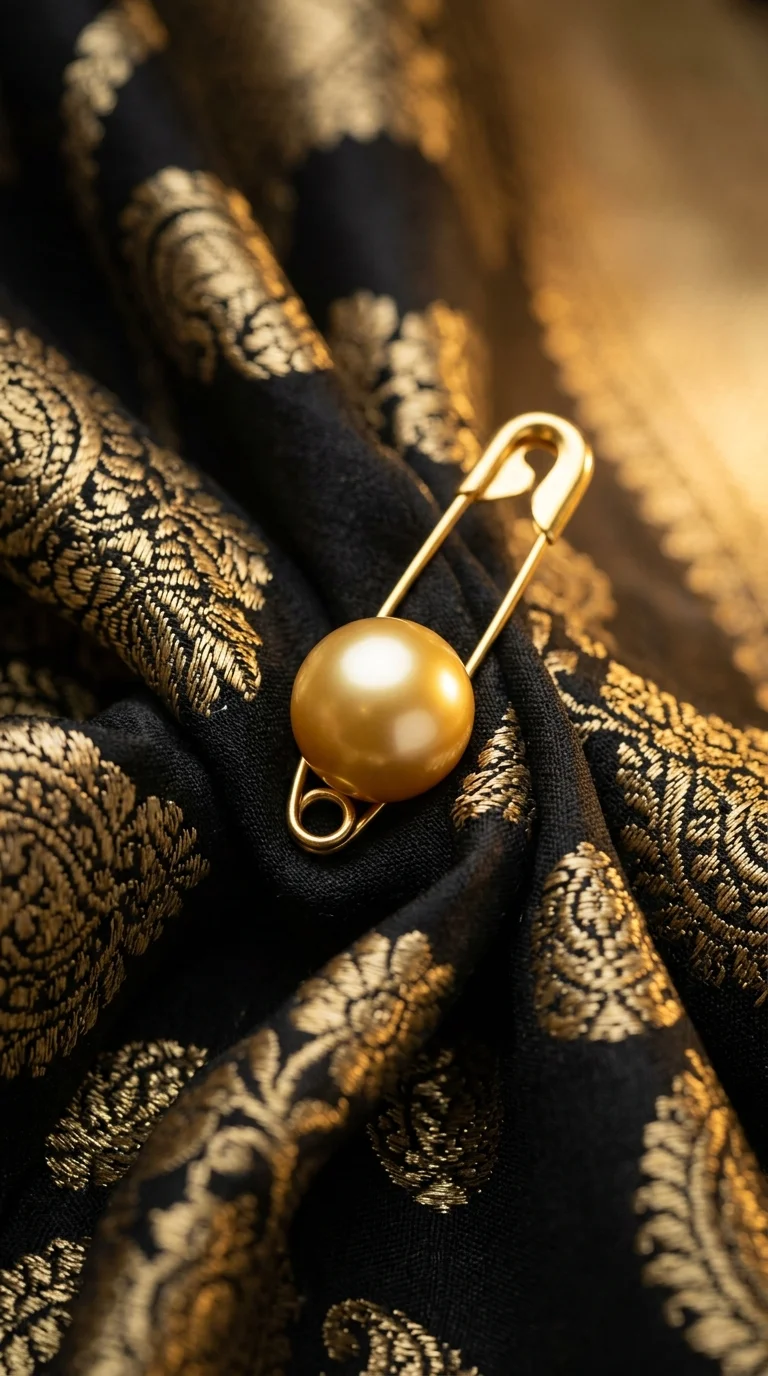
There is a quiet, collective heartbreak that every saree connoisseur has experienced. You return home from a wedding, unpin your cherished handloom Banarasi silk saree, and notice a small, frayed puncture hole right at the shoulder or waist pleats. In worse cases, a cluster of fine warp filaments has been severed, creating an irreparable ladder in the weave.
Most women blame themselves, assuming they pinned too aggressively or pulled the drape too tight.
However, textile engineers and master drapers know the truth: the fault lies in the mechanical design of standard safety pins.
When pure silk meets standard metal hardware under the natural gravitational weight of a draped saree, a specific form of mechanical shear occurs. Here is the textile science behind why safety pins ruin pure silk, and the foolproof styling techniques celebrity drapers use to guarantee zero fabric tears.
1. The Textile Science: Why Pure Silk is Uniquely Vulnerable
To understand why safety pins cause such severe damage, we must examine the microscopic structure of handloom silk.
An authentic Pure Katan Silk Banarasi Saree is woven using 2-ply twisted mulberry silk yarns. Each individual filament consists of twin fibroin protein cores. While silk has immense tensile strength along its length, it is remarkably delicate when subjected to lateral friction or localized shear stress.
When you drape a heavy Banarasi saree—especially one woven with dense 24K gold zari or rich brocade—the gathered pleats exert a continuous downward gravitational load of 800 to 1,500 grams (0.8–1.5 kg).
When this entire downward load is concentrated onto the narrow 0.7 mm shaft of a steel pin, the localized pressure on the silk filaments exceeds their shear threshold.
2. Anatomy of the Hazard: The "Coil Guillotine"
A standard safety pin is composed of four distinct anatomical parts:
- The Sharp Needle Tip (designed to pierce fabric)
- The Front Shaft (where fabric rests)
- The Top Clasp Head (which locks the needle)
- The Bottom Wire Coil (the circular spring loop that provides opening tension)
The primary culprit behind 95% of torn silk sarees is Part 4: The Bottom Circular Wire Coil.
How the Trap Happens in Real Time:
- The Motion: As you walk, dance, or sit during an event, your body movements create dynamic cyclic tension.
- The Shift: The downward pull of gravity drags the gathered silk bundle downward along the pin shaft toward the hinge.
- The Entrapment: The fine silk warp filaments slide directly into the tight V-notch between the needle and the circular wire loop.
- The Guillotine Effect: The sharp, stamped metal edges of the coil act like micro-shears. Under the weight of the pleats, the trapped threads are pinched and severed one by one.
When you attempt to unpin the saree at the end of the evening, the trapped threads are violently yanked against the metal coil, leaving behind a frayed hole.
3. The 3 Master Stylist Hacks to Protect Your Saree
Celebrity saree drapers who dress brides in bespoke heirlooms never use a bare standard safety pin directly on pure silk. Instead, they rely on three simple, field-tested physical buffers:
Hack #1: The Pearl / Bead Buffer (The 2-Second Fix)
The simplest and most elegant solution is to add a mechanical barrier between the silk and the pin coil.
- How It Works: Before pinning your saree, slide a small 4 mm–6 mm smooth plastic or faux-pearl bead onto the needle shaft, pushing it all the way down until it rests against the base coil.
- Why It Works: The round circumference of the pearl completely covers and seals the entrance to the dangerous wire coil loop. When downward gravity pulls your silk pleats, the threads hit the wide, polished curve of the pearl and cannot physically enter the coil notch.
- Bonus: A gold or cream pearl looks like deliberate jewelry embellishment rather than an unsightly safety pin!
Hack #2: Switch to Seamless Bulb / Gourd Pins
If you frequently wear handloom sarees, replace standard safety pins in your vanity kit with Bulb Pins (also known as Calabash or Gourd Pins).
- The Design Difference: Unlike traditional safety pins, bulb pins are manufactured without a coiled spring loop at the base. Instead, they feature a smooth, continuous teardrop curve.
- The Benefit: Because there is no sharp notch or wire junction, silk filaments glide freely across the base with zero pinch points.
Hack #3: The Blouse Interfacing Anchor (Load Distribution)
Never pin a heavy saree pallu solely through single-layer sheer silk.
- The Technique: Always catch the inner lining fabric of your blouse or the sturdy shoulder seam tape when pinning.
- The Mechanics: The multi-layered woven cotton or canvas lining of your blouse absorbs 80% of the gravitational pull, relieving tensile stress on the delicate outer silk fibers.
4. Golden Rules of Saree Pinning: Where to Pin & Where NEVER to Pin
| Saree Zone | Can You Pin Here? | Recommended Technique |
|---|---|---|
| Shoulder Pleats (Pallu) | ✅ YES | Pin vertically behind the shoulder seam. Use a pearl buffer and catch the blouse lining. |
| Waist Pleats (Center) | ✅ YES | Pin horizontally inside the pleat bundle from behind, using a bulb pin. |
| Single Floating Pallu | ⚠️ CAUTION | Pin only to the blouse shoulder seam; never pin the free-flowing body of the drape. |
| Zari Border Jaal | ❌ NEVER | Never pierce directly through heavy metallic zari threadwork; pin through plain silk margins instead. |
5. Emergency Care: What to Do If a Pin Snags Your Silk
If you unpin your saree and notice a snagged or pulled thread:
- DO NOT CUT THE THREAD: Cutting a pulled float thread will create a permanent hole that will unravel when dry-cleaned.
- Gently Massage the Weave: Lay the saree flat on a smooth table. Using the pads of your thumbs, gently stretch the fabric diagonally in cross-directions. In many handloom weaves, the shifted thread will naturally settle back into its warp-weft alignment.
- Use a Fine Needle to Tease: If a small loop remains visible on the right side of the saree, use a blunt embroidery needle to gently pull the loop through to the reverse side of the fabric.
- Steam Lightly: A gentle pass of vertical garment steam relaxes the mulberry silk proteins, closing up minor needle punctures.
To learn more about preserving your precious investments, read our comprehensive guide on How to Properly Care for and Store Banarasi Silk Sarees.
Final Thoughts: Preserve the Heirloom
A genuine Varanasi handloom saree takes weeks of meticulous artisan labor to weave. Every thread represents centuries of mathematical precision and cultural heritage.
By taking two seconds to slip a pearl buffer onto your pin or switching to seamless bulb pins, you ensure that your treasured handloom remains flawless—ready to be passed down through generations.
Explore our curated collection of authentic, heirloom-grade Pure Katan Silk Sarees at Shri Geeta Sarees, woven directly on traditional wooden handlooms in Varanasi.
Frequently Asked Questions (FAQs)
Why do safety pins leave black marks or rust stains on silk?
Standard steel safety pins can oxidize when exposed to body sweat, humidity, or perfume, transferring iron oxide (rust) onto the silk fibers. Always use stainless steel, brass, or gold-plated rustproof pins.
Can I use double-sided fashion tape instead of pins?
Fashion tape is excellent for holding lightweight silks or dupattas against the skin. However, for heavy Banarasi bridal sarees (1+ kg), tape lacks the shear strength needed to hold structured pleats and can leave sticky adhesive residue on delicate zari. Use bulb pins with pearl buffers instead.
Are magnetic saree brooches safe for silk sarees?
High-strength neodymium magnetic clasps are 100% puncture-free and safe for holding lightweight to medium sarees. However, test the magnetic hold before an event to ensure it can support the weight of heavy multi-layered pleats without slipping.
Continue Reading
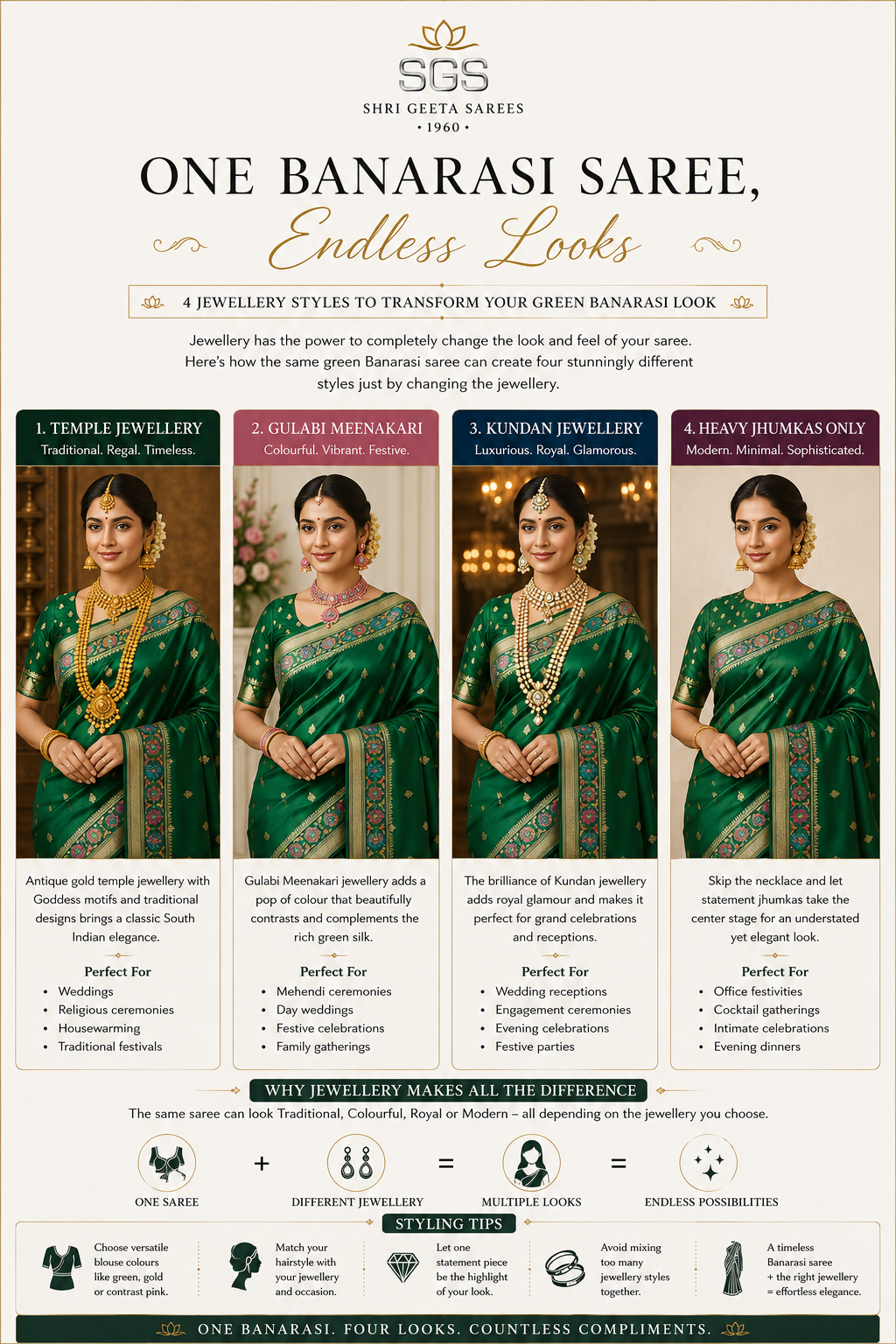
How One Banarasi Saree Can Create 4 Completely Different Looks
A beautiful Banarasi silk saree is one of the most versatile pieces in your wardrobe. Discover how to create four stunning looks just by changing your jewellery.
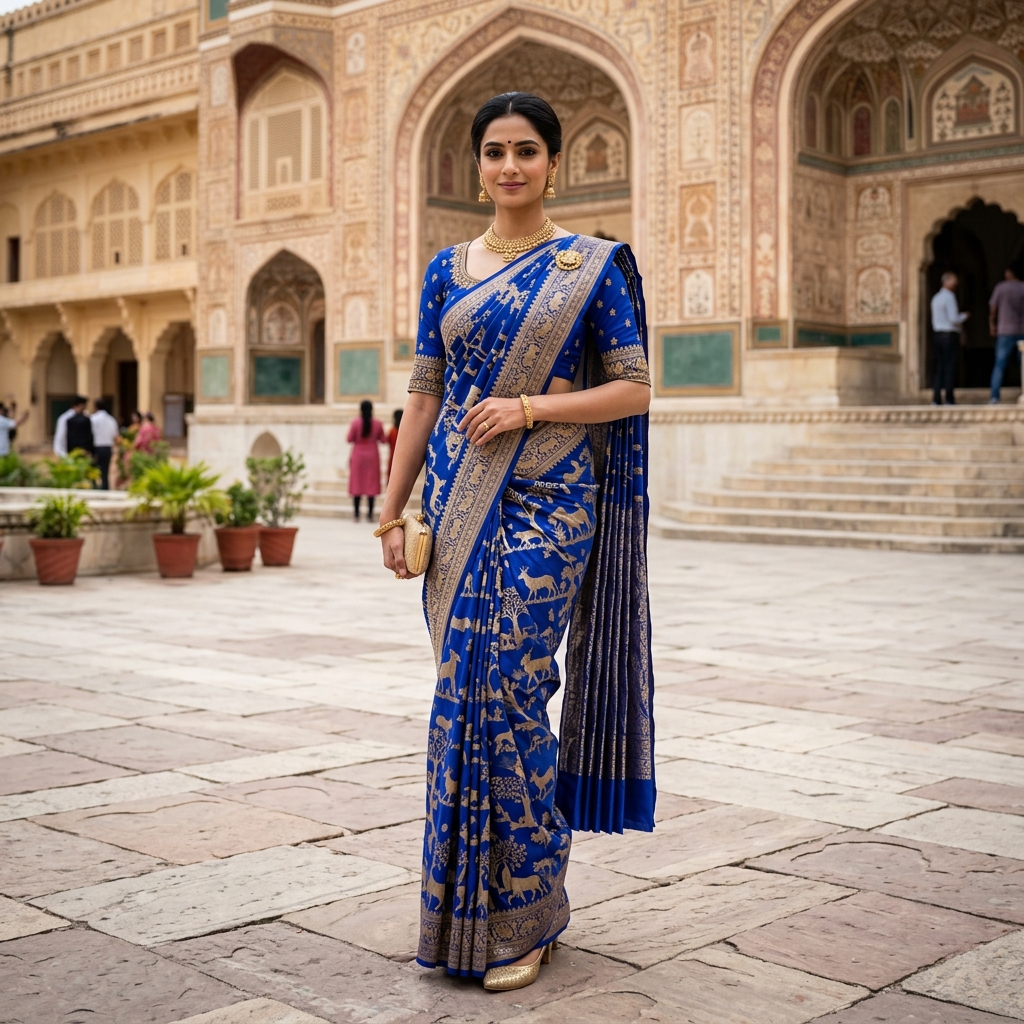
4 Elegant Ways to Drape a Banarasi Saree | Shri Geeta Sarees
Looking for new ways to wear your handwoven Banarasi saree? Discover 4 elegant and easy styling methods, from classic traditional to modern reception drapes.
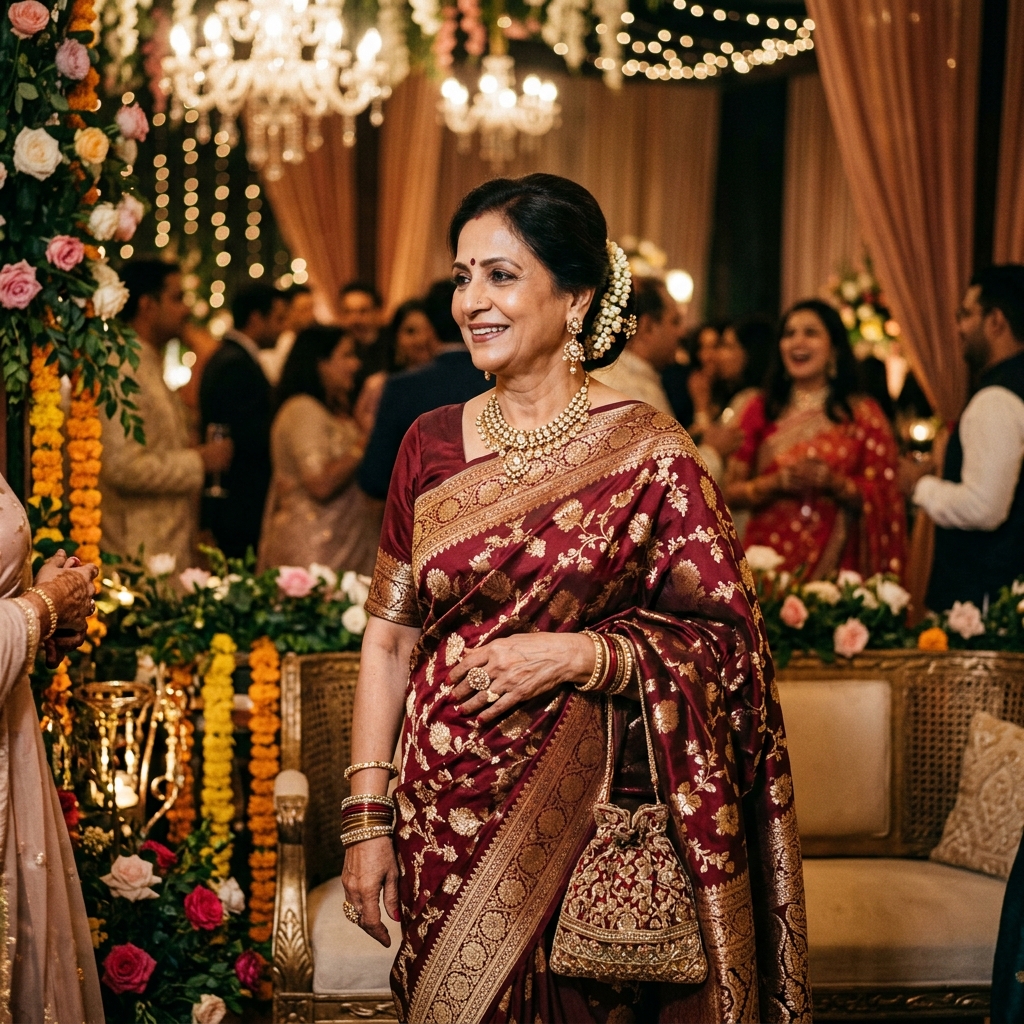
Banarasi Saree for Mother of the Bride: A Guide to Getting It Right
A comprehensive guide to choosing the perfect Banarasi saree for the mother of the bride, covering colors, weaves, and styling advice.
Types of Banarasi Silk: Katan, Georgette, Organza & Tissue Explained
Confused by Banarasi saree fabrics? A Varanasi weaver explains the exact difference in drape, weight, and styling for Katan, Georgette, Organza, and Tissue silk.