Anatomy of a Banarasi Pallu: The 400-Year Architectural Secret of the Konia Corner
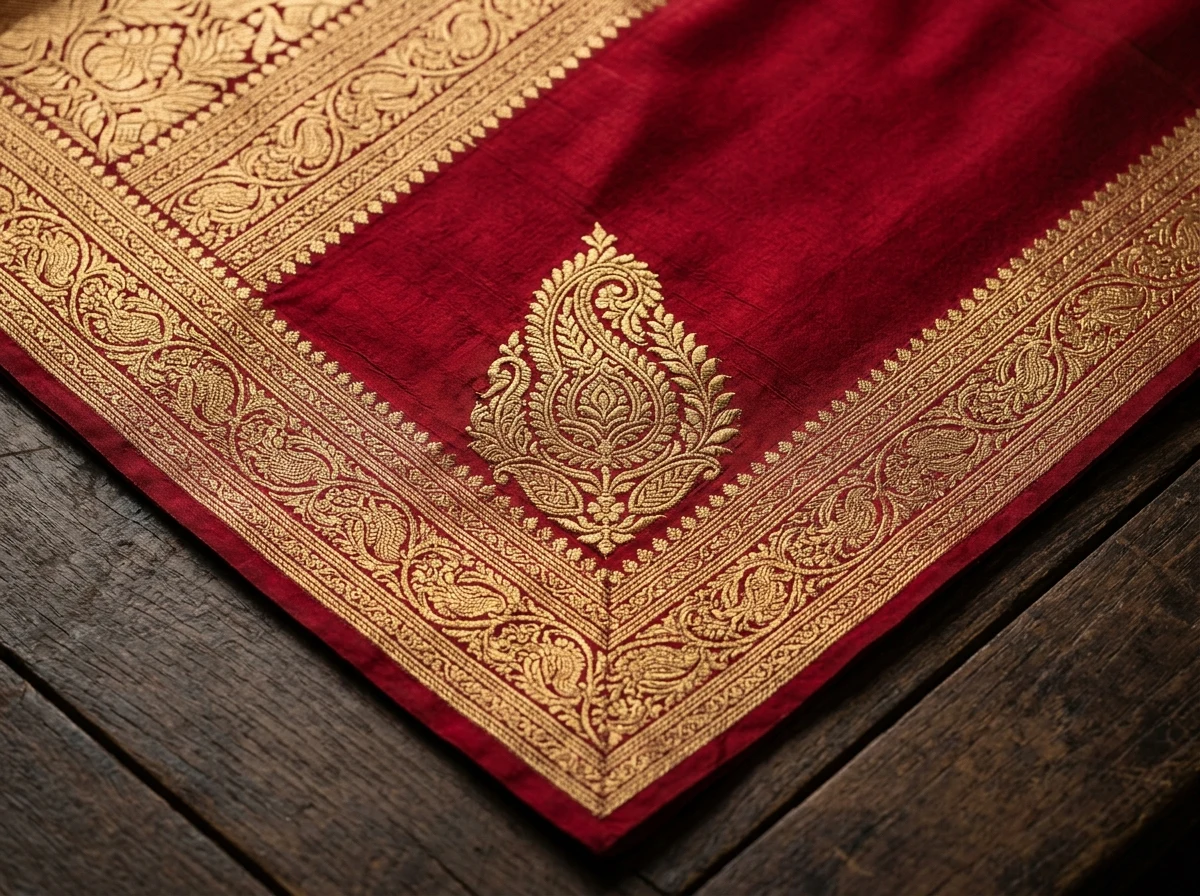
Next time you drape an authentic Pure Katan Silk Banarasi Saree, turn your attention away from the grand center of the pallu and look closely at the corner.
Right where the running horizontal border (Kinara) meets the dense, gold-encrusted end-piece (Aanchal), you will almost always find a solitary, majestic paisley or mango motif angled inward into the body field.
It is not placed there at random. It is not an afterthought, nor is it merely decorative filler.
In the sacred textile lexicon of Varanasi handloom, this solitary corner piece is called the Konia (कोनिया)—derived from the Hindi word Kona (कोना), meaning corner.
For more than four centuries, master weavers in Varanasi have considered the Konia the ultimate litmus test of a weaver's mathematical mastery and structural draftsmanship.
Here is the untold 400-year architectural secret behind why the Banarasi pallu has a corner motif, the mathematical geometry that governs its curve, and the exact physical test to verify if your saree features an authentic handloom Kadhwa Konia.
1. The Textile Dilemma: The 90-Degree Inner Corner Void
To understand why the Konia was invented, one must first look at a saree through the eyes of an architect.
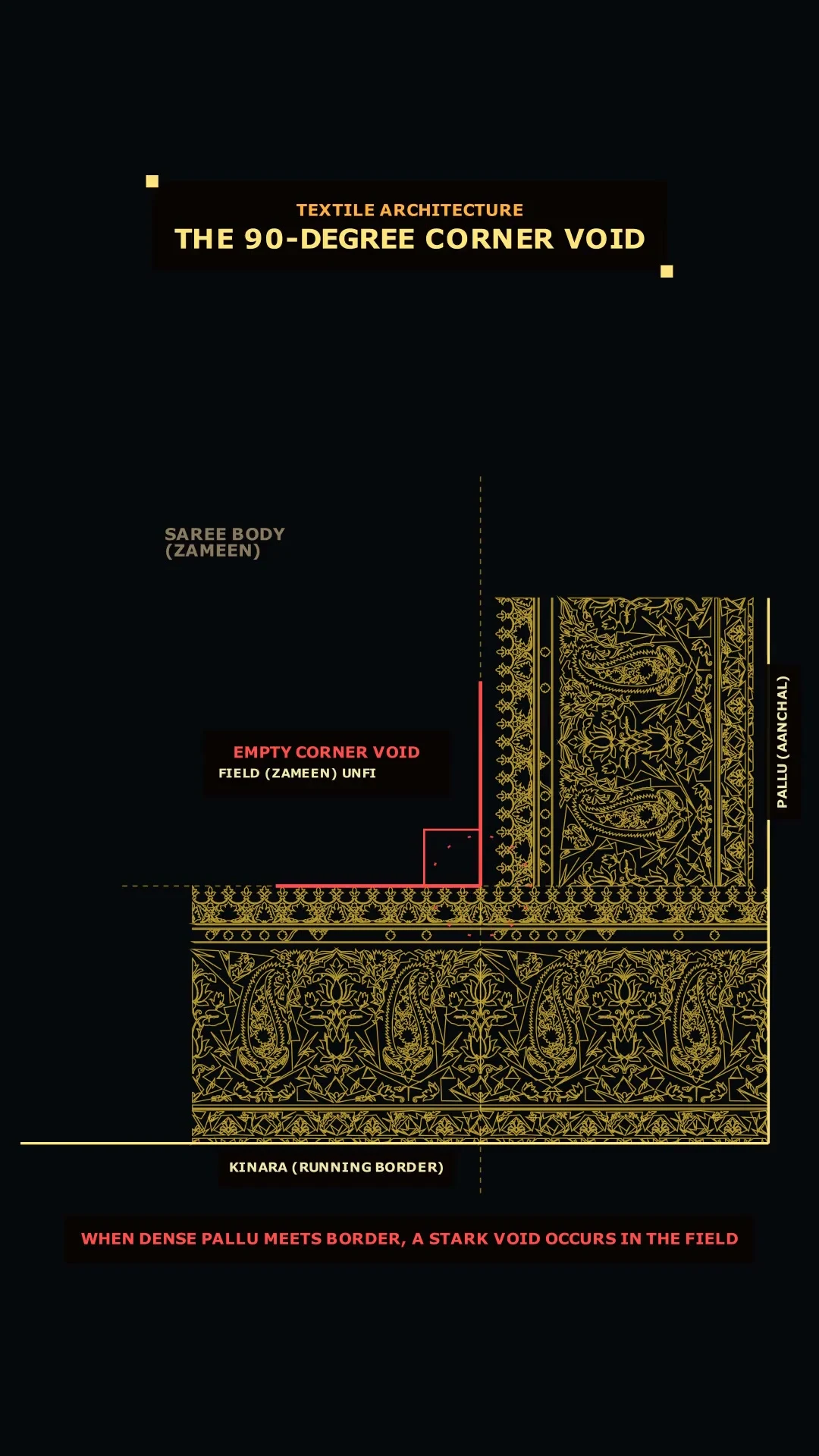
A saree is a massive rectangular canvas—measuring roughly 5.5 meters in length by 1.15 meters in width. Architecturally, it consists of three distinct zones:
- The Kinara (किनारा): The running longitudinal border that frames the top and bottom edges of the saree.
- The Pallu or Aanchal (आंचल): The grand cross-border at the end of the saree, woven with intense density using real metallic zari threads to give it weight and drape.
- The Zameen (ज़मीन): The body or field of the saree, which is either open monochrome silk or sprinkled with delicate, lightweight motifs (butis).
Along the outer perimeter of the fabric, the running border and the pallu meet seamlessly to form a solid, unbroken rectangular hemline. There is never an outer gap in the fabric.
However, an acute aesthetic crisis occurs on the inside:
When the heavy, broad running border meets the colossal, dense pallu border, their inner boundaries form a rigid, unyielding 90-degree right angle that cuts abruptly into the delicate silk field (Zameen).
In textile design, this is known as an aesthetic shear:
- To the right and bottom, the eye encounters millions of interwoven $24\text{K}$ gold zari threads forming an impenetrable, glittering wall of brocade.
- Directly adjacent, inside the corner of the Zameen, the fabric suddenly drops into sheer, lightweight mulberry silk.
Without an artistic mediator, this junction looks harsh, severed, and unfinished—like a palace hall where carved stone walls end abruptly against an unpainted brick partition.
The master weavers of Varanasi needed an element that could mediate this massive contrast in visual weight.
2. From Mughal Squinches to Varanasi Looms: The 400-Year Origin
During the late 16th and early 17th centuries, the royal workshops of Varanasi flourished under Mughal patronage. Artisans, architects, calligraphers, and master weavers lived and worked in close proximity, constantly exchanging mathematical and decorative doctrines.
In Islamic and Mughal architecture, architects faced a notorious engineering dilemma: how to place a circular dome on top of a square room.
To solve this, architects constructed squinches and spandrels—triangular or arched vaulted transitions built across the four corners of a square room to soften the $90^\circ$ angles and distribute the downward thrust of the dome.
Arched corner squinches and spandrels were engineered to bridge the 90° masonry gap and distribute the downward thrust of the dome.
The Konia corner spandrel was invented to mediate the visual and structural tension between dense metallic borders and delicate field silk.
Varanasi’s master weavers translated this exact architectural principle onto the handloom.
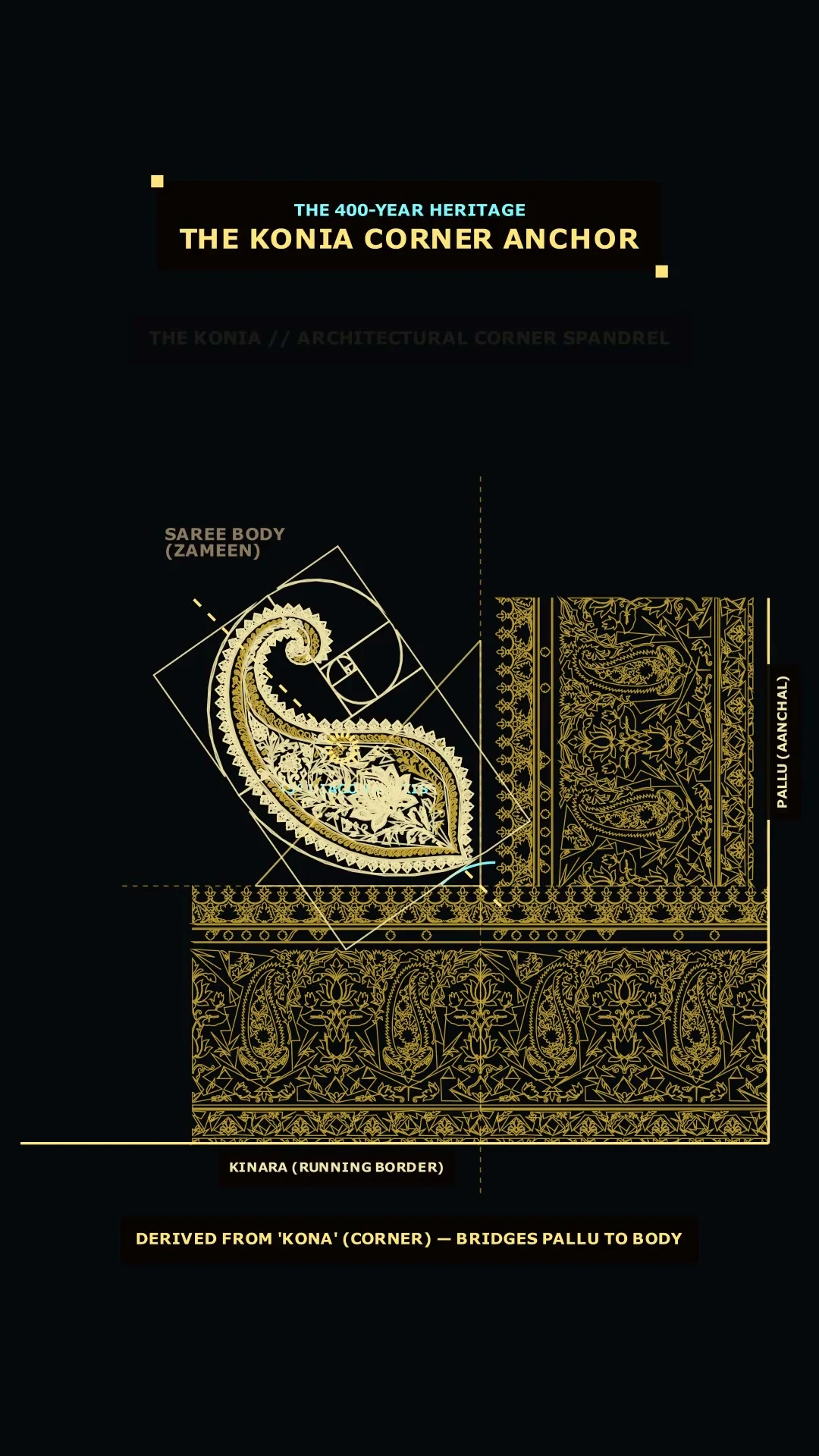
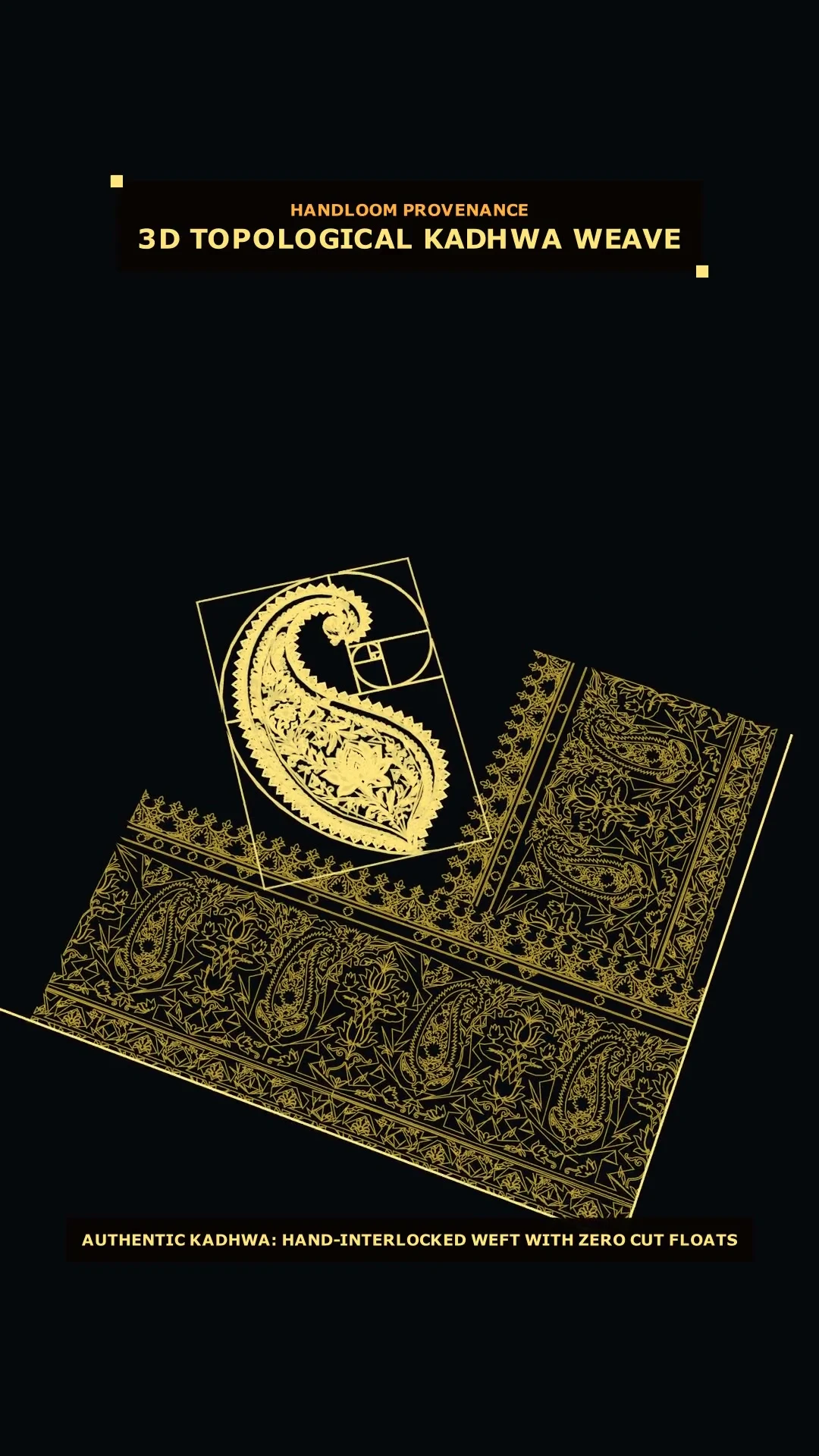
They designed the Konia to act as a textile corner spandrel. Nestled directly into the inside $90^\circ$ corner of the Zameen, its broad base anchors against the intersection of the two borders, while its elegant, tapered tip arcs inward at a $45^\circ$ diagonal, effortlessly guiding the viewer’s eye from the colossal weight of the pallu into the serene fluidity of the body.
3. The Sacred Mathematics: The Logarithmic Spiral of the Kalka
The shape of a Konia is almost universally a variation of the Kalka (कालका)—the teardrop-shaped paisley or raw mango motif that has symbolized fertility, abundance, and auspicious life in India for over a millennium.
Yet beneath its romantic floral surface lies rigorous mathematical geometry.
The Diagonal Axis of Balance
The Konia does not lie parallel to either the running border or the cross-pallu. Instead, its central axis of symmetry bisects the $90^\circ$ right angle at precisely $45^\circ$:
- This diagonal trajectory generates an optical vector of movement, drawing the eye toward the center of the saree when draped over the shoulder.
- The outer contour of the paisley follows a logarithmic spiral—the same golden ratio curve ($\phi \approx 1.618$) found in nautilus shells and galactic spirals.
- As the curve coils tighter toward its ornate crown (turra), the density of the zari work increases, creating a natural focal point of light reflection.
When the saree is draped over the wearer's left arm or pinned across the shoulder in classic Nivi or Seedha Pallu style, the Konia falls directly at the crest of the drape, framing the waist or hip with an architectural jewel that moves dynamically with the wearer’s stride.
4. The Craft Proof: Why a True Konia Must Be Woven in Kadhwa
The existence of a Konia motif is not enough; how it is woven determines whether a saree is an authentic handloom heirloom or a cheap mechanical reproduction.
Because the Konia sits alone in the corner of an otherwise open or butidar field (Zameen), it presents an extraordinary technical hurdle on the loom.
The Powerloom Cutwork Short-Cut (Fehkwa / Cutwork)
On a mechanical powerloom or automated jacquard loom, the shuttle flies continuously from one edge of the 45-inch fabric to the other.
To weave a single 6-inch Konia in the corner, the machine must shoot zari threads across the entire width of the saree. The empty space between the Konia and the opposite border is left with long, floating strands of metallic thread. Later, factory workers use mechanical trimmers to shear these floats off by hand.
The result? The reverse side of the Konia is covered in hundreds of rough, prickly, cut thread ends. Over time, these cut fringes unravel, catch on jewelry, and abrade delicate blouse fabrics.
The Sacred Kadhwa Standard (Discontinuous Weft)
In an authentic handloom Banarasi from Shri Geeta Sarees, the Konia is woven exclusively using the legendary Kadhwa (कढ़वा) technique:
- Discontinuous Extra Weft: The master weaver does not shoot the zari shuttle across the entire warp. Instead, the artisan uses an independent, handheld bamboo spool (tili) specifically for the Konia.
- Hand-Interlocked Anchors: Every individual pick of gold zari is woven exclusively within the boundary of the paisley motif and hand-knotted at the perimeter before reversing direction.
- Zero Floats on the Reverse: Because the metallic thread never travels beyond the outline of the motif, there is not a single floating or cut thread on the underside of the fabric. The back is as smooth, sealed, and tactilely pristine as the front.
Weaving an intricate Konia in pure Kadhwa adds several days of intensive manual labor to a single saree—each row requiring the artisan to count warp threads manually from a graph (Naksha) without mechanical shortcuts.
5. The 10-Second Heirloom Closet Check: How to Spot Fakes
If you own a Banarasi saree in your family collection, you can test its provenance in under ten seconds:
The 10-Second Konia Audit
Flip the inner corner of your pallu upside down and run your fingertips across the reverse side of the motif:
Smooth, Sealed & Engraved
- •Zero loose threads: The reverse side is as flat and smooth as the front silk ground.
- •Individually interlocked: Each zari pick is hand-knotted at the motif perimeter using bamboo spools (tili).
- •Snag-free heirloom: Never scratches the skin or catches onto jewelry.
Hairy, Prickly Cut Fringes
- •Hundreds of cut ends: Sheared metallic threads left by continuous shuttle passes across the width.
- •Prickly abrasive feel: Feels scratchy against skin and abrades delicate blouse fabrics.
- •Vulnerable to unweaving: Loose sheared floats pull and fray over time.
- Step 1: Locate the inner corner of your pallu where the running border meets the end-piece.
- Step 2: Turn the fabric over to examine the reverse side directly behind the Konia.
- Step 3: Run your fingertips across the back:
- If the reverse feels completely flat and silk-smooth with no loose ends, you are holding a museum-grade Kadhwa handloom masterpiece.
- If your fingers snag on hundreds of prickly, sheared thread ends, it is a machine-woven cutwork replica.
6. How to Preserve Pallus with Heavy Konia Brocade
Because the corner of the pallu carries high metallic concentration from the convergence of two borders and the Konia motif, it requires thoughtful preservation:
- Never Use Steel Safety Pins Without Buffers: The weight of a Kadhwa pallu can pull heavily on a single pin point. Always use a pearl-head pin with an archival acid-free buffer to prevent tears, as outlined in our guide on How to Pin a Silk Saree Without Tearing.
- Reverse the Dressing Routine: High-proof alcohol in luxury fragrances dissolves delicate silk dyes and tarnishes electroplated zari. Always follow the 2-Minute Evaporation Rule for Perfumes before draping your pallu.
- Fold Along the Motif Boundaries: Never fold a saree directly across the raised crest of a Konia. Fold along the natural boundary between the border and the Zameen to prevent permanent zari creases, and store in breathable cotton muslin as detailed in our guide on How to Hang and Store Silk Sarees.
Six Decades of Architectural Handloom Heritage
At Shri Geeta Sarees (established in 1960 at Chowk, Varanasi), we have preserved the sacred geometry of the Banarasi loom across three generations. To us, a Konia is not just a motif—it is the physical signature of an artisan who respects the architectural harmony of silk, gold, and proportion.
Every saree in our Pure Katan Silk Archive is woven by master craftspeople using authentic handloom techniques, ensuring that the heirlooms you pass down to your children remain as structurally sound and visually breathtaking as the day they left the loom.
Explore our comprehensive study on What is a Banarasi Saree Motif? A Guide to Buta, Jaal, and Paisley Patterns or visit our flagship showroom in the historic heart of Varanasi.
Frequently Asked Questions (FAQs)
What is a Konia in a Banarasi saree?
A Konia (कोनिया, derived from 'Kona' meaning corner) is an architectural corner motif, traditionally shaped like a curved paisley (kalka/mango), woven specifically at the inner corner where the running longitudinal border (kinara) meets the dense cross-pallu (aanchal). It functions as a visual spandrel, seamlessly bridging the heavy metallic gold brocade with the open silk body field (zameen).
Is there a gap between the borders in a Banarasi saree?
No. The outer borders of a Banarasi saree meet continuously at a 90-degree angle to form a solid, unbroken outer hemline. The "void" is strictly on the inside: when the thick running border and the dense pallu intersect, their inner perimeters leave a stark 90-degree empty corner inside the body field (zameen). The Konia sits nestled on the inside silk ground to fill this void.
Why is an authentic Konia woven only in Kadhwa technique?
Because the Konia sits as an isolated motif in the corner of an otherwise plain or lightly scattered silk field (zameen), weaving it with continuous shuttle passes (cutwork/fehkwa) would leave hundreds of loose, floating threads across the reverse of the saree. In authentic Varanasi handloom Kadhwa, master artisans use individual spools (tili) to interlock each zari weft thread by hand, leaving zero loose cut floats on the reverse side.
How can I check if my Banarasi pallu has an authentic Konia?
Perform the 10-Second Reverse Inspection: Flip the corner of your pallu upside down. If the reverse of the Konia motif is clean, smooth, and seamlessly interlocked into the warp with zero loose fringe threads, it is authentic handloom Kadhwa. If you feel coarse, cut thread fringes or dense hairy floats, it is a machine-made powerloom cutwork copy.
Where did the Konia motif originate historically?
The Konia originated during the late 16th to early 17th century in Varanasi as a textile translation of Indo-Persian and Mughal architecture. Just as Mughal architects used ornate corner squinches and arched spandrels to mediate the sharp transition between square vertical walls and round domes, Banarasi master weavers designed the Konia as a textile spandrel to transition the dense metallic border into the delicate silk body.
Continue Reading
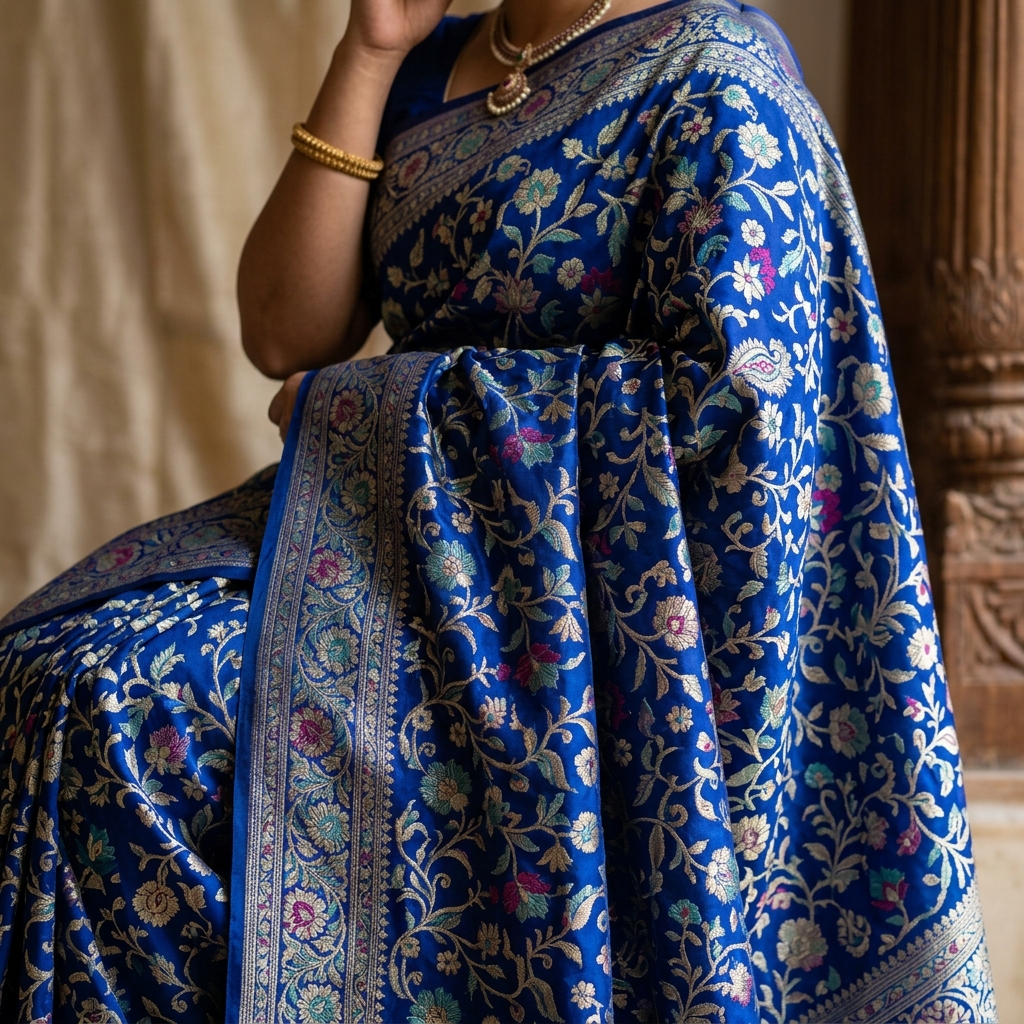
What is Fekwa (Fakua/Cutwork) in Banarasi Sarees?
Learn about Fekwa (or Fakua/Cutwork), an authentic Banarasi weaving technique that creates beautiful floral motifs and jaal patterns. Find out why it's more affordable without compromising quality.
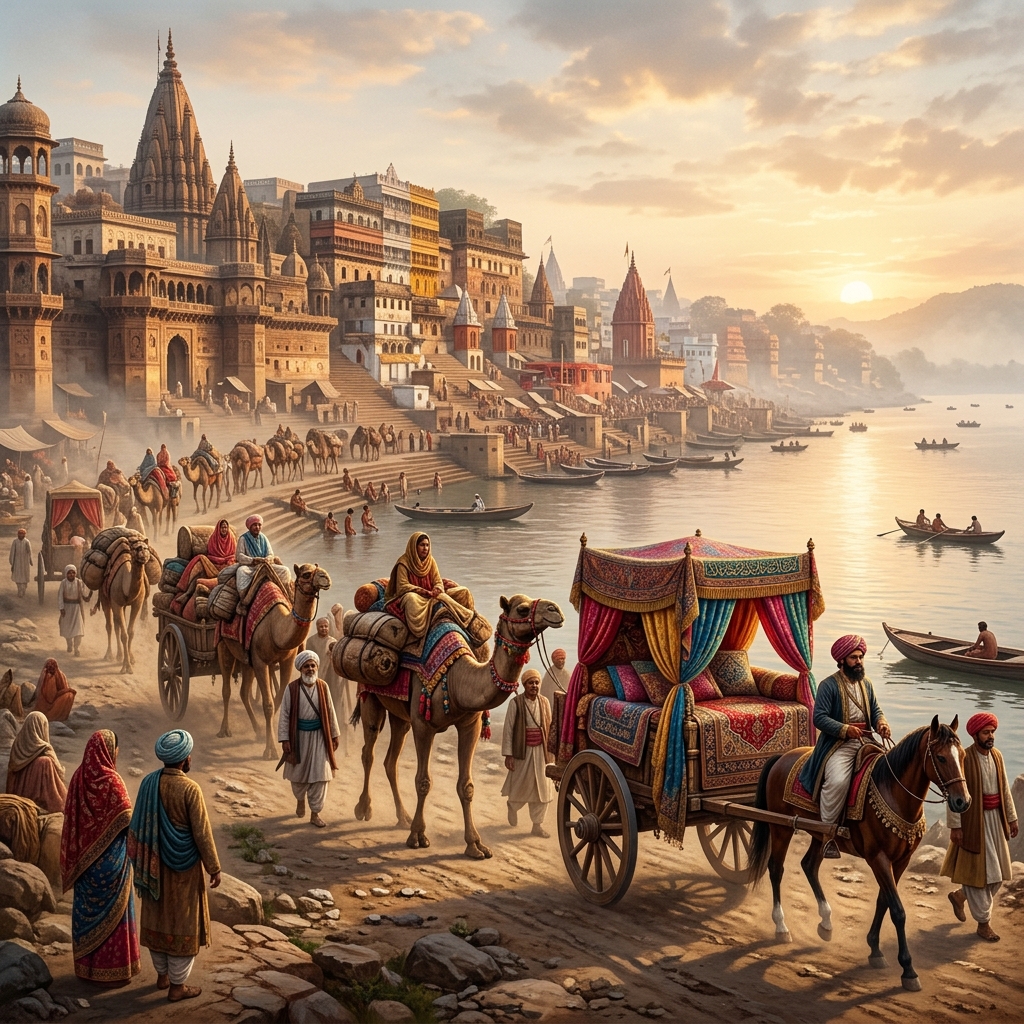
The Silk Route Through Varanasi: History of Banarasi Weaving
Trace the centuries-old journey of silk into Varanasi — from ancient trade routes to Mughal courts to the handloom houses of today.
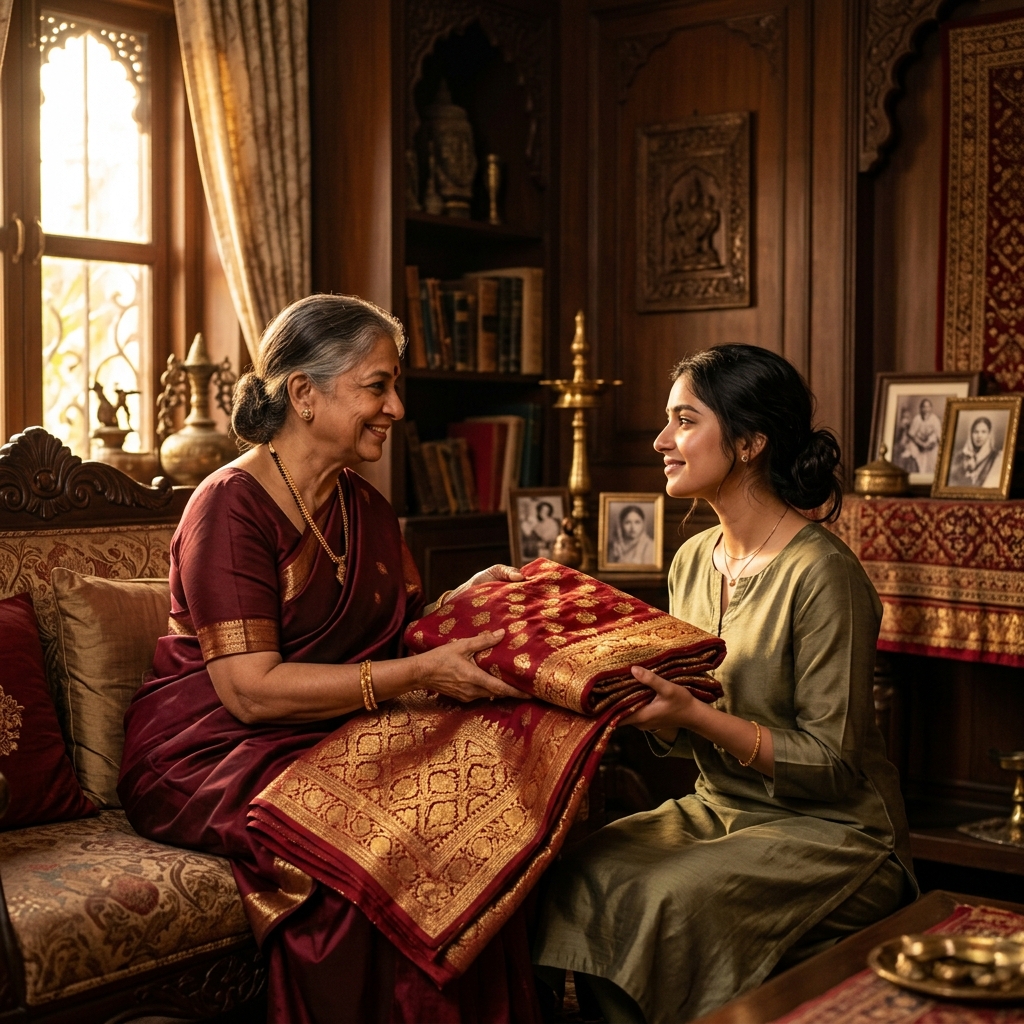
The Banarasi Saree as a Family Legacy: An Heirloom Woven in Silk
Explore the tradition of passing down Banarasi sarees, the craftsmanship that makes them endure, and how to preserve a vintage Banarasi silk saree as a family legacy.
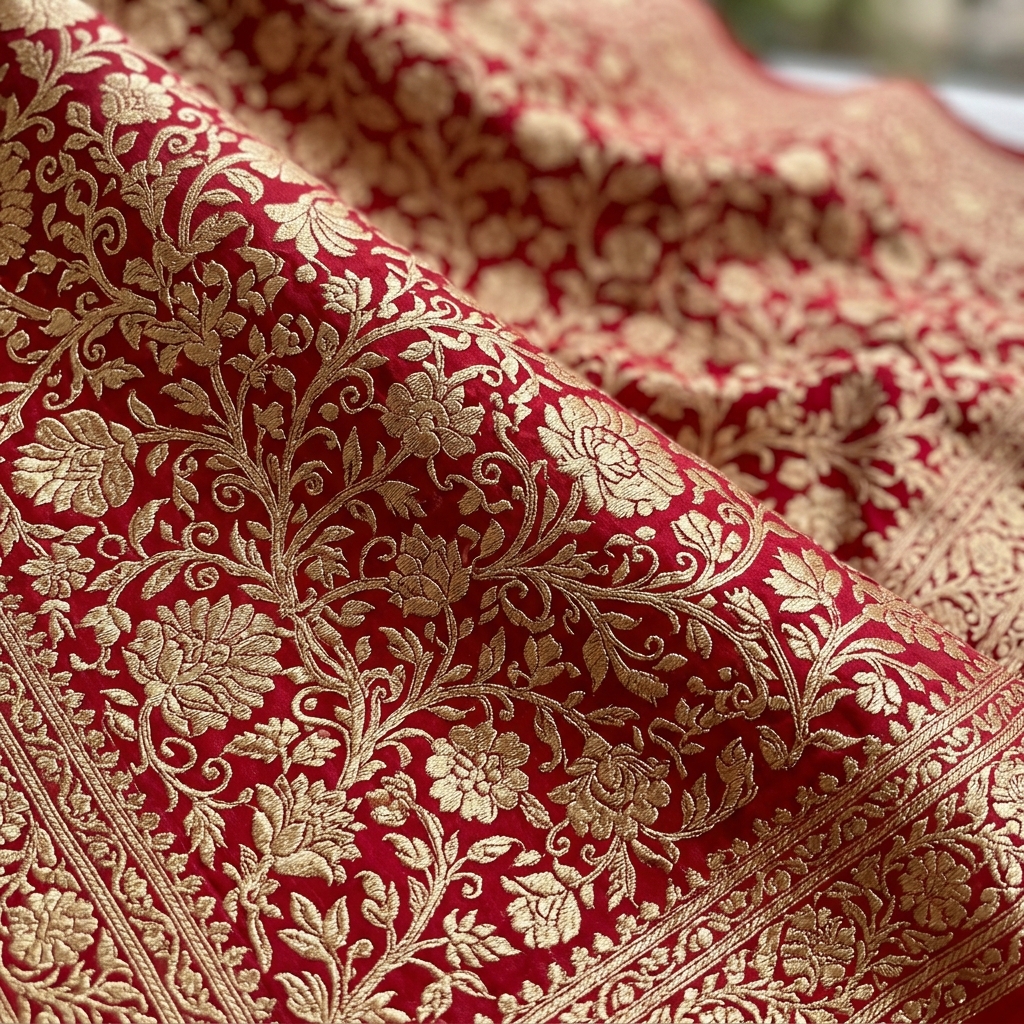
What is a Banarasi Saree Motif? A Guide to Buta, Jaal, and Paisley Patterns
Understand the language of Banarasi saree motifs — from the mango-shaped buta to the trellis-like jaal. A weaver's guide to reading pattern, symbolism, and craft.
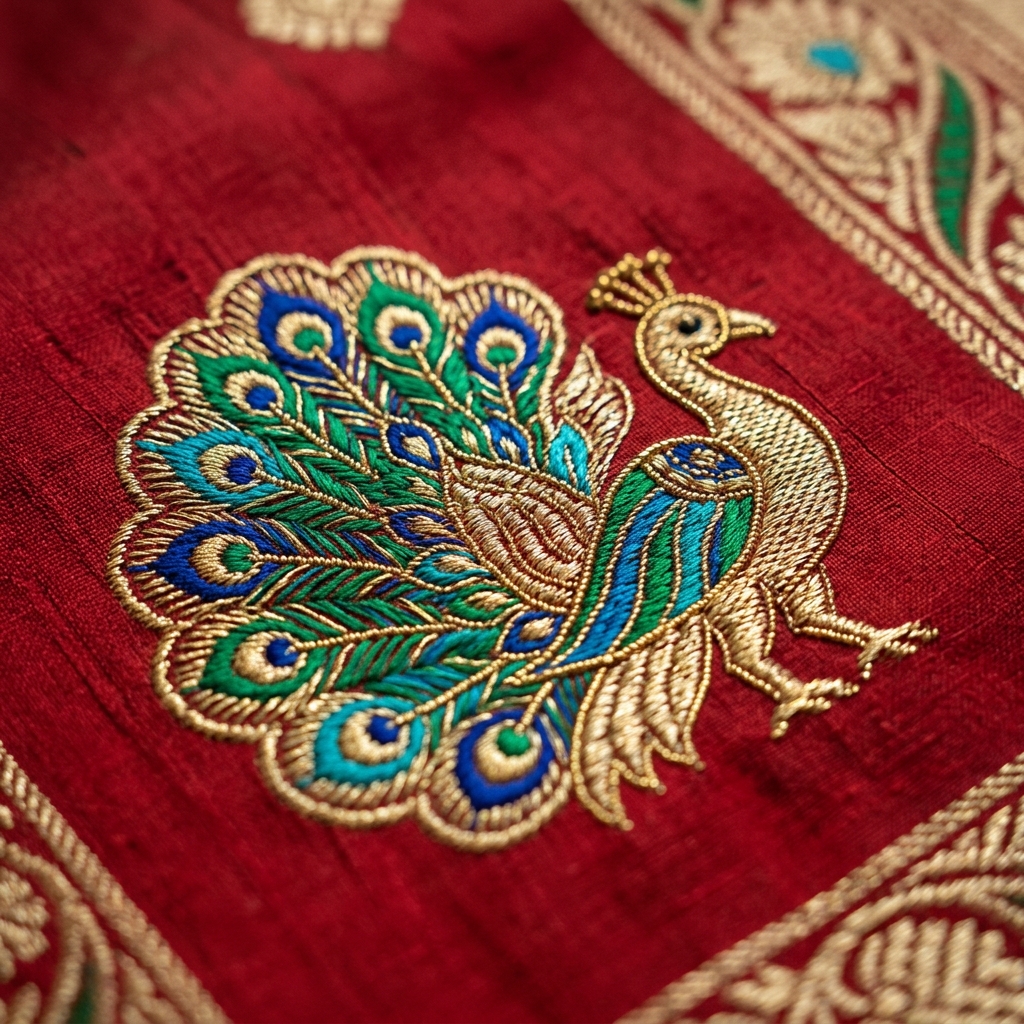
What is a Kadhua Banarasi Saree?
Discover the art of Kadhua Banarasi sarees — individually woven motifs, no loose threads, and an embossed 3D finish. Learn about Meenakari vs Sonarupa and why Kadhua is the pinnacle of Banarasi craftsmanship.