
The Empress’s Teacup: How an Ancient Accident in 2700 BCE Breathed Life into Silk
The Empress’s Teacup: How an Ancient Accident in 2700 BCE Breathed Life into Silk (And Built World Empires)
By Shri Geeta Sarees Editorial Bureau • Category: Silk Heritage & Travel • 7 Min Read
"A single thread of silk, born from a leaf and a cup of tea, conquered the courts of Rome, carved the world’s greatest trade highway, and found its eternal spiritual sanctuary in the sacred pit looms of Kashi."
Every time you drape an authentic pure handloom Banarasi silk saree, you are wrapped in a 5,000-year-old unbroken chain of human curiosity. You can feel it in the weight—that cool, liquid glide of twisted Katan silk yarns and the radiant shimmer of 24K electroplated gold zari.
Yet, long before the weavers of Varanasi (Kashi) codified the infinite vine of the Banarasi Jaal, and centuries before Roman senators panicked over their treasury draining into Asian ports, the entire global silk empire existed only as a whisper—locked inside a single cocoon dangling from an imperial garden branch.
Here is the untold, historically documented story of how an emperor's fourteen-year-old bride, a steaming cup of freshly brewed tea, and a freak thermodynamic accident in 2700 BCE gave birth to the most revered textile in human civilization.
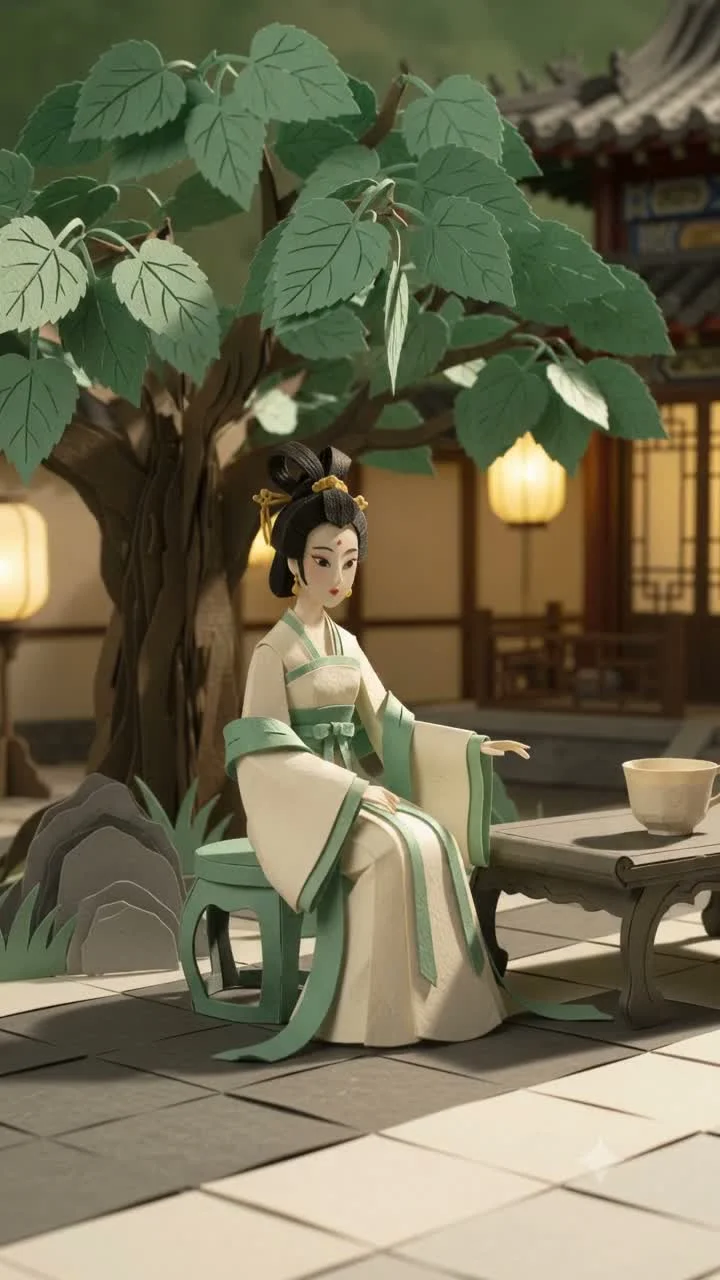
Figure 1: Handcrafted visual recreation of Empress Leizu in the imperial palace gardens, moments before the fateful tea ceremony.
1. The Garden Ceremony of 2700 BCE: Legend Meets Archaeology
In the third millennium before the common era, ancient China was ruled by Huangdi, the legendary Yellow Emperor. According to ancient Chinese historical texts—including the Records of the Grand Historian (Shiji) penned by court archivist Sima Qian in the 1st century BCE, as well as the Confucian Book of Rites (Liji)—the emperor's chief consort was a teenage empress named Leizu (often known as Xi Ling Shi).
One warm spring morning around 2700 BCE, Empress Leizu was resting beneath a grove of wild white mulberry trees (Morus alba) in the imperial palace gardens. Her attendants had served her a cup of freshly steeped hot herbal tea.
As she raised the porcelain bowl to her lips, a breeze ruffled the branches above.
A small, hardened oblong object fell from the dense foliage, plummeting straight into her steaming teacup.
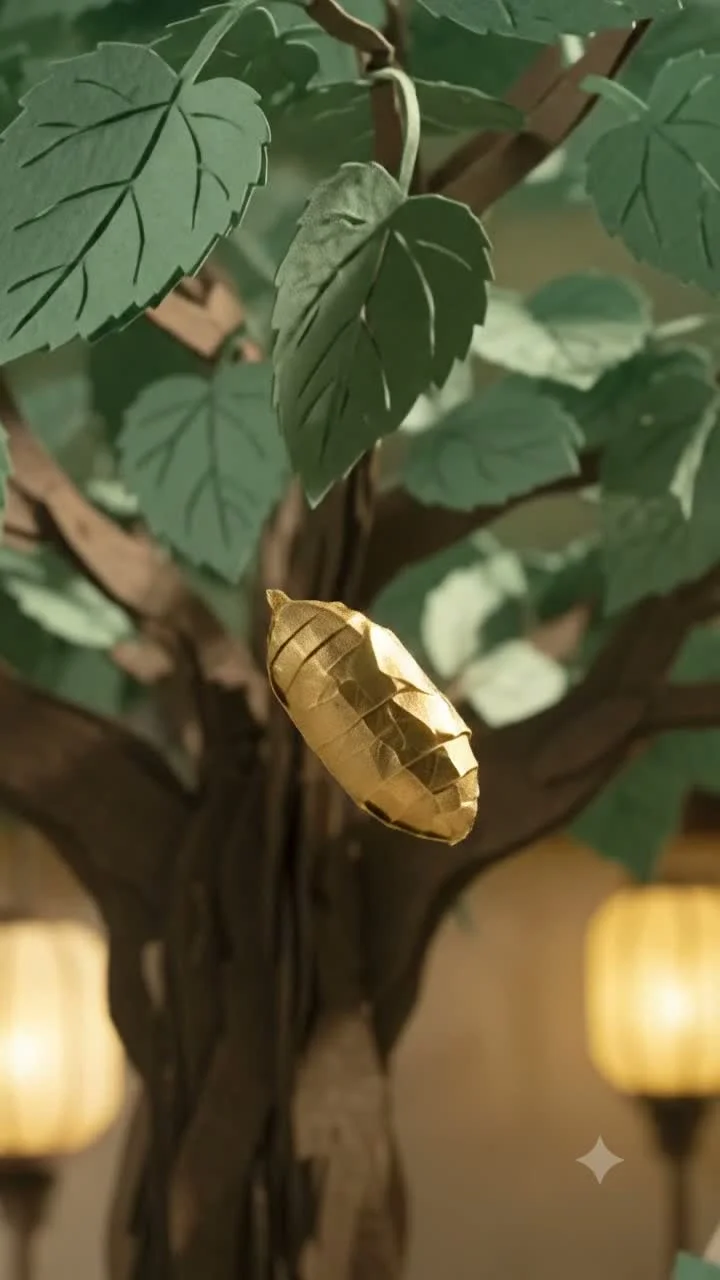
Figure 2: The Bombyx mori cocoon drops into the hot tea, initiating the thermal breakdown of sericin.
2. The Accidental Biochemistry of the Steaming Teacup
What fell into Empress Leizu's cup was the pupal casing of a wild silkworm (Bombyx mandarina, ancestor of the domestic Bombyx mori).
Under normal room temperature, a silkworm cocoon is tough, rigid, and impervious to water. It is nature's armored shelter, designed to protect the metamorphosing caterpillar from monsoon deluges, predators, and fungal rot.
Had the cocoon dropped onto the grass or into cold water, it would have stayed a stiff, impenetrable shell. But the Empress’s tea was steaming—well above 65° Celsius (150° Fahrenheit).
       [ THE BIOCHEMICAL DISSOLUTION OF A SILK COCOON ]

   Boiling Tea Water (>65°C) ──► Melts the Hydrophilic Protein Gum (Sericin)
             │
             ▼
   Fibroin Strands Freed    ──► Continuous Triangular Micro-Filament Released
             │
             ▼
   Tensile Strength Intact  ──► ~1,000 to 1,500 Continuous Meters Unspooled
In textile biochemistry, a silk cocoon is constructed from two distinct protein components:
- Fibroin (70–80%): The structural core—a pair of triangular, crystalline protein filaments possessing tensile strength comparable to high-grade steel wire of the same diameter.
- Sericin (20–30%): A sticky, gummy globular protein that the silkworm excretes like cement, fusing the microscopic fibroin filaments into a hardened casing.
When the cocoon hit the boiling tea, the thermal energy dissolved the water-soluble sericin gum.
Curious, the young empress reached in with her fingertips to fish the foreign object out. Instead of pulling out a soggy, mushy blob, she felt a microscopic, glistening thread catch on her fingers.
As she gently pulled, the thread didn't break.
It began to unspool.
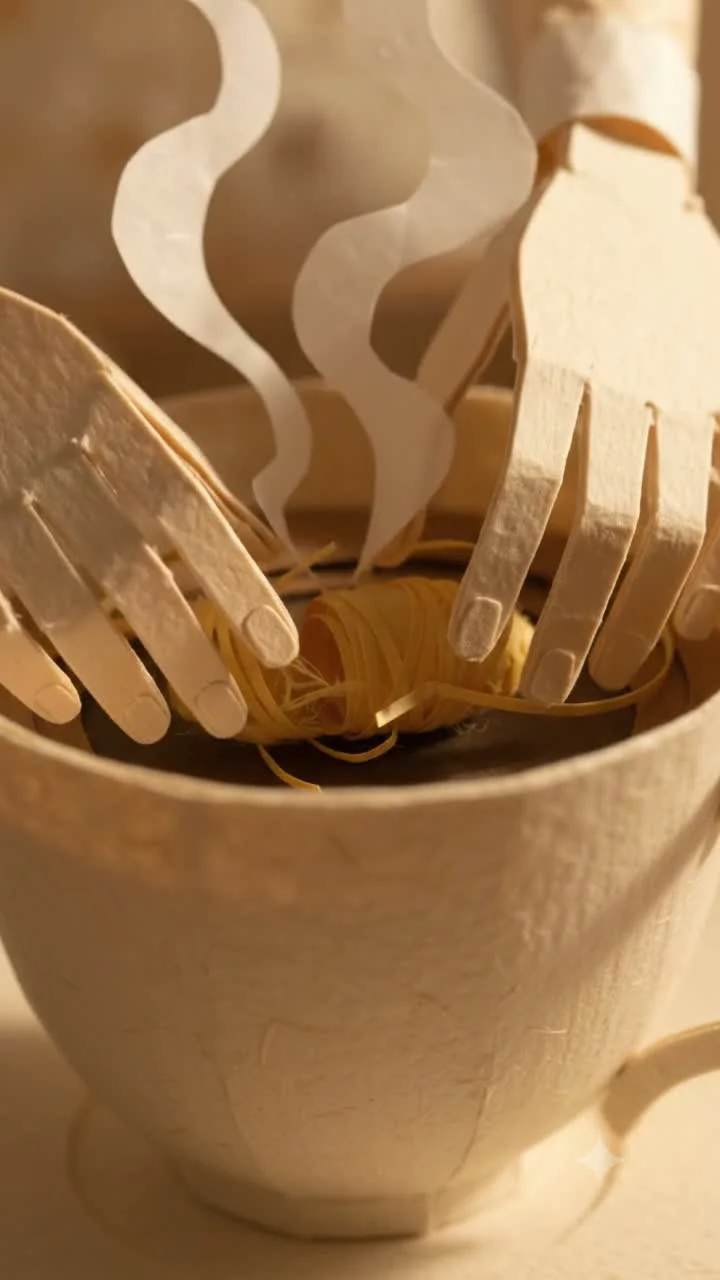
Figure 3: Empress Leizu unravels the continuous, unbroken fibroin filament from the dissolved cocoon.
3. The 1,000-Meter Thread: Why Silk Defied the Laws of Nature
Every other natural textile fiber known to the ancient world was a staple fiber:
- Cotton fibers measure only 2 to 4 centimeters in length.
- Wool hairs measure 5 to 10 centimeters.
- Linen (Flax) fibers measure 20 to 50 centimeters.
To make fabric from cotton, wool, or linen, humans had to laboriously card, comb, and spin thousands of short fragments together, creating thousands of microscopic friction points.
Silk was different.
As Empress Leizu unspooled the cocoon across the courtyard, walking step after step, the thread kept coming. A single Bombyx mori cocoon produced an unbroken, continuous filament between 1,000 and 1,500 meters long—nearly a full mile of continuous, uninterrupted protein filament.
Leizu realized two revolutionary truths:
- The Prism Phenomenon: Because the fibroin filament has a natural rounded-triangular cross section, it refracts incident light like a three-dimensional glass prism, splitting white sunlight into a warm, pearlescent luster that no dull plant fiber could ever replicate.
- The Thermal Secret: By domesticating the caterpillar, harvesting the cocoons before the moth broke through the casing (which severs the continuous strand), and submerging them in hot water, humanity could harvest endless unbroken threads.
Empress Leizu did not keep this as a palace novelty. She invented the first silk reel to wind multiple micro-filaments into a cohesive warp yarn, and commissioned the construction of specialized wooden looms.
For her discoveries, history crowned her Can Shen—the Goddess of Sericulture.
4. The 2,000-Year Imperial Lockdown: The Death Penalty for Smugglers
Recognizing that this gossamer cloth was worth more than its weight in pure bullion, Chinese dynasties instituted the most draconian trade embargo in world history.
For over twenty centuries:
- The exact biological origin of silk was made an Imperial State Secret.
- Foreign merchants were allowed to purchase finished bolts of silk, but were strictly forbidden from traveling inland to see how it was produced.
- Anyone caught attempting to smuggle silkworm eggs, larvae, or white mulberry seeds outside the imperial borders was condemned to death by public execution (Lingchi).
Western civilizations were utterly mystified.
- The Romans believed silk was harvested from the fleeces of magical forest trees (Seres).
- In 16 AD, as documented by Roman naturalist Pliny the Elder, the Roman Senate attempted to pass emergency austerity decrees to ban men from wearing silk, claiming that over 100 million sesterces of pure Roman gold coins were draining into the East every single year to pay for "woven air."
Yet, no secret can remain buried forever. By the 5th century CE, princesses concealing eggs in their ornate bridal headdresses and Christian monks concealing live cocoons inside hollow bamboo walking canes carried the secret across the Pamir Mountains and into the kingdoms of Central Asia and India.
5. From the Forbidden City to the Ghats of Kashi: The Holy Looms of Varanasi
While sericulture began along the banks of the Yellow River, it was in Varanasi (Kashi) that silk found its highest spiritual and artistic expression.
Long before Chinese sericulture leaked westward, northern India had its own indigenous wild silks (Tussar, Muga, and Eri). But when domesticated Bombyx mori sericulture met the ancient weaving guilds of Kashi around 600 BCE, a creative explosion occurred.
                  [ THE 5,000-YEAR SILK TIMELINE ]

   2700 BCE  ──► Empress Leizu discovers silk in hot tea (China)
   1200 BCE  ──► Early wild silk evidence in Harappan civilization (Nevasa/Chanhudaro)
    600 BCE  ──► Kashi becomes the world silk capital (Buddhist scriptures record 500 layers)
     16 AD   ──► Roman Senate debates the 100M coin drain on Asian silk
    419 AD   ──► Princess smugglers carry silkworms into Khotan
    552 AD   ──► Monks smuggle cocoons into Constantinople in hollow canes
   1590 AD   ──► Mughal courts introduce Persian Jaal & real gold zari to Varanasi pit looms
   PRESENT   ──► Shri Geeta Sarees preserves authentic Kadhwa handloom in Chowk, Varanasi
The Shroud of the Buddha (600 BCE)
In the ancient Buddhist canon—specifically the Dīgha Nikāya and Mahāparinibbāna Sutta—it is recorded that when Gautama Buddha attained Mahaparinirvana in Kushinagar, his disciples wrapped his body in 500 layers of pure Kashi silk (Kāsikāsu).
Why? Because Varanasi silk was known throughout the ancient world for its microscopic purity and gossamer density—so finely spun that it absorbed neither ash nor dust.
The Mughal Golden Age (16th Century)
In the 1500s, Persian master artisans migrated to Varanasi under Mughal patronage, fusing Indian spiritual symbolism with the intricate botanical mathematics of Persian carpets. They introduced:
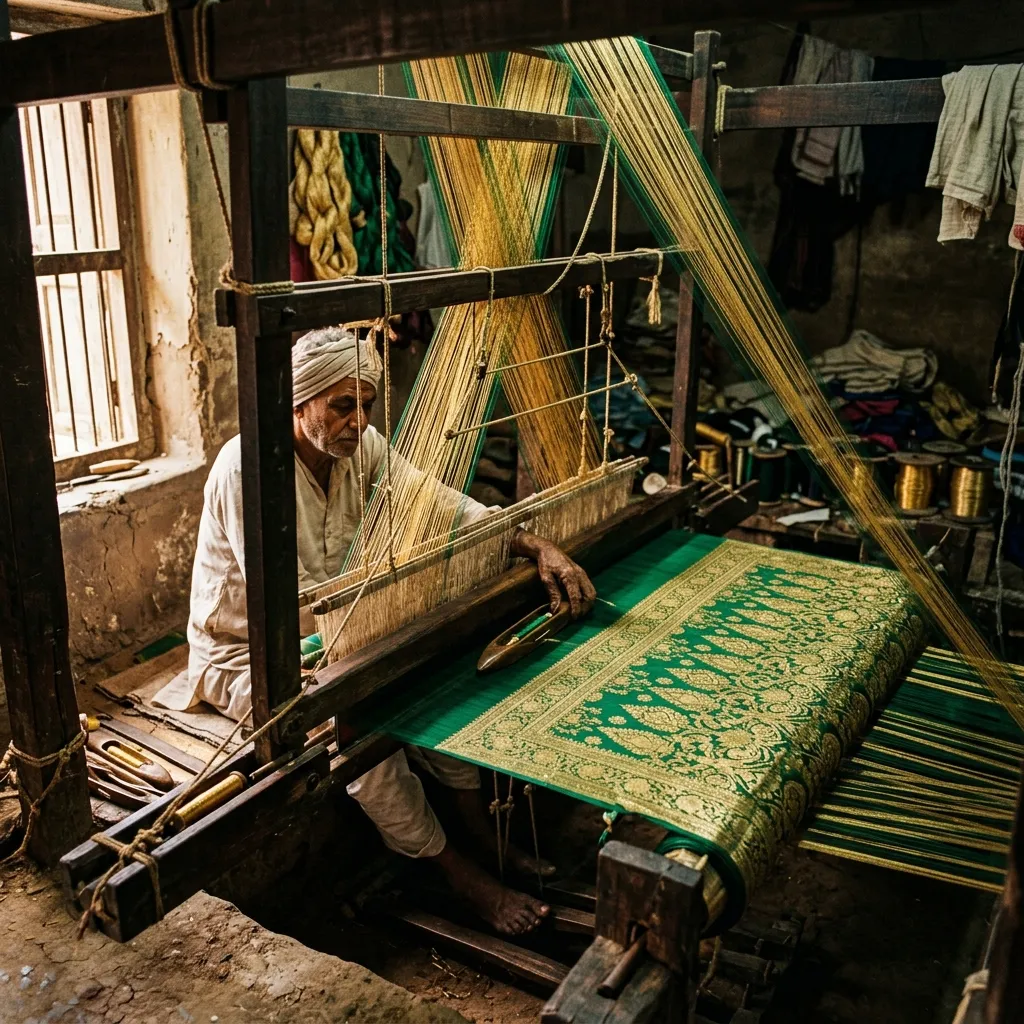
- The Pit Loom (Gaddha Loom): Sunk into the earthen floor to maintain 70% natural atmospheric humidity, keeping fine silk threads supple and resilient.
- The Kadhwa Technique: An excruciatingly slow hand-weaving method where each individual floral motif (Buti) is woven with an independent gold shuttle, leaving zero loose floating threads on the reverse.
- Katan Silk (Twisted Warp): Combining multiple raw fibroin filaments with counter-directional high twist, resulting in a fabric with razor-sharp pleat memory and liquid drape.
6. How to Experience Authentic Silk Heritage Today
Today, the global market is flooded with synthetic polyester replicas, chemical-washed viscose, and machine-made powerloom cuts masquerading as handloom.
When you visit Varanasi, stepping away from the bustling commercial tourist hubs and entering the historic weaving quarters of Chowk and Madanpura, you can still hear the rhythmic clack of the wooden shuttles (Khat-Khat).
At Shri Geeta Sarees, established in the heart of Varanasi across generations, we preserve the very weaving principles born from Leizu's teacup and perfected on Kashi's sacred pit looms:
- 100% Pure Silkmark Certified Fibroin: Tested for zero synthetic adulteration.
- Authentic Tested Gold & Silver Zari: Ensuring your bridal heirloom does not tarnish or corrode over decades of celebration.
- True Kadhwa Craftsmanship: Woven thread by thread on authentic handlooms by hereditary Varanasi weaving families.
Frequently Asked Questions (FAQ)
1. Did Empress Leizu really discover silk?
While Chinese folklore regards Empress Leizu as the mythological discoverer of silk around 2700 BCE, archaeological excavations confirm that sericulture was actively practiced in China during this exact era. Excavations at Qianshanyang and Liangzhu culture sites have unearthed silk fabrics, woven ribbons, and carved ivory silkworms dating to 2750–2500 BCE, confirming that systematic sericulture is over 4,700 years old.
2. Why does hot water unravel a silk cocoon?
A silkworm spins its cocoon using two proteins: fibroin (the structural thread) and sericin (a gummy water-soluble protein). In boiling water above 65°C, the sericin gum dissolves, freeing the continuous fibroin filament so it can be unspooled without tearing.
3. How many meters of silk are in one cocoon?
A single healthy Bombyx mori silkworm cocoon yields between 900 to 1,500 meters (roughly 3,000 to 4,900 feet) of continuous, unbroken silk filament. Because an individual filament is too fine to weave alone, between 4 to 8 filaments are twisted together to create a single usable weaving yarn.
4. How is Banarasi Katan silk different from raw Chinese silk?
Raw silk extracted directly from the cocoon contains residual sericin gum and is relatively stiff. To create Banarasi Katan silk, two high-quality mulberry silk threads are degummed and twisted together with opposing directional torque (S-twist and Z-twist) before weaving. This creates an exceptionally dense, tear-resistant, liquid-smooth fabric that holds structural bridal pleats flawlessly.
5. Where can I buy authentic handloom Banarasi silk in Varanasi?
To buy authentic handloom Banarasi sarees directly from master weaver collections without retail middlemen or machine-counterfeits, visit Shri Geeta Sarees in Chowk, Varanasi. You can also explore our curated online collection and book virtual video shopping consultations with our textile heritage specialists.
Plan Your Heritage Weave Experience in Varanasi
Visiting Varanasi? Stop by our heritage showroom to touch the authentic handloom weaves, inspect the reverse-side Kadhwa craftsmanship in person, and take home a piece of living 5,000-year-old textile history.
- Flagship Showroom: Shri Geeta Sarees, Chowk, Varanasi, Uttar Pradesh 221001
- Explore Our Curated Catalog: Browse Handloom Banarasi Sarees
- Read More Heritage Guides: A Day Trip to Sarnath: Buddhist Heritage • Anatomy of an Authentic Banarasi Jaal
Continue Reading
A Food Lover's Guide to Varanasi: 5 Local Street Food Spots You Cannot Miss
From piping hot Kachori Sabzi to winter-special Malaiyyo, discover the ultimate local street food spots hidden in the ancient alleys of Banaras. A true culinary pilgrimage.

The Ultimate First-Timer's Guide to Varanasi: Ghats, Temples, and Handloom Heritage
Planning your first trip to the spiritual capital of India? Discover the best times to visit the Kashi Vishwanath temple, how to navigate the ancient ghats, and where to find authentic Banarasi handloom weavers in the Chowk district.
How to Identify a Pure Handloom Banarasi Saree
Learn how to distinguish a genuine pure handloom Banarasi saree from a mass-produced powerloom imitation. Explore the markers of authentic Varanasi weaving.