
The Silk That Grows Brighter With Age: Why Moonga Silk Defies Textile Physics
The Silk That Grows Brighter With Age: Why Moonga Silk Defies Textile Physics
Every piece of clothing in your wardrobe is quietly deteriorating.
From the day a fabric leaves the loom, sunlight slowly breaks its bonds, washing strips its sheen, and friction frays its threads. Mulberry silk, chiffon, georgette, and linen all follow this same downward slope of wear and tear.
Except for one.
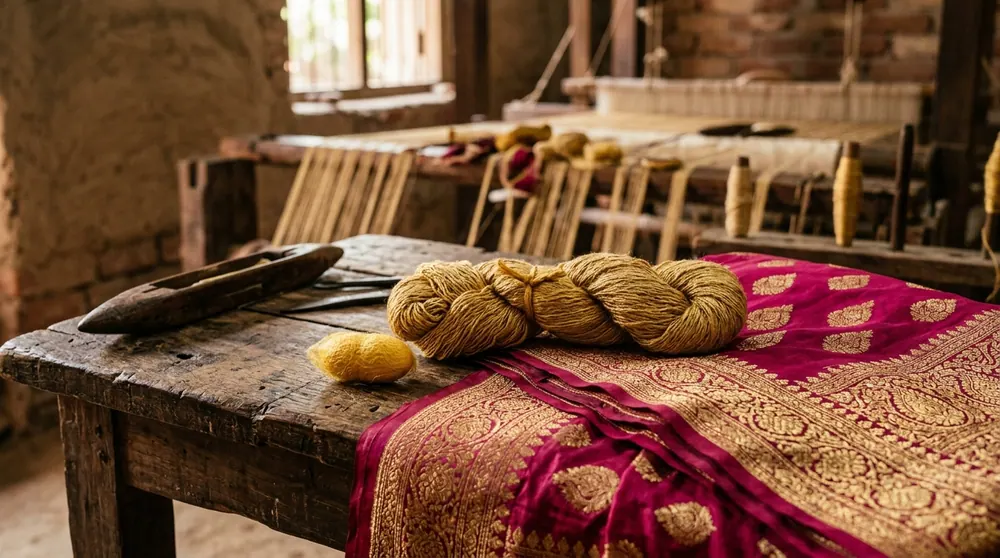
There is a wild golden thread cultivated exclusively along the banks of the Brahmaputra River that reverses this natural law. The more you wear it, the softer its drape becomes. Every gentle hand wash deepens its natural golden glow. Fifty years after it is woven, it looks more luminous than the day it came off the wooden loom.
This is Moonga Silk (historically documented as Muga), the most resilient and naturally golden natural fiber on earth.
When this wild Assam yarn travels to the historic handlooms of Varanasi, master weavers marry its extraordinary strength with centuries-old Banarasi brocade techniques. The result is a saree that does not just outlast generations; it improves with them.
Here is the real science behind its natural golden pigment, how master artisans weave it, and how to protect yourself from synthetic imitations in today's bridal market.
1. Born in the Wild: Why Moonga Silk Is Naturally Golden
Most people assume that silk is dyed gold using chemical vats or metallic gold foil wrapped around cotton threads.
With Moonga silk, nature handles the chemistry.
Moonga silk is produced by the wild caterpillar Antheraea assamensis, a species found only in the micro-climate of the Assam valley. Unlike domesticated mulberry silkworms (Bombyx mori) that are bred indoors on trays and fed chopped leaves, the Moonga silkworm cannot survive in captivity. It lives outdoors in the open canopy of wild Som (Machilus bombycina) and Soalu (Litsea polyantha) trees.
       [ THE NATURAL GOLD BIO-CHEMISTRY ]
   Wild Canopy Feeding   ──► Caterpillar absorbs natural tree tannins
   Cocoon Formation      ──► Secretes golden carotenoid-protein fibroin
   Zero Chemical Bleach  ──► Natural amber-gold filament extracted intact
   Luster Evolution      ──► Washing polishes the triangular fiber core
During its forty-day lifespan, the caterpillar absorbs natural tannins and aromatic compounds from these wild leaves. When it spins its cocoon, it secretes a specialized fibroin protein saturated with a natural carotenoid amber pigment.
When artisans boil the cocoon in mild alkaline water to soften the sericin gum, they do not bleach the fiber. The filament that spools off the reel is already a rich, shimmering honey gold.
Because this color comes from the cellular structure of the protein itself rather than an external dye bath, it cannot wash out, fade, or bleed onto your skin.
2. The Triangular Prism Effect: Why the Sheen Never Dulls
If you place a strand of regular mulberry silk and a strand of Moonga silk under a microscope, you immediately see why they reflect light differently.
- Mulberry silk fibers are roughly oval or circular. They reflect light evenly, giving a soft, uniform sheen.
- Moonga silk fibers have a distinct triangular cross-section with micro-ridges along the filament wall.
This triangular geometry turns every individual thread into a microscopic optical prism. When sunlight hits the saree, it does not just bounce off the surface. It enters the fiber, refracts through the interior protein walls, and disperses back out as warm golden highlights.
   [ OPTICAL REFRACTION: THE PRISM CORE ]
   Incoming White Light  ──► Hits triangular fiber facet
   Internal Refraction   ──► Bounces through natural amber carotenoids
   Prismatic Output      ──► Liquid golden luster from every viewing angle
Even more remarkable is what happens when you wash the fabric. Over decades of gentle handling, microscopic surface impurities on the raw silk are gradually polished away. This clears the optical path to the inner triangular core, allowing the silk to refract light with even greater clarity.
This is why heirloom Moonga sarees passed down from grandmothers to granddaughters often look distinctly richer than brand-new store pieces.
3. When Assam Gold Meets the Varanasi Pit Loom
For centuries, raw Muga silk remained primarily within royalty in Northeast India. The Ahom dynasty of Assam strictly decreed that only royals could wear full garments of wild golden Muga.
The transformation into modern luxury happened when this raw golden filament found its way to the weaving quarters of Varanasi: Piluikothi, Madanpura, and Alaipura.
Varanasi weavers recognized that Moonga possesses the highest tensile strength of any natural silk in the world. It is so tough that historically, Assamese archers used twisted Muga filaments for bowstrings.
   [ THE VARANASI MOONGA KATAN ARCHITECTURE ]
   Assam Wild Muga Yarn  ──► Natural golden warp (unmatched tensile strength)
   Varanasi Kadhwa Loom  ──► Pure silver & 24K gold zari hand-embroidered weft
   Interlocking Petals   ──► Zero loose threads on the reverse side
   Finished Drape        ──► Royal structural memory that never sags
The Varanasi master weavers began twisting these wild filaments into heavy two-ply yarns to create Moonga Katan Silk. They set these golden warps on traditional wooden pit looms, weaving intricate Kadhwa florals, Shikargah hunting scenes, and geometric Tanchoi patterns directly across the golden field.
Because the base fabric already carries a natural warm luster, the contrast between the woven gold zari and the silk background creates a rich, tonal depth known in Varanasi as Ganga-Jamuna (the meeting of two shades of gold).
4. Pure Handloom Moonga vs. Synthetic Art-Silk Copies
Because wild Moonga cocoons can only be harvested outdoors twice a year and are vulnerable to changing monsoon patterns, true Moonga silk represents less than 1% of total Indian silk production.
This natural scarcity has led to a flood of synthetic polyester and viscose copies sold under confusing names like "Muga Art Silk," "Semi-Moonga," or "Golden Tissue."
Here is how authentic handloom Moonga compares directly against industrial synthetic alternatives.
| Feature | Authentic Varanasi Moonga Silk | Synthetic / "Art Moonga" Copy |
|---|---|---|
| Fiber Origin | 100% Wild Antheraea assamensis sericulture. | Polyester, nylon, or chemically treated viscose rayon. |
| Natural Color | Warm amber-honey gold from the cocoon. No dye needed. | Artificially dyed using yellow chemical dyes and plastic coatings. |
| Texture & Scroop | Firm, crisp hand-feel with a characteristic rustle. | Slippery, limp, or overly stiff like gift-wrapping paper. |
| Luster Behavior | Glows deeper and softens with every wash over decades. | Dulls, turns grayish, and sheds micro-plastics after 2 washes. |
| Breathability | High thermal regulation. Cool in summer, warm in winter. | Traps heat and perspiration, causing static cling to the body. |
| UV Resistance | Absorbs up to 85% of harmful UV rays naturally. | Breaks down and turns brittle under direct sunlight exposure. |
| Lifespan | 60 to 100 Years. An undisputed family heirloom. | 1 to 3 Years. Frayed seams and faded synthetic dyes. |
5. The 4-Step Diagnostic: How to Identify Real Moonga Silk
When purchasing a Moonga silk saree, you do not have to rely on a salesperson's claims. Use these four practical tests to verify authenticity on the spot.
1. The Friction Warmth Test
Fold a corner of the saree and rub the silk vigorously between your palms for ten seconds.
- Real Moonga Silk: The friction generates instant warmth that lingers on the fabric, releasing a subtle, clean, organic protein scent. The gold luster in the rubbed spot will appear slightly richer due to the body heat.
- Synthetic Imitation: The fabric will feel cold, generate electrical static cling, and smell faintly of hot plastic.
2. The Scroop Sound Test
Gently press a fold of the silk between your thumb and forefinger and slide them against each other close to your ear.
- Real hand-twisted Moonga Katan produces a distinctive, crisp, rustling crunch known in the textile trade as scroop. This sound is caused by the natural protein grains of the silk fibers rubbing against one another.
- Synthetic fibers glide silently without any textured acoustic resistance.
3. The Edge Thread Burn Test
If you have access to a loose fringe thread from the unstitched pallu or blouse piece:
- Real Moonga: The thread burns slowly, curls away from the flame, leaves a dark, fragile, crushable black ash bead, and smells distinctly of burnt hair or feathers.
- Synthetic: The thread melts rapidly into a hard, uncrushable plastic ball and emits black, chemical-smelling smoke.
4. The Sunlight Prism Check
Hold the saree up against natural morning sunlight near an open window.
- True wild Moonga will exhibit micro-variations in gold saturation across the yarn, with subtle amber, champagne, and honey tones refracting through the weave.
- Machine-dyed viscose will show a flat, aggressive, monotone yellow that looks identical from every angle.
6. How to Care for a Moonga Silk Saree
Moonga silk is naturally the toughest silk fiber in existence, but proper preservation will keep the gold zari work pristine for half a century.
   [ HEIRLOOM PRESERVATION GUIDELINES ]
   Storage    ──► Wrap in pure, unbleached cotton muslin cloth (Malmal)
   Hangers    ──► Avoid wire or metal hangers (use flat wooden shelf storage)
   Fragrance  ──► Never spray perfume or alcohol directly on gold zari
   Cleaning   ──► Professional petrol dry cleaning every 2-3 years
- Store in Breathable Muslin: Never store silk in plastic bags. Plastic traps ambient humidity, which can oxidize the silver and gold core of the zari. Use unbleached cotton malmal cloth that allows the silk proteins to breathe.
- Rotate Crease Lines Twice a Year: Every six months, unfold the saree, let it air out in a shaded room for an hour, and fold it along fresh lines to relieve tension on the heavy weft threads.
- Handle Water with Confidence: Unlike delicate chiffons that watermark easily, pure Moonga can withstand cold water hand washes with mild reetha (soapnut) extract. However, because bridal Banarasi sarees carry intricate handloom zari borders, professional dry cleaning is recommended to protect the metal threadwork.
The Undefeated Heirloom
In an era of disposable fashion where garments are manufactured to fall apart in six months, Moonga silk stands as a quiet defiance of time.
It is a fabric that demands nothing from industrial speed and gives everything to human patience. It takes thousands of wild cocoons, weeks of delicate hand-reeling, and months at the Varanasi pit loom to bring six yards to life.
When you drape a true Moonga Banarasi saree, you are wearing a living textile that will attend your celebrations today, accompany your milestones tomorrow, and grace your grandchildren decades from now.
Woven in Varanasi. Treasured for generations. This is Shri Geeta Sarees.
Frequently Asked Questions About Moonga Silk Sarees
What makes Moonga silk different from regular silk?
Regular silk comes from domesticated mulberry caterpillars and is naturally off-white, requiring chemical dyeing. Moonga silk comes from wild caterpillars found only in Assam that feed on aromatic forest leaves, producing a filament that is naturally honey-gold, significantly stronger, and increasingly luminous with every wash.
Why is authentic Moonga silk expensive?
Moonga silkworms cannot be bred in closed indoor farms and must be reared in open forest canopies where harvests are limited by weather conditions. Producing a single pure Moonga saree requires over 5,000 wild cocoons and months of artisan handloom weaving in Varanasi.
Can Moonga silk be dyed into other colors?
Yes. While its natural golden amber shade is the most prized, pure Moonga silk can be dyed in rich jewel tones such as emerald green, royal peacock blue, ruby red, and deep plum. The underlying golden fiber gives every dyed shade a luminous, sun-kissed undertone.
Is Moonga silk suitable for summer weddings?
Yes. Because wild Moonga silk is a natural porous protein with high thermal regulation, it breathes easily, wicks moisture away from the body, and absorbs up to 85% of UV rays, making it comfortable in both warm summer afternoons and cool evening celebrations.
Continue Reading
How One Banarasi Saree Can Create 4 Completely Different Looks
A beautiful Banarasi silk saree is one of the most versatile pieces in your wardrobe. Discover how to create four stunning looks just by changing your jewellery.
4 Elegant Ways to Drape a Banarasi Saree | Shri Geeta Sarees
Looking for new ways to wear your handwoven Banarasi saree? Discover 4 elegant and easy styling methods, from classic traditional to modern reception drapes.

Banarasi Saree for Mother of the Bride: A Guide to Getting It Right
A comprehensive guide to choosing the perfect Banarasi saree for the mother of the bride, covering colors, weaves, and styling advice.
Types of Banarasi Silk: Katan, Georgette, Organza & Tissue Explained
Confused by Banarasi saree fabrics? A Varanasi weaver explains the exact difference in drape, weight, and styling for Katan, Georgette, Organza, and Tissue silk.