How to Wear a Saree to Hide Your Tummy: 8 Styling Tricks That Actually Work
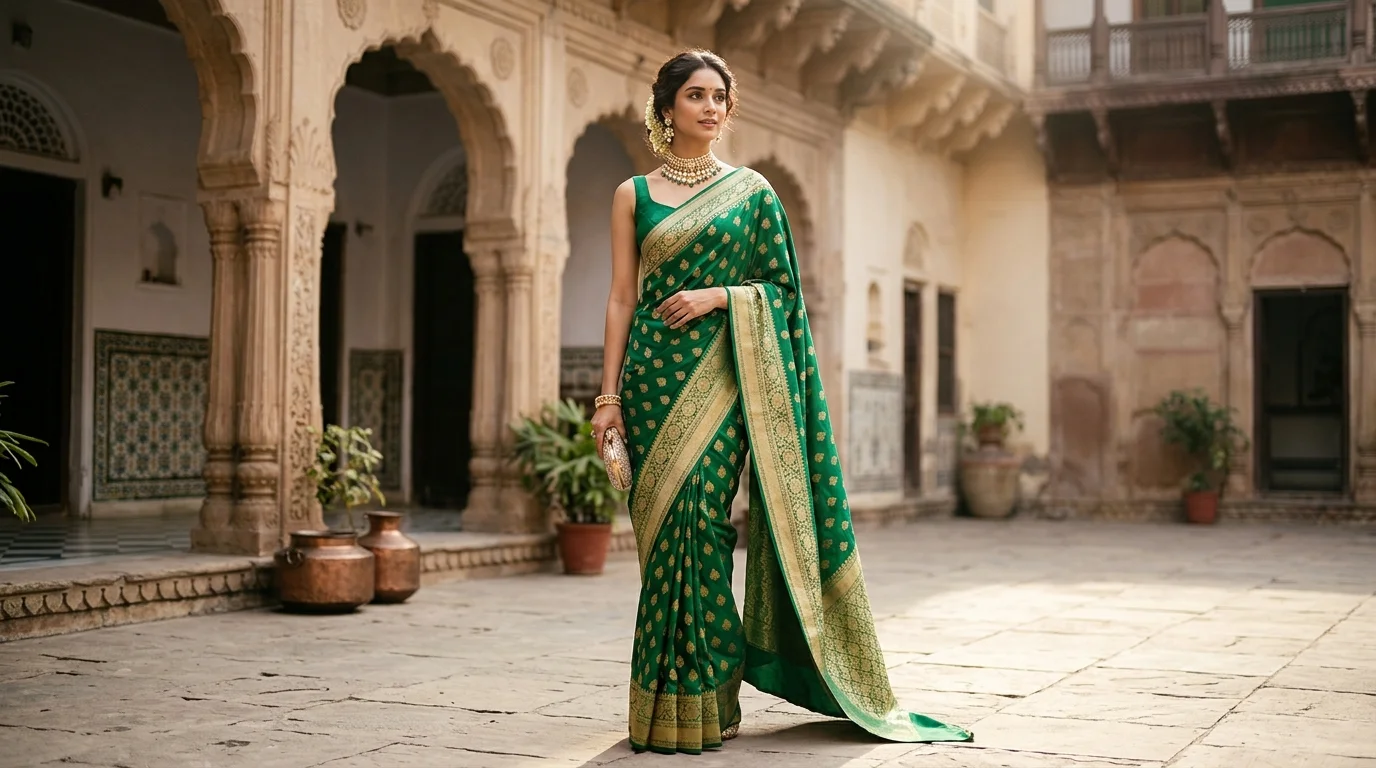
No fabric on earth is more forgiving than six yards of pure silk—if you know how to architect its fall. The saree was never designed for a single rigid body type; it was invented as a canvas of pure tailoring through drape. Long before shapewear, corsetry, and structured designer blouses entered modern runways, Indian women sculpted breathtaking, statuesque silhouettes purely through pleat count, waistline anchoring, and the physics of the pallu.
If you have ever felt hesitant about draping a saree because of a softer midsection, lower belly bulge, or post-pregnancy curve, the issue is almost never your body. It is almost always a draping miscalculation.
Trying to hide a tummy under tight bands, stiff fabrics, or excessive layers of gathered cloth only adds artificial volume. Real styling mastery is about vertical elongation, diagonal asymmetry, and fluid body skimming.
Here is the masterclass guide to styling a saree to skim, flatter, and celebrate your silhouette with effortless royal grace.
Direct Answer: The 8 Golden Rules to Hide a Tummy in a Saree
For quick reference, here are the core styling principles that instantly create an elongated, slimming saree drape:
1. Foundation & Tailoring Pillars
- Anchor at Natural Waist: Fasten the waistband at your true natural waist (just under the ribcage) to eliminate the artificial "shelf" bulge created by high navel drawstrings.
- Seamless Saree Shapewear: Replace gathered cotton petticoats with a 4-way stretch compression skirt for a single, unbroken foundation column.
- Princess-Cut Vertical Seams: Insist on curved princess seams that contour the ribcage without horizontal dart puckering.
- Strategic Under-Bust Hemline: Ensure the blouse ends cleanly just below the bust line or extends into a structured longline peplum—never ending at the belly's widest point.
2. Drape & Textile Pillars
- Fluid Fall Over Stiff Starch: Prioritize body-skimming textiles like Khaddi Chiffon, Pure Georgette, Satin Silk, and fine Pure Silk Katan.
- The 6-to-7 Narrow Pleat Rule: Fold 6 to 7 crisp pleats (2.5–3 inches wide) stacked flat rather than a bulky stack of 10 wide pleats.
- The Diagonal Floating Pallu: Let the pallu cascade freely over one shoulder in an open drape to create an asymmetrical line that bisects the torso.
- Collarbone Statement Framing: Place focal jewellery (Polki chokers, vertical Rani Haar, statement earrings) at or above the collarbone to draw attention upward.
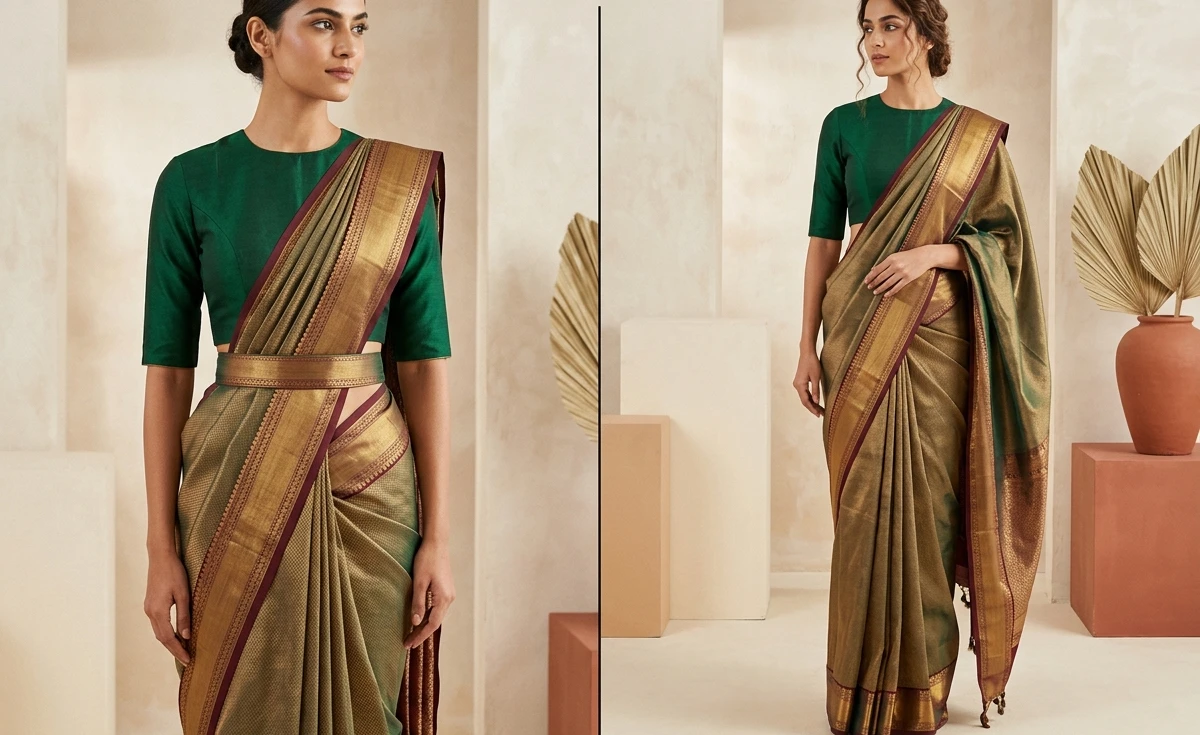
1. Anchor the Waistband at the Natural Waist (Raise the Pleats, Not the Panic)
The single biggest mistake women make when trying to look slimmer in a saree is pulling the drawstring of the petticoat higher and higher above the navel, hoping it will compress the stomach.
It does not. Tying the waistband too high creates an optical "shelf", pushing abdominal tissue downward and outward directly beneath the tight drawstring.
The Solution:
- Find Your Natural Waist: Tie the petticoat or shapewear at your true natural waistline—just at or slightly below the ribcage where your torso naturally indents.
- Let the Pleats Drop Naturally: Let your front pleats begin at the natural waistline rather than pulled taut over the belly. A drape starting at the natural waistline creates an uninterrupted, fluid vertical line from torso to floor.
2. The Power of Saree Shapewear vs. Traditional Cotton Petticoats
Every fashion stylist backstage at luxury couture weeks replaces the drawstring cotton petticoat with seamless saree shapewear.
Traditional cotton petticoats feature a bulky fabric casing around a cord that gathers several meters of cotton directly at your waist. When tied tightly, this knot creates a visible bump under fine silks.
Saree Shapewear vs. Petticoat Comparison Matrix
| Feature | Saree Shapewear (Compression Slip) | Traditional Cotton Petticoat | Impact on Silhouette |
|---|---|---|---|
| Waistband Construction | Seamless, broad elastic contour band | Bulky drawstring channel with knot | Shapewear eliminates the "muffin top" and visible drawstring knot. |
| Fabric Physics | Polyamide / Spandex with 4-way stretch | Rigid woven cotton with zero stretch | Shapewear hugs curves smoothly; cotton bunches at the waist. |
| Lower Midsection Fit | Targeted compression from ribcage to thigh | Loose flare from waist downward | Shapewear creates a smooth column for pleats to fall against. |
| Mobility & Comfort | Built-in side/back slit for walking ease | Wide circular hem | Both allow walking, but shapewear maintains a mermaid contour. |
Pro Tip: If you prefer traditional cotton petticoats for daily breathability, opt for a tailored 8-panel A-line cut with a flat zipper/hook closure rather than a heavily gathered drawstring skirt.
3. Keep Front Pleats Narrow, Crisp, and Flat (The 6-to-7 Pleat Rule)
When tucking your front pleats, more is not better. Creating 9 to 10 wide pleats packs a massive density of folded silk right over your lower belly, creating an artificial bulge where you want smoothness.
The Precision Pleating Technique:
- Fold 6 to 7 Narrow Pleats: Keep each pleat approximately 2.5 to 3 inches wide. Narrow pleats stack in a razor-thin vertical column.
- Stagger Your Pleats Slightly: When stacking the pleats before tucking, stagger each subsequent pleat by a millimeter to the right so they do not form a single thick brick of fabric.
- Secure with a Safety Pin: Pin the pleats together internally just below the tuck line to prevent them from fanning out horizontally when you walk.
- Iron the Creases with Your Fingers: Run your hand firmly down the length of the pleats to set the vertical memory of the silk.
4. Let the Blouse Do the Structural Engineering
A saree blouse is not an afterthought; it is the architectural foundation of the entire ensemble. Three specific tailoring adjustments transform how your torso appears:
Blouse Cut Comparison: What to Avoid vs. What to Embrace
| Styling Element | What to Avoid (Volume Traps) | What to Embrace (Vertical Elongation) |
|---|---|---|
| Seam Construction | Heavy horizontal bust darts | Princess-Cut Seams: Curved vertical seams extending from shoulder/armhole to hem. |
| Blouse Hemline | Ending right at tummy's widest point | Under-Bust or Longline: Ends cleanly below ribcage or extends to peplum. |
| Neckline Shape | High closed collars, boat necks | Plunging V-Neck, Sweetheart, or Scoop: Creates an optical vertical line. |
| Sleeve Length | Cap sleeves or tight sleeveless armholes | Elbow-Length (3/4th) Sleeves: Frames the torso and restores symmetry. |
1. Princess-Cut Seams Over Single Darts
Always instruct your master tailor to cut your blouse with princess seams—curved vertical seams running from the armhole or shoulder down across the bust apex to the bottom hem. Princess seams contour the ribcage smoothly without horizontal puckering.
2. Strategic Blouse Hemlines
- The High Under-Bust Hem: A blouse that ends cleanly just below the bust line (at the ribcage) leaves the midsection as a canvas for the saree fabric itself, rather than breaking your torso with a harsh horizontal seam.
- The Elegant Longline / Peplum Cut: If you prefer complete midriff coverage, choose an extended longline blouse or structured peplum jacket that falls past the hip with a gently flared hem.
- The Danger Zone: Never allow a blouse to terminate exactly at the widest point of your tummy.
3. Balanced Sleeves (3/4th & Elbow Length)
Sleeveless blouses on a fuller midsection often accentuate the width of the torso by contrast. Elbow-length or three-quarter sleeves create a strong vertical frame on either side of your body, balancing your proportions.
5. Fabric Chooses the Fall: Fluid Drapes vs. Rigid Textures
Stiff, heavily starched fabrics like synthetic art silks, stiff net, or cardboard-like organzas hold their own rigid shape—which means they stand away from your natural hollows and exaggerate your widest point.
For an effortlessly slimming drape, prioritize fluid, body-skimming silks that have natural drape weight:
Saree Fabric Silhouette Matrix
| Saree Fabric | Drape Characteristic | Slimming Score | Best SGS Collection |
|---|---|---|---|
| Khaddi Chiffon / Georgette | Liquid drape; hugs the curves gently while falling in crisp vertical lines | 10 / 10 | Khaddi Chiffon Sarees |
| Satin Silk | Ultra-soft, weighted fluid fall with a subtle luxury sheen | 9.5 / 10 | Satin Silk Sarees |
| Pure Silk Katan (Kadhua Weave) | Soft handloom silk where individual zari motifs lie completely flat | 9.0 / 10 | Pure Silk Katan Sarees |
| Banarasi Tanchoi Silk | Satin-weave background with flat zari brocade and zero reverse floating threads | 9.0 / 10 | Pure Handloom Silk |
| Banarsi Soft Cotton | Breathable artisanal weave with supple, unstarched drape | 8.5 / 10 | Banarsi Cotton Sarees |
| Pure Tissue Silk (Supple Weft) | Luminous metallic luster with fluid silk base | 8.5 / 10 | Pure Tissue Sarees |
| Stiff Starched Cotton & Synthetic Art Silk | Rigid, stands away from waist; creates bulky boxy profile | 3 / 10 | Avoid for slimming drapes |
(To learn more about handloom silk varieties, explore our guide on Types of Banarasi Silk: Katan, Georgette, Organza & Tissue Explained).
6. The Pallu Is Your Best Accessory (The Diagonal Sweep)
How you drape and pin the pallu dictates where the viewer's eye travels across your body:
- The Trap of the Narrow Pinned Pallu: A tightly pinned, narrow pallu pinned back on the shoulder leaves the entire midriff and side waist completely uncovered and exposed to harsh horizontal sightlines.
- The Magic of the Diagonal Floating Pallu: An open, unpleated single-shoulder drape sweeps diagonally across your torso, creating an asymmetrical line that covers the lower abdomen while creating an unbroken vertical column of pure silk.
1. The Single-Shoulder Floating Pallu (The Ultimate Slimming Drape)
Draping the pallu over your left shoulder and letting it cascade freely in an open, unpleated single drape is the most flattering technique in Indian fashion. The vertical sheet of silk sweeps diagonally across your torso, covering the curve of the waist while leaving the opposite shoulder open, creating an asymmetrical line that instantly slims the waist.
2. The Bengali Diagonal Wrap
In traditional Bengali draping, the wide, unpleated pallu is wrapped diagonally across the front of the body and thrown back over the right shoulder. This unbroken diagonal expanse visually breaks up the horizontal width of the midsection.
3. The Gujarati / Seedha Pallu Modification
If you are wearing a Seedha Pallu (front pallu drape), avoid spreading the heavy border flat across your chest. Instead, gather the pleats neatly so the zari cascades in a slim, disciplined vertical line down your right side.
7. Play With Print Placement & Motif Geometry
The old advice of "wear only tiny prints" is outdated. What truly matters is where the motifs sit and how they guide the eye.
- Concentrate Motifs on Borders & Pallu: A saree with a clean, unembellished body and rich, intricate borders draws attention to the edges and hemline, creating a vertical silhouette.
- Choose Vertical Jaal & Bel Motifs: Vertical vines (bel), diagonal stripes (leheriya), and elongated paisleys (kalka/ambi) create a lengthening optical illusion.
- Avoid Dense Horizontal Bands at the Waist: Heavy horizontal borders or dense waist-level embroidery visually cut your height in half.
8. Jewellery & Accessorizing as Sleight of Hand
The human eye naturally tracks to the brightest, most detailed focal point in an outfit. By placing your most radiant jewelry at or above the collarbone, you draw all attention upward toward your face and smile.
- Collarbone Statement Necklaces: Pair an open V-neck or sweetheart blouse with an exquisite Polki choker or emerald pendant that rests high on the collarbone.
- Long Vertical Rani Haar: A long multi-strand pearl Mala or Sautoir chain creates an elongating "Y-line" down the center of your chest.
- Dramatic Shoulder-Duster Earrings: Long Chandbalis or Jhumkas draw the eye vertically along the neck, reinforcing statuesque posture.
- Skin Undertone Harmony: Choose warm gold or cool silver zari that complements your natural complexion. Discover your shade in our 30-Second Guide on How to Find Your Skin Undertone & Choose Saree Colors.
Quick Reference Cheat Sheet: Do's and Don'ts
| Feature | DO's (Embrace for a Slimming Drape) | DON'Ts (Avoid to Prevent Bulk) |
|---|---|---|
| Waistline Anchor | Fasten at the natural waist (under ribcage). | Pulling waistband high above navel (creates a shelf). |
| Foundation | High-waist seamless saree shapewear with compression. | Bulky drawstring cotton petticoat with knot. |
| Front Pleats | 6 to 7 narrow, crisp pleats (2.5–3" wide) stacked flat. | 9 to 11 wide, bunched pleats fanning outward. |
| Blouse Cut | Princess-cut seams with V-neck or sweetheart neckline. | Horizontal bust darts with high stiff collar or boat neck. |
| Blouse Length | Ends just below bustline or elegant longline peplum. | Ends right at the widest point of the belly. |
| Pallu Style | Diagonal single-shoulder floating pallu. | Rigidly pinned narrow pallu exposing full midriff. |
| Fabric | Fluid Khaddi chiffon, pure georgette, soft Katan silk. | Starched synthetic art silk, stiff net, or rigid organza. |
The SGS Philosophy: A Saree Is Meant to Be Arranged, Not to Disguise
At Shri Geeta Sarees, we have dressed brides, mothers, and connoisseurs of Indian heritage for over six decades in Varanasi.
A saree is never about hiding your body. It is about arranging six yards of masterfully woven silk around your body with intention, confidence, and royal poise. When your pleats are disciplined, your blouse is architecturally fitted, and your silk moves like liquid gold, you do not just look slim—you look unforgettable.
Explore our curated handloom collections woven in Varanasi:
- Pure Silk Katan Sarees: Iconic bridal weaves with flat Kadhua craftsmanship.
- Khaddi Chiffon Sarees: Ethereal, liquid-drape georgette and chiffon drapes.
- Satin Silk Sarees: High-sheen, ultra-fluid drapes for evening receptions.
- Banarsi Cotton Sarees: Soft, breathable elegance for daytime celebrations.
- Pure Tissue Sarees: Radiant metallic weaves with supple falls.
Frequently Asked Questions (FAQs)
How do you hide lower belly fat in a saree?
To conceal lower belly fat in a saree, tie your petticoat or shapewear at your natural waistline (just below the ribcage) rather than low on the hips. Make 6 to 7 narrow, flat front pleats and start them slightly lower so they fall straight down in a clean vertical column. Pair this with a single-shoulder floating pallu that sweeps diagonally across the torso to break up the horizontal width of your midsection.
Which saree fabric is best for hiding a tummy?
Fluid, body-skimming fabrics with natural weight and zero stiffness are the most flattering for hiding a tummy. Opt for Khaddi chiffon, pure georgette, crepe, soft satin silk, and lightweight Banarasi Tanchoi or Kadhua weaves. Avoid stiff, starched cottons, rigid synthetics, or bulky heavily-embossed jacquards that stand away from the body and add artificial volume.
Should I wear a saree shapewear or a traditional cotton petticoat?
A high-waist saree shapewear (mermaid or compression slip) is generally superior for tummy control because it provides seamless, continuous compression from the ribcage down to the thighs, eliminating the visible waistband bulge or "muffin top" caused by traditional cotton petticoat drawstrings. However, if using a cotton petticoat, ensure it has a flat waistband rather than excessive gather bunching.
What blouse design is best to hide a stomach bulge in a saree?
Choose a blouse tailored with vertical princess-cut seams rather than horizontal darts, with a length that ends either just below the bust line or extends longer like a peplum or corset blouse. Avoid blouses that end exactly at the widest point of your tummy, as horizontal seams draw the eye directly to that line. 3/4th or elbow-length sleeves also balance overall upper-body symmetry.
How many front pleats should I make to look slim in a saree?
Make 6 to 7 narrow, crisp pleats (approximately 2.5 to 3 inches wide each) instead of 8 to 10 wide pleats. Narrow pleats lie completely flat against the lower abdomen without fanning outward, creating a smooth vertical line that elongates your legs and torso.
Can I wear a heavy Banarasi silk saree if I have a tummy?
Yes, absolutely. To wear a Banarasi silk saree effortlessly without looking bulky, choose finely woven Katan silk with genuine Kadhua or Tanchoi craftsmanship where the motifs lie flat against the fabric. Drape the pallu in an open, fluid single cascade over one shoulder and use a structured shapewear underneath to maintain an unbroken, statuesque column.
Why does tucking the petticoat too high make the stomach look bigger?
Pulling the waistband of your petticoat too high above the navel compresses the upper waist while forcing lower abdominal tissue to bulge out directly below and above the band, creating an artificial shelf. Fastening the band at your true natural waistline allows the fabric to skim smoothly over your abdominal curve.
Does a waist belt (Kamarbandh) help hide a tummy in a saree?
A sleek, medium-width metallic or fabric waist belt works wonders when placed at the narrowest part of your torso (the high natural waist). It cinches the fabric, holds the diagonal pallu securely in place, and visually draws the eye upward toward the narrowest point of your silhouette.
Continue Reading
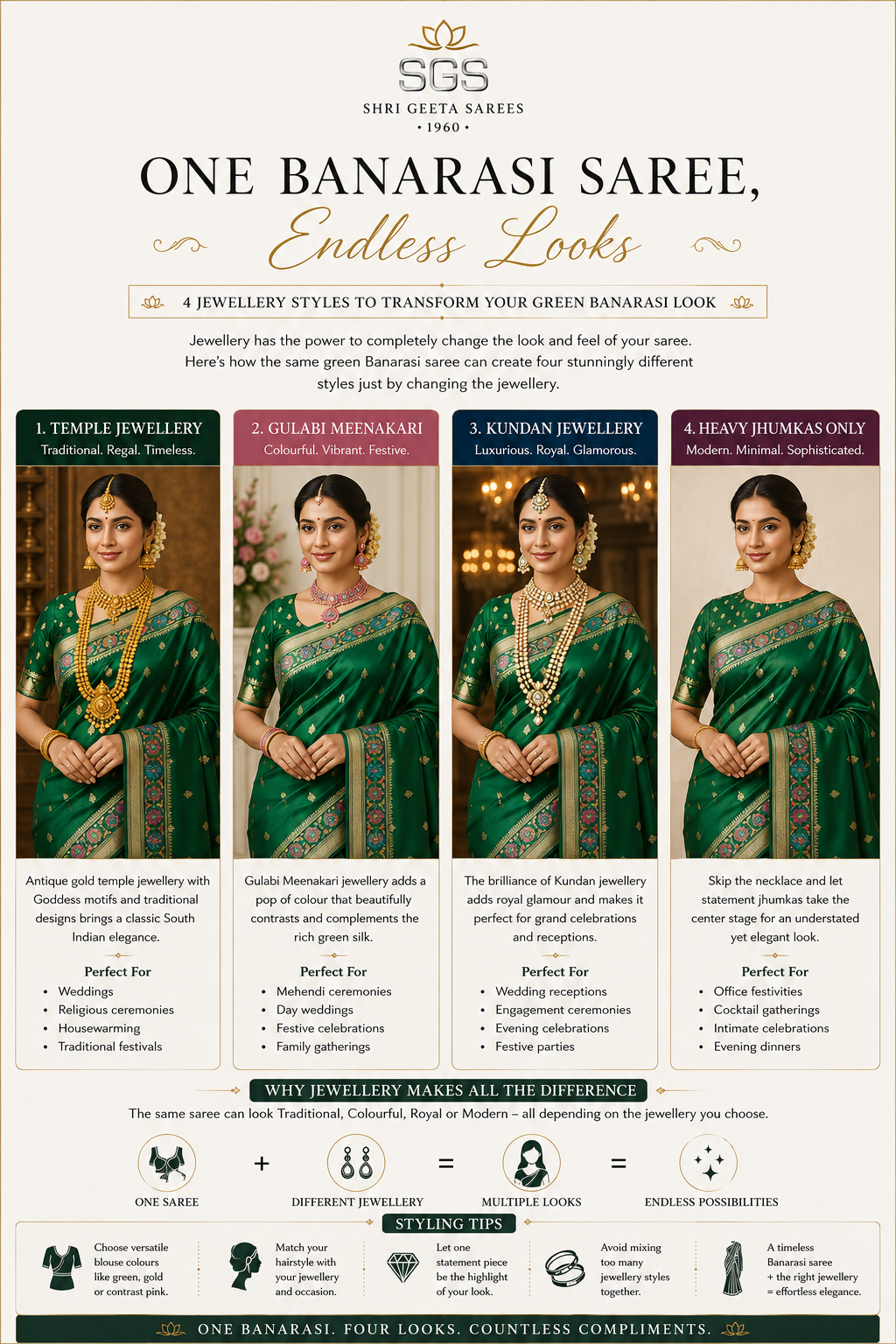
How One Banarasi Saree Can Create 4 Completely Different Looks
A beautiful Banarasi silk saree is one of the most versatile pieces in your wardrobe. Discover how to create four stunning looks just by changing your jewellery.
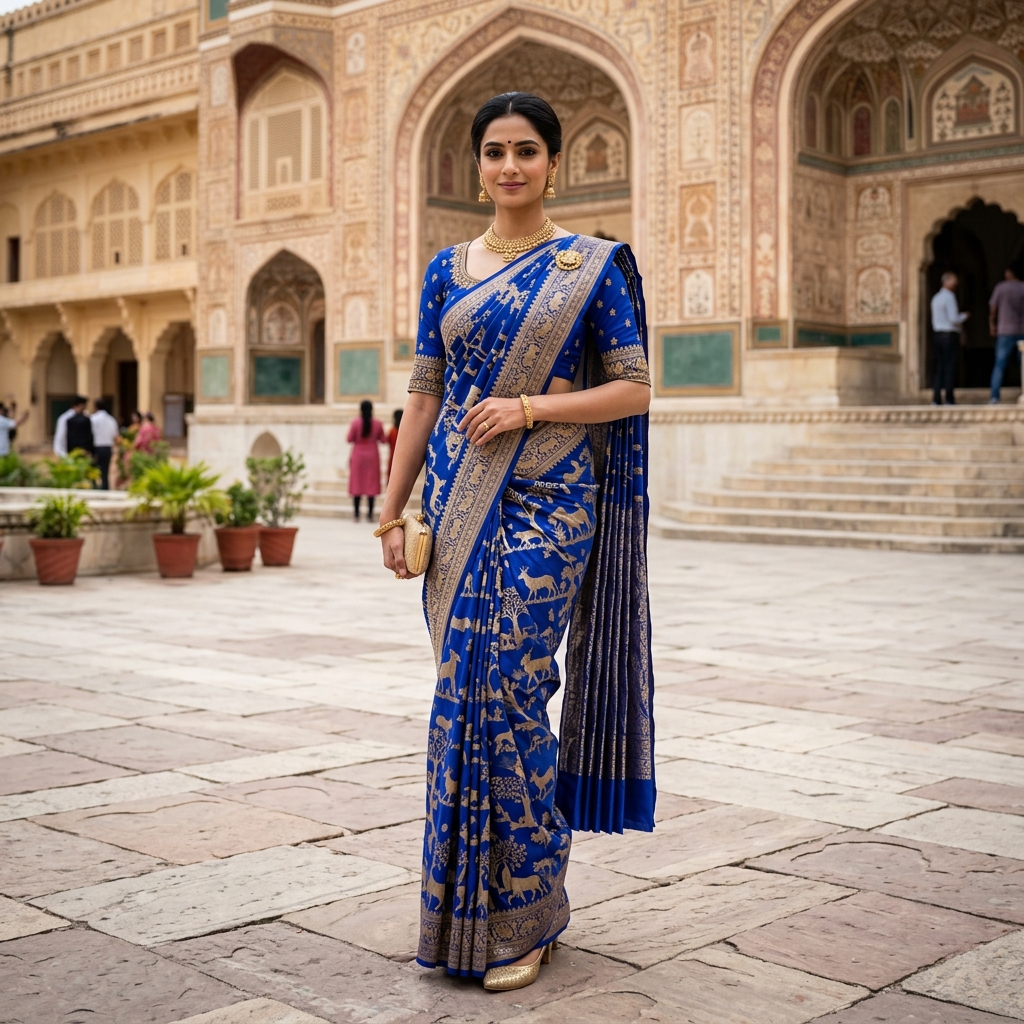
4 Elegant Ways to Drape a Banarasi Saree | Shri Geeta Sarees
Looking for new ways to wear your handwoven Banarasi saree? Discover 4 elegant and easy styling methods, from classic traditional to modern reception drapes.
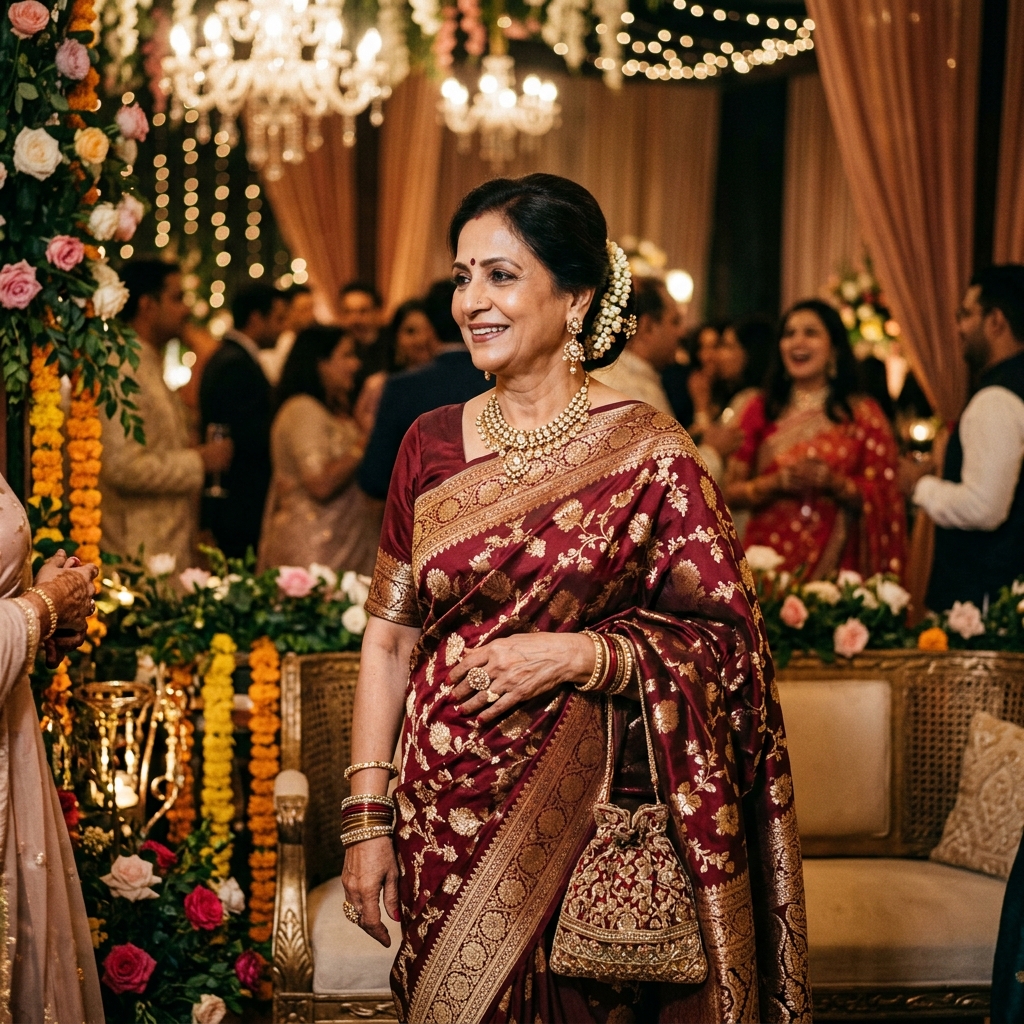
Banarasi Saree for Mother of the Bride: A Guide to Getting It Right
A comprehensive guide to choosing the perfect Banarasi saree for the mother of the bride, covering colors, weaves, and styling advice.
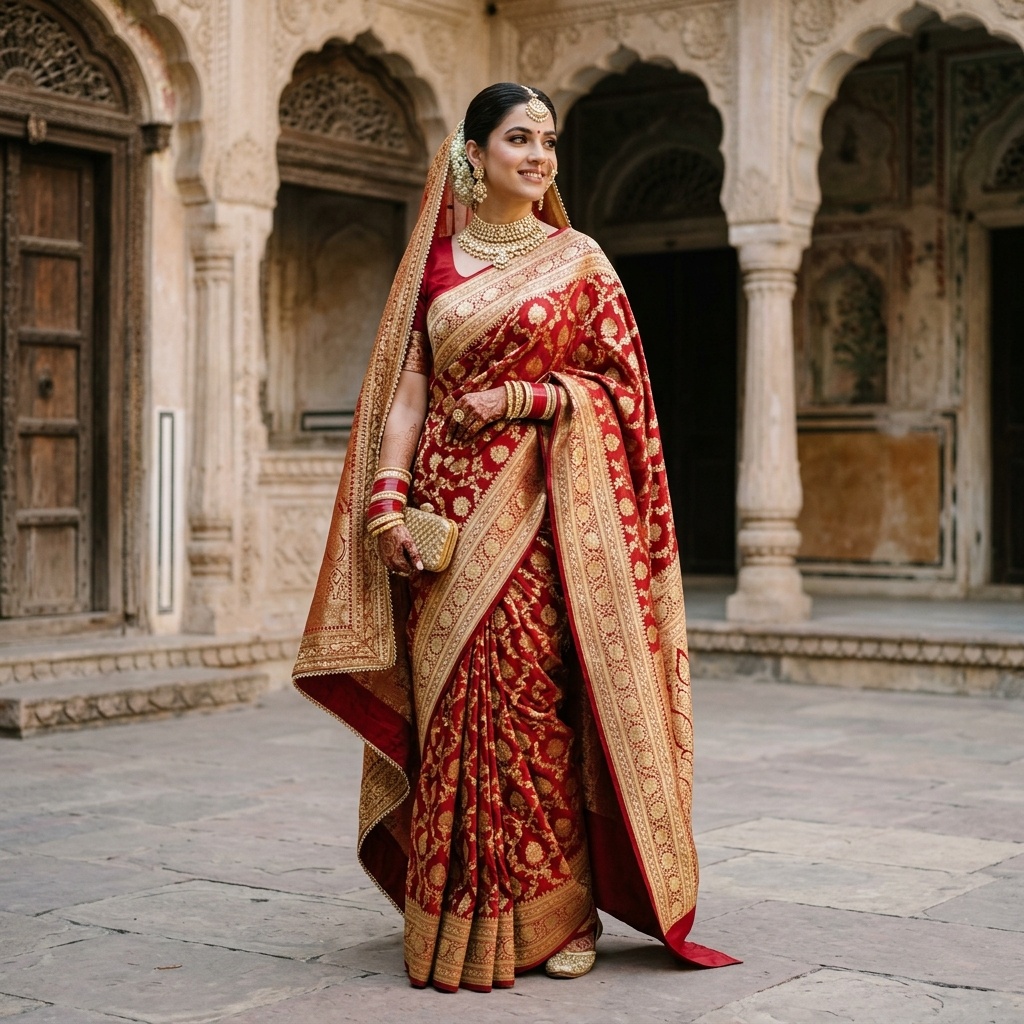
Types of Banarasi Silk: Katan, Georgette, Organza & Tissue Explained
Confused by Banarasi saree fabrics? A Varanasi weaver explains the exact difference in drape, weight, and styling for Katan, Georgette, Organza, and Tissue silk.