
The Infinite Vine: Anatomy of an Authentic Banarasi Jaal Saree
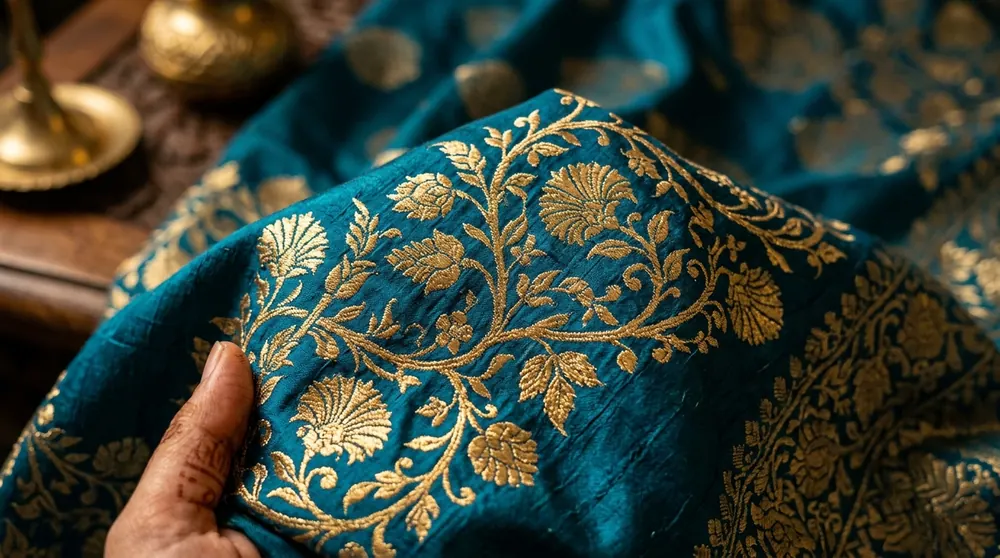
The Infinite Vine: Anatomy of an Authentic Banarasi Jaal Saree
Turn your saree upside down.
If the reverse side feels rough against your fingers—if you feel a carpet of short, prickly severed threads that snag on your bangles and scratch your collarbone—you are not looking at a four-month handloom masterpiece. You are holding a twenty-minute machine shortcut.
Few garments in the global lexicon of textiles command the awe of a Banarasi Jaal saree. Draped across six yards of heavyweight Katan silk, a true Jaal is not merely a piece of clothing. It is an unbroken mathematical equation of gold zari, engineered by hand in the subterranean pit looms of Varanasi.
Yet, in today's crowded bridal market, 90% of buyers cannot distinguish between an authentic Kadhwa Handloom Jaal and an industrial Powerloom Cutwork copy.
Here is the untold story of the infinite vine, the ancient Persian geometry behind its curves, and the simple diagnostic tests that protect you from costly counterfeits.
1. The Geometry of the "Infinite Net": What Is a True Jaal?
In weaving terminology, traditional Banarasi sarees generally fall into two distinct compositional philosophies:
- The Buti / Buta Tradition: Isolated, standalone motifs (such as a single mango paisley or jasmine flower) scattered rhythmically across a plain silk ground with empty space in between.
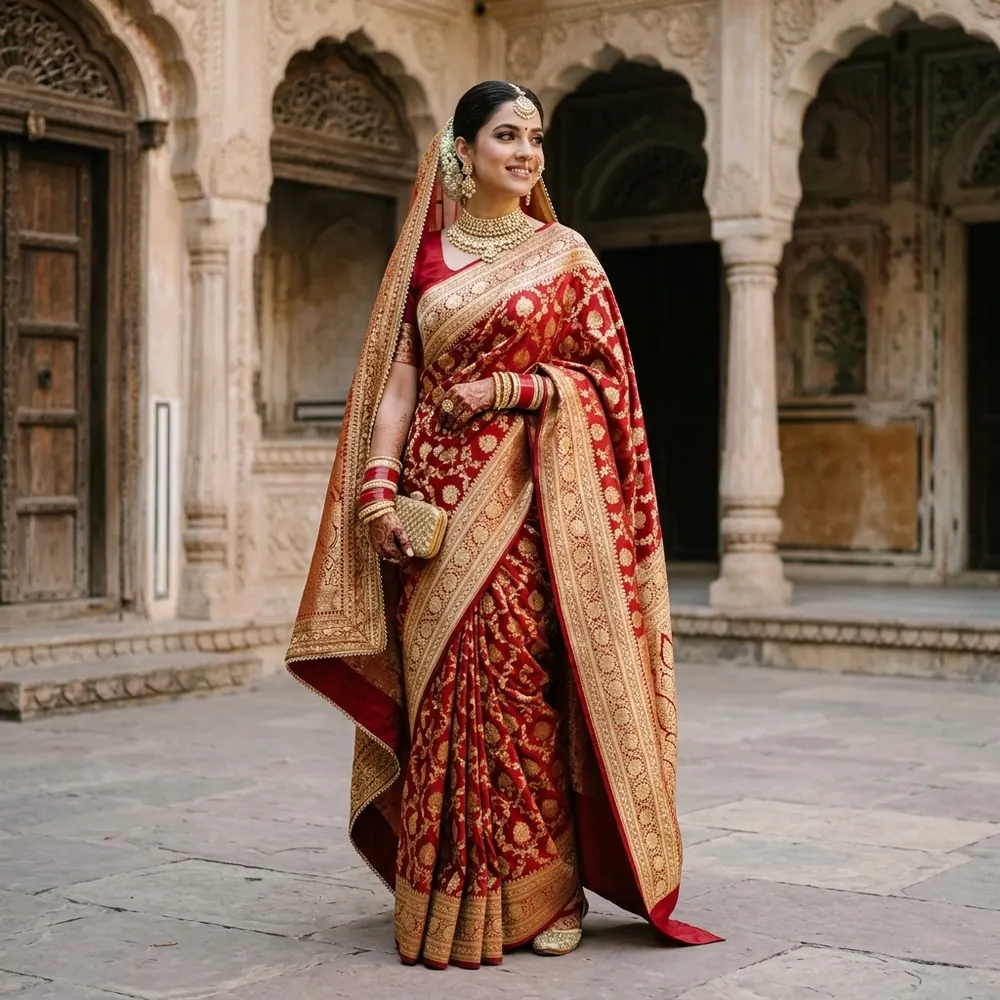
- The Jaal (Jangla) Tradition: An all-over, continuous interlocking trellis or vine network (Bel) that encompasses the entire surface of the saree from the first pleat to the fall.
The word Jaal translates literally to "net" or "lattice." But in the hands of a Varanasi master weaver (Ustad), it is far more than a simple grid.
       [ THE TOPOLOGICAL VINE STRUCTURE ]
   Sinuous Main Stem (Bel)  ──► Continuous Harmonic Wave
   Branching Tendrils       ──► Radiating Foliage (Patte)
   Terminal Blossoms        ──► Fan-Palmettes (Pankhas) & Lotus (Kamal)
   Interlocking Nodes       ──► Interlocking Floral Bridges (Zero Breakage)
Originating from 16th-century Persian garden tapestries brought to the courts of Varanasi under Mughal patronage, the Jaal represents the concept of Bagh-e-Eram (the eternal paradise garden).
Look closely at an authentic Banarasi Jaal: you cannot locate where the vine begins or where it ends.
Every blossoming fan-palmette (Pankha), every lotus bud (Kamal), and every teardrop leaf (Patta) branches organically from a continuous, undulating stem that travels the full length of the warp. There are no disjointed floral islands. It is a single, continuous topological circuit of gold.
2. 10,000 Coordinates: The Mathematical Science of the Naksha
How does an artisan transfer an organic, free-flowing floral vine onto a rigid loom that can only move vertically and horizontally?
The answer lies in one of the most sophisticated analog computing systems in human history: The Varanasi Jala and Naksha mechanism.
Before a single thread of silk is woven, the master designer (Nakshaband) spends weeks plotting the intricate Jaal onto graph paper (Likhi). Every single square represents a precise intersection of warp (vertical silk) and weft (horizontal gold zari).
   [ PHYSICAL ANALOG COMPUTER: THE NAKSHA MATRIX ]
   Graph Plotting (Likhi)   ──► 10,000+ Coordinate Points
   Master Harness (Jala)    ──► Cords Tied by Hand in Cotton Twine
   Binary Warp Lift         ──► 1 = Lift Silk Warp | 0 = Suppress Silk Warp
   Tension Balancing        ──► Zero Puckering across 6 Yards of Katan Silk
Because an all-over Jaal covers nearly 80% of the saree's surface in dense metallic yarn, the slightest miscalculation in weft tension will cause the silk to buckle and pucker, ruining months of work.
To prevent this, the master weaver calculates over 10,000 individual warp-lift coordinates by hand. The pattern is codified into thousands of cotton harness loops hanging above the pit loom. As the weaver depresses the wooden foot pedals (Khatka), the exact silk threads lift in perfect rhythmic harmony, allowing the gold zari to glide through without disturbing the structural integrity of the fabric.
3. The Reverse Never Lies: Kadhwa vs. Powerloom Cutwork
If you remember only one rule when buying a Banarasi saree, make it this: The front tells you the design, but the back tells you the truth.
In modern textile production, powerlooms attempt to mimic the complex visual appearance of a Jaal using a technique known as Fekwa / Cutwork.
Understanding how the reverse side is made will immediately reveal the difference in touch, weight, and lifespan.
| Diagnostic Feature | Authentic Varanasi Kadhwa Jaal | Powerloom / Machine Cutwork Copy |
|---|---|---|
| Weaving Technique | Each floral motif is hand-locked individually using miniature wooden spools (Tilus). | A single shuttle shoots zari continuously across the entire width of the loom. |
| Reverse Side Finish | 100% Flush & Clean. Zero loose threads, zero cut floats. Smooth as skin. | Jagged & Scratchy. Hundreds of severed thread ends left after trimming. |
| Comfort on Skin | Glides effortlessly over bare skin without catching or irritation. | Prickly cut-threads catch on diamond jewelry, blouse lace, and skin. |
| Production Time | 90 to 150 Days of meditative, synchronized artisan labor. | 4 to 6 Hours on an automated industrial loom. |
| Weight & Drape | Substantial, fluid, and liquid-like. Drapes with royal weight. | Stiff, papery, and prone to frayed unravelling over time. |
| Heirloom Longevity | Retains structural integrity for 50+ years; can be passed down 3 generations. | Cut threads unravel and shed gold foil after 2–3 dry cleans. |
The Powerloom Shortcut (Cutwork / Fekwa)
On an automated machine loom, the gold zari weft cannot turn around inside a flower. It must fly straight across the entire 45-inch width of the fabric from left to right.
In areas where there is no floral motif, the gold thread simply floats loosely across the back of the saree. Once the saree comes off the machine, workers use shears to snip these floats away.
The result? Thousands of raw, severed thread edges left exposed on the reverse side. With every wear, friction against your petticoat or jewelry tugs at these raw ends, slowly causing the design to fray and disintegrate.
The Artisan Mastery (Kadhwa Handloom)
In a genuine Varanasi Kadhwa Jaal, no thread is ever cut.
Two or three weavers sit shoulder-to-shoulder inside the wooden pit loom. For every single leaf and petal, the artisan uses a miniature pointed wooden bobbin (Tilu) to hand-embroider the gold zari directly through the warp. Once a petal is completed, the zari is knotted and tucked flush into the base weave.
When you run your palm across the reverse of a Kadhwa Jaal, it feels almost identical to the front—silky, smooth, and completely unblemished.
4. The 5-Second Touch Test: How to Inspect a Jaal in a Showroom
When shopping for a bridal Banarasi Jaal, skip the sales pitch and run these three tactile diagnostics:
1. The Blind Thumb Glide
Flip the saree to its underside and run your thumb firmly across a dense floral cluster.
- If it feels silky, embedded, and continuous: It is handloom Kadhwa.
- If you feel sharp bristles, prickly nubs, or loose thread fringes: It is machine cutwork.
2. The Weight & Pleat Fluidity Test
Gather the body of the saree into four deep pleats and let them fall naturally from waist height.
- Authentic pure Katan silk (twisted mulberry yarn) has a natural heft and structural memory. The pleats will fall in clean, vertical columns with liquid grace.
- Synthetic or blended powerloom copies will flare outward like stiff paper or cling statically to synthetic fabrics.
3. The Zari Burnish Test
Examine the gold zari under natural morning light.
- True handloom Banarasi Jaal uses electroplated metallic wire (Chandi / Sona Zari) over a core silk/cotton yarn. It produces a soft, warm, regal champagne glow (Ganga-Jamuna warmth).
- Cheap polyester metallic yarn (Plastic Zari) produces an aggressive, glaring, brassy yellow shine that reflects light like tin foil.
5. Preserving the Heirloom: Caring for a Pure Banarasi Jaal
A genuine Kadhwa Jaal is a living heirloom engineered to outlive its original wearer. To ensure it retains its luster for your daughters and granddaughters:
- Never Hang on Metal Hangers: The immense weight of pure gold zari over 6 yards will stretch the warp over time. Store the saree gently folded in breathable, unbleached pure cotton muslin (Malmal).
- Periodic Refolding: Every 4 to 6 months, unfold the saree and refold it along different crease lines to prevent permanent fiber stress along the gold wefts.
- Keep Away from Direct Aromas: Never spray perfume directly onto the zari. Alcohol and synthetic fragrances oxidize the metallic electroplating, turning gold zari black.
- Dry Clean Only with Heritage Specialists: Always specify petrol/hydrocarbon dry cleaning without aggressive moisture cycles to preserve the natural sericin sheen of the Katan silk.
The Eternal Weave
When you wrap yourself in an authentic Banarasi Jaal, you are not merely participating in an occasion. You are stepping into an unbroken lineage of master weavers who have sat at the wooden pit looms of Varanasi for half a millennium.
Every curve in the vine is a calculated breath. Every leaf is a testament to human patience.
Woven in Varanasi. Treasured for generations. This is Shri Geeta Sarees.
Frequently Asked Questions About Banarasi Jaal Sarees
What is the difference between a Banarasi Jaal and a Banarasi Buti saree?
A Banarasi Buti saree features discrete, standalone floral motifs scattered across a plain silk field. A Banarasi Jaal saree features an all-over, continuous interlocking vine lattice (Bel) that covers the entire canvas without isolated floral islands.
Why are Kadhwa Jaal sarees more expensive than machine-made sarees?
A handwoven Kadhwa Jaal requires 90 to 150 days of intensive manual labor by two to three master weavers. Because every motif is hand-locked individually without cutting threads, it delivers unmatched durability, comfort on the skin, and heirloom value that machine copies cannot replicate.
How do I identify a pure Katan silk Banarasi Jaal?
Pure Katan silk is woven from tightly twisted double-filament mulberry silk threads. It possesses a distinct rich rustle (scroop), a substantial yet fluid drape, a natural warm sheen (not plastic glare), and passes the silk hallmark burn test with crisp ash smelling of burnt hair.
Are Banarasi Jaal sarees heavy to wear?
Because a traditional Jaal is covered in dense gold or silver zari, it carries a regal, reassuring heft. However, because authentic pure silk breathes naturally and drapes fluidly along the body's natural contours, an authentic Kadhwa Jaal feels remarkably balanced and comfortable throughout long wedding celebrations.
Continue Reading
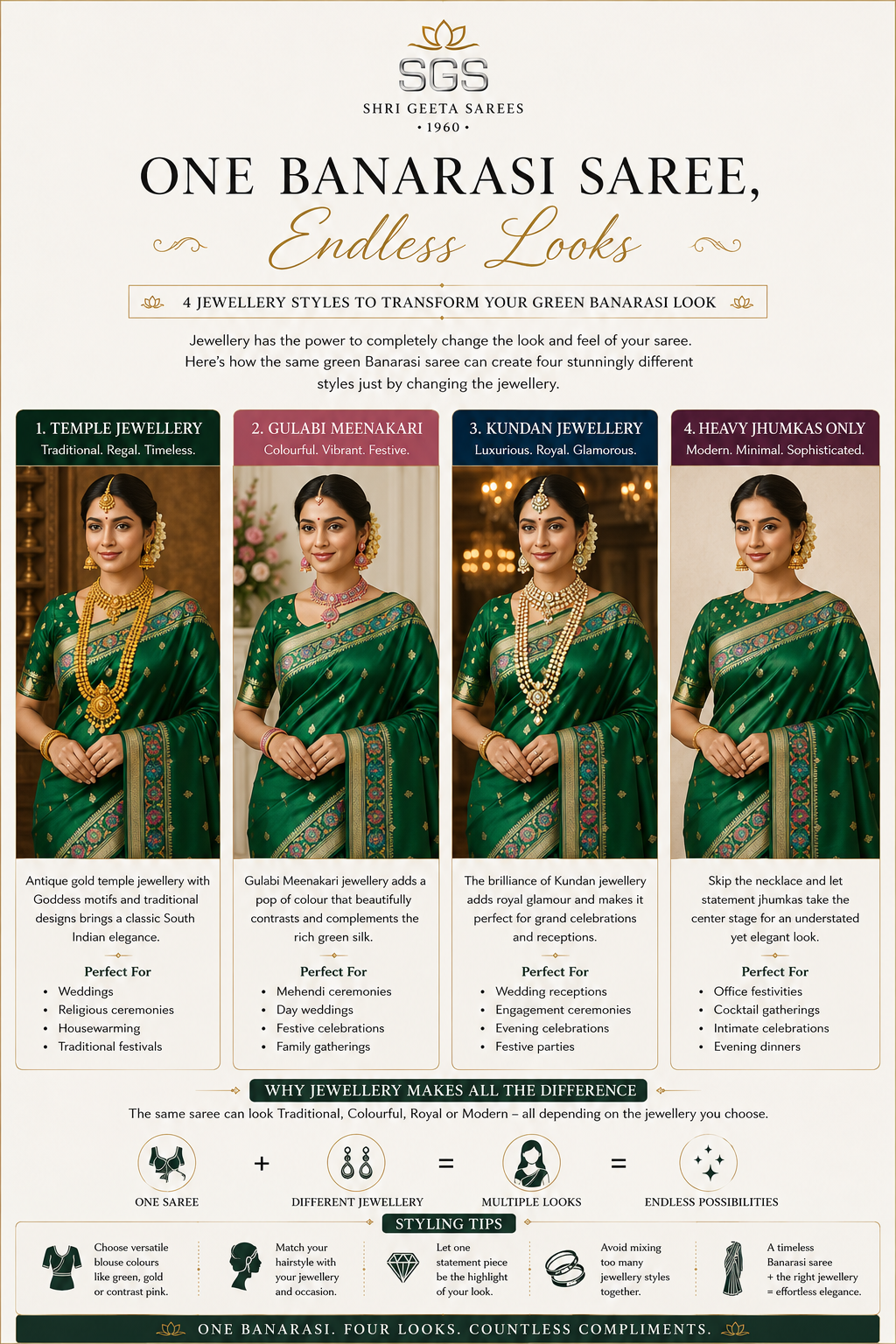
How One Banarasi Saree Can Create 4 Completely Different Looks
A beautiful Banarasi silk saree is one of the most versatile pieces in your wardrobe. Discover how to create four stunning looks just by changing your jewellery.
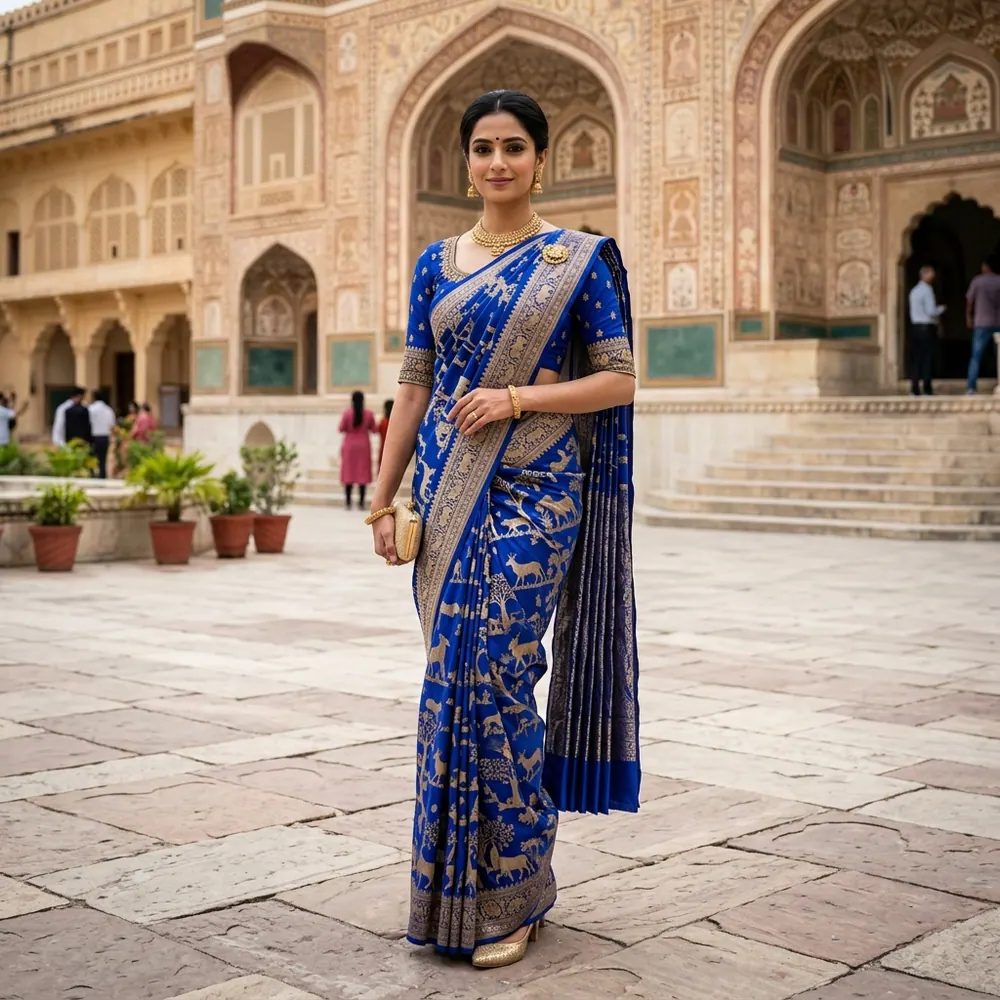
4 Elegant Ways to Drape a Banarasi Saree | Shri Geeta Sarees
Looking for new ways to wear your handwoven Banarasi saree? Discover 4 elegant and easy styling methods, from classic traditional to modern reception drapes.
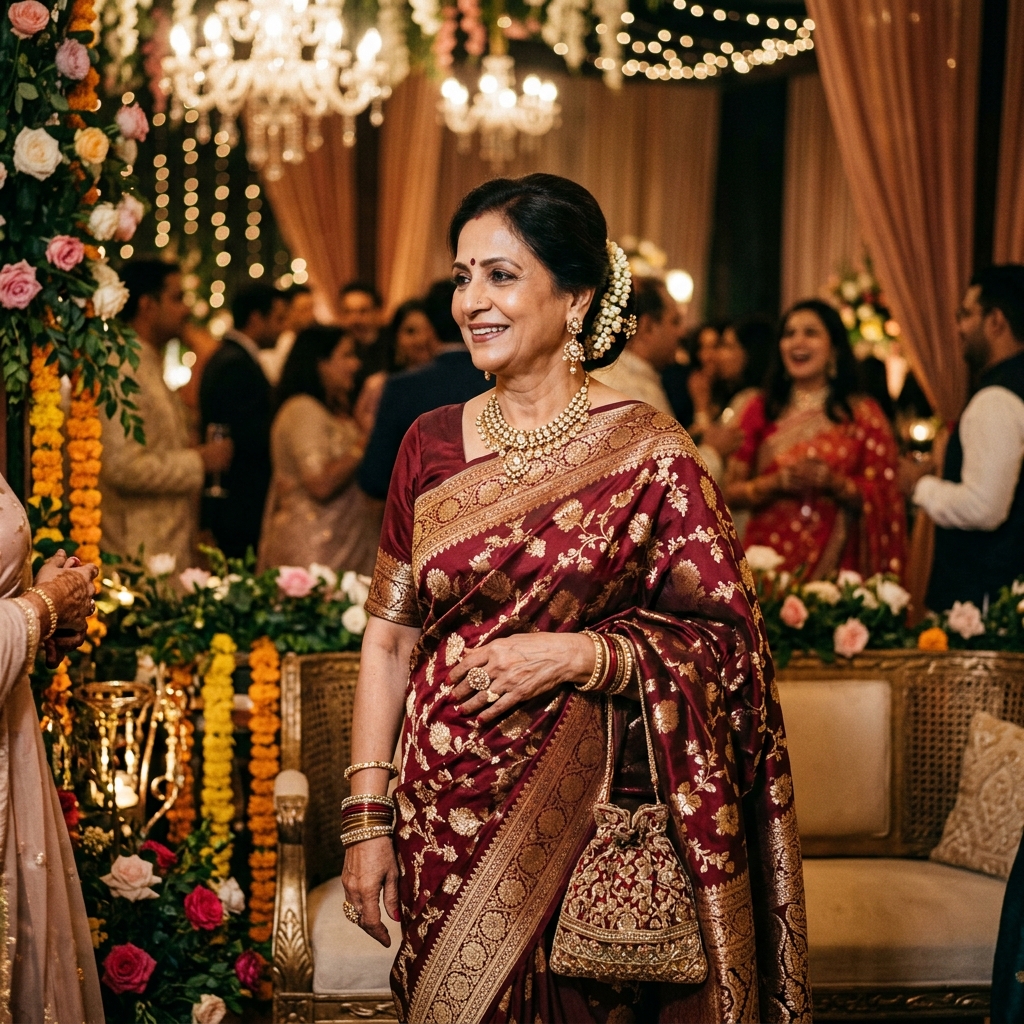
Banarasi Saree for Mother of the Bride: A Guide to Getting It Right
A comprehensive guide to choosing the perfect Banarasi saree for the mother of the bride, covering colors, weaves, and styling advice.
Types of Banarasi Silk: Katan, Georgette, Organza & Tissue Explained
Confused by Banarasi saree fabrics? A Varanasi weaver explains the exact difference in drape, weight, and styling for Katan, Georgette, Organza, and Tissue silk.