Buying an Authentic Banarasi Saree Near Kashi Vishwanath Temple: A Local’s Guide

Buying an Authentic Banarasi Saree Near Kashi Vishwanath Temple: A Local’s Guide
If you have just stepped out of the newly renovated Kashi Vishwanath Corridor, you are likely overwhelmed by two things: the profound spiritual energy of the temple, and the immediate barrage of "guides" offering to take you to the best Banarasi saree shop.
For tourists and pilgrims, buying a pure Banarasi silk saree in Varanasi is a bucket-list experience. But the lanes radiating from the temple and Dashashwamedh Ghat are a maze of tourist traps. If you do not know where to go, you are highly likely to pay pure silk prices for powerloom polyester.
Here is exactly how to navigate the market near the temple, spot authentic handloom, and find your way to Govindpura—the historic weaving neighborhood where the true gaddis (heritage saree houses) operate.
The Reality of Shopping Near the Temple
The moment you exit the temple complex or step off an auto-rickshaw near Godowlia crossing, you will be approached.
Auto drivers, boatmen, and street-corner touts operate on a heavy commission system. If a guide leads you into a sprawling, brightly lit showroom on the main road, their commission (often 30% to 50%) is immediately baked into the price of your saree. These high-rent, main-road showrooms rarely stock authentic Kadhua handloom; instead, they cater to fast-moving tourist traffic with mass-produced powerloom fabrics.
To find the real weaving houses, you have to leave the main road and step into the narrow lanes (galis).
How to Spot Authentic Silk on the Spot
Before you buy, use these three non-negotiable checks to ensure you are looking at authentic Banarasi silk:
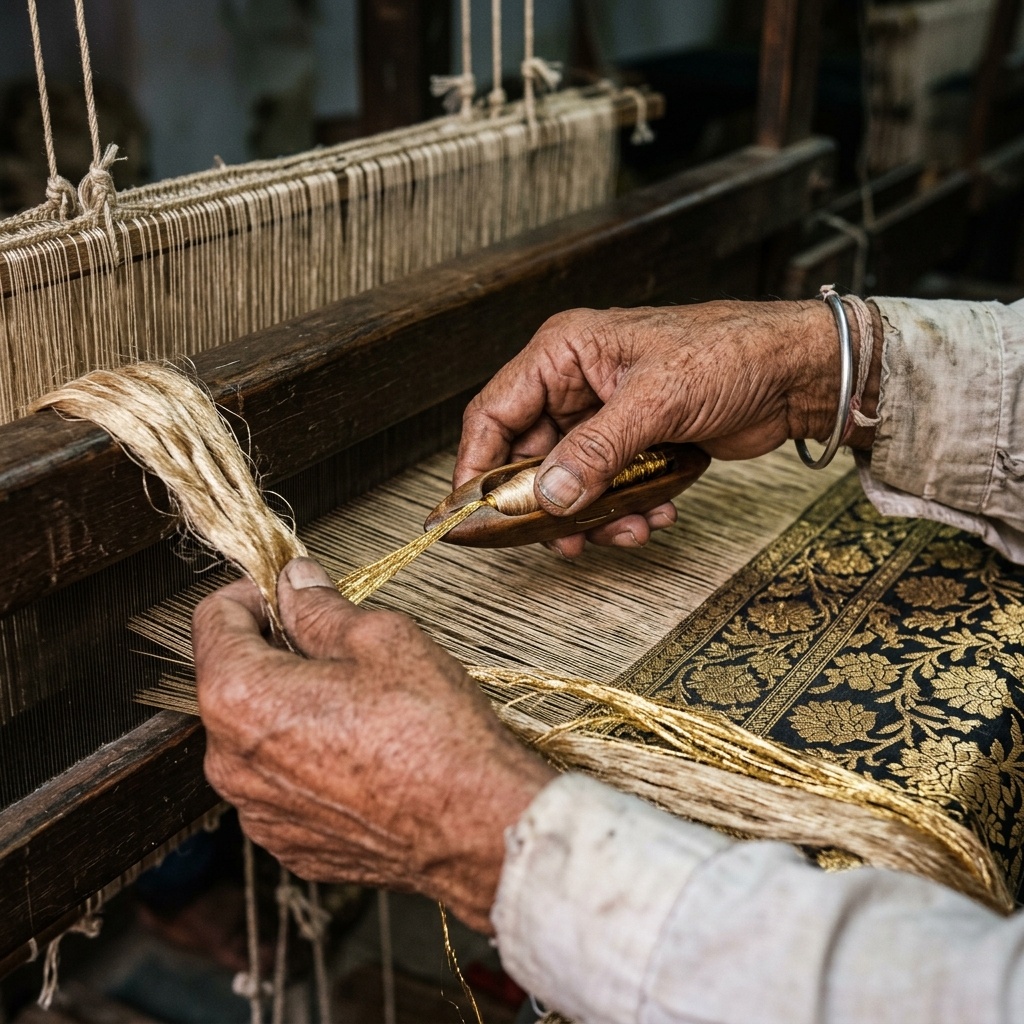
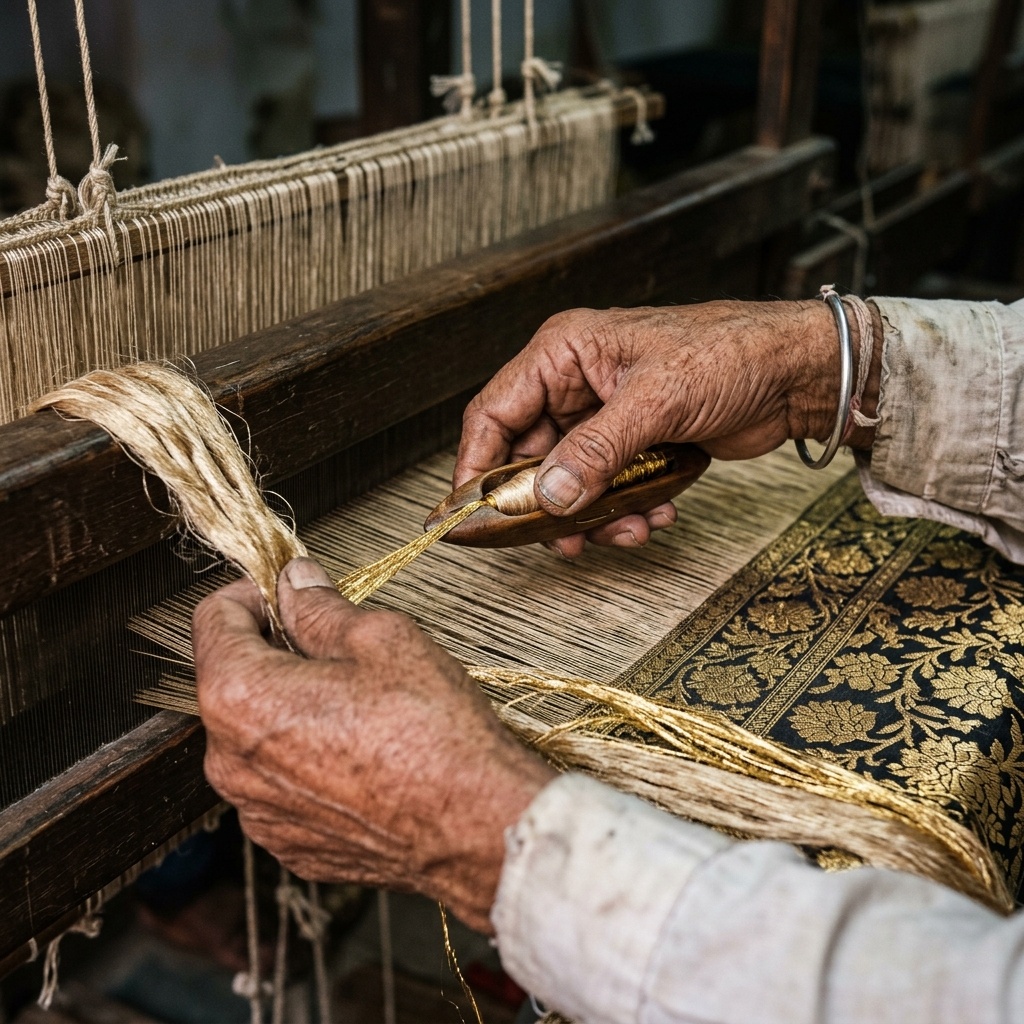
- The Burn Test: Pluck a single loose thread from the warp (the weaver will allow this if the silk is pure). Light it. Pure silk burns slowly, smells exactly like burning hair, and leaves a powdery black ash. Synthetic polyester will melt, smell like burning plastic, and leave a hard, black bead.
- Check the Reverse Side: A genuine handloom Banarasi, especially a Kadhua weave, will have an incredibly neat reverse side with no loose, floating threads behind the motifs. Powerloom sarees often have a messy web of cut threads on the back.
- Look for the Drape: Pure Katan silk or Georgette will drape elegantly and feel supple in your hands. Cheaper synthetic blends feel unnaturally stiff or excessively slippery.

The Traditional Gaddi Experience
Serious buyers do not shop in modern retail showrooms with glass racks. They shop at a gaddi.
A gaddi is a traditional wholesale and retail house. When you enter, you remove your shoes and sit on crisp white floor mattresses and bolsters. The owner sits across from you, pulling sarees directly from wrapped bundles based on your exact preferences for weave, weight, and occasion.
This is how Banarasi sarees have been sold for centuries. It is an unhurried, highly sensory experience where you can touch dozens of textiles while sipping chai.
Finding Shri Geeta Sarees from the Temple
Since 1960, Shri Geeta Sarees has been a trusted custodian of the Banarasi weaving tradition. We operate a traditional gaddi in Govindpura, just a short walk from the temple, strictly without touts or commissions.
How to find us:
- Exit the Kashi Vishwanath Temple from Gate 4.
- Walk straight towards Chowk Thana (the local police station).
- From Chowk Thana, ask any local shopkeeper for Rani Kuan in the Govindpura neighborhood.
- We are located at Ck. 23/39, Rani Kuan.
Because we do not pay street commissions, you pay only for the craftsmanship of the weavers. Whether you are looking for a heavy Katan silk bridal saree or a fluid Banarasi Georgette for a summer event, you will find authentic, certified handloom at honest prices.
When you are ready to see the real textiles of Varanasi, step away from the touts and come sit at our gaddi.
FAQ: Shopping for Sarees in Varanasi
Q: Are the shops near Dashashwamedh Ghat authentic? A: Most shops directly on the ghats or the Godowlia main crossing cater to quick tourist sales. For authentic, heirloom-quality handloom, you must venture slightly inland into neighborhoods like Govindpura or Chowk.
Q: How much does a real Banarasi pure silk saree cost? A: A genuine pure silk handloom Banarasi starts around ₹10,000 to ₹15,000 for simpler weaves and can go upwards of ₹1,00,000 for dense, metallic Tissue or complex Kadhua Jangla work. If a shop offers you a "pure silk Banarasi" for ₹3,000, it is guaranteed to be synthetic powerloom.
Q: What is the Silk Mark? A: The Silk Mark is a certification provided by the Silk Mark Organisation of India (SMOI) guaranteeing that the base fabric is 100% natural silk. Always ask if the saree is Silk Mark certified.